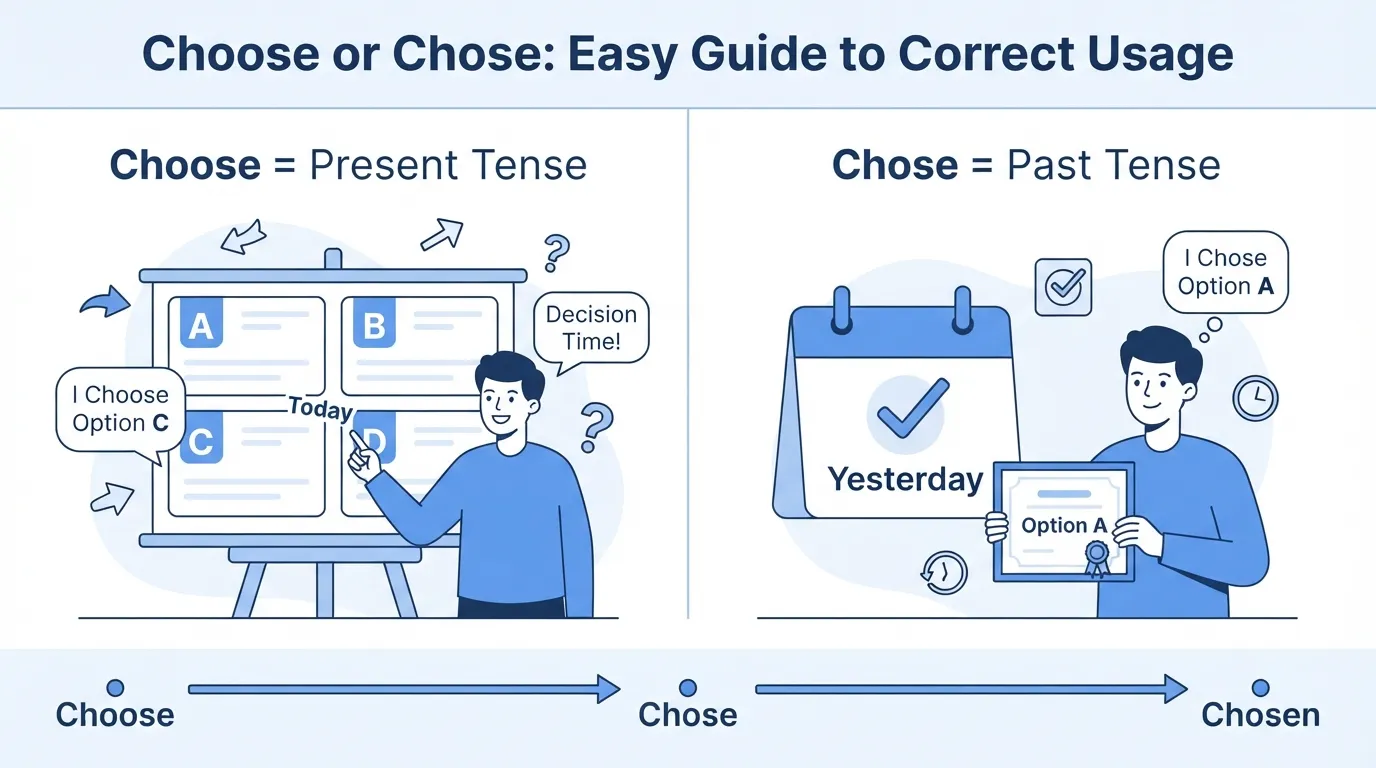
Choose is the present tense of the verb meaning to select or decide, while chose is its past tense. The difference depends on when the action happens, not on the meaning.
I once reviewed an assignment from an English learner who wrote, “Yesterday, I choose the blue backpack.” The sentence looked almost perfect, but one small word changed the grammar completely. The student knew what they wanted to say but wasn’t sure whether to use choose or chose.
This is one of the most common mistakes in English. The two words look nearly identical, sound similar, and have the same basic meaning. The only difference is time. One refers to an action happening now or in the future, while the other describes an action that already happened.
Many native speakers type the wrong form by accident, and English learners often confuse the pronunciation and spelling. The good news is that the rule is simple once you understand it.
In this guide, you’ll learn the difference between choose and chose, when to use each word, common mistakes to avoid, pronunciation tips, and real-world examples that will help you remember the correct form every time.
Choose or Chose : Quick Answer
The difference is simple:
- Choose is the present tense of the verb.
- Chose is the past tense of the verb.
Quick examples
- I choose healthy food every day.
- She always chooses the window seat.
- Yesterday, I chose the blue shirt.
- They chose a new team leader last week.
A quick memory trick:
If the action happened yesterday or earlier, use chose. If it happens now or later, use choose.
The Origin / Background of Choose or Chose
The verb choose comes from the Old English word cēosan, which meant to select, decide, or prefer. It has been part of the English language for over a thousand years.
Like many common English verbs, choose is irregular. Instead of forming the past tense by adding -ed, it changes its spelling completely.
This is why English uses:
- choose → chose → chosen
rather than:
- choose → chooseed ❌
Because the present and past forms differ by only one letter, learners often confuse them in writing.
Understanding the three principal forms makes the pattern much easier to remember:
- Choose – Present
- Chose – Past
- Chosen – Past participle
Choose or Chose Explained :Key Differences
Although both words describe making a decision, they are used in different tenses.
What does choose mean?
Choose means to select, pick, or decide between two or more options.
Use it when the action happens:
- now,
- regularly,
- or in the future.
Examples:
- I choose kindness every day.
- Students choose their electives next semester.
- Please choose one answer.
What does chose mean?
Chose is the simple past tense of choose.
Use it when the action has already happened.
Examples:
- I chose the red dress yesterday.
- They chose a new president last year.
- We chose the fastest route home.
What about chosen?
Many learners confuse chose with chosen, but they are not interchangeable.
Chosen is the past participle and is used with helping verbs such as has, have, or had.
Examples:
- She has chosen the winner.
- We have chosen a new logo.
- They had chosen the wrong address.
Never use chosen by itself as the simple past tense.
Comparison Table
| Term | Meaning | When to Use | Region/Context |
| Choose | Present tense verb | Present, future, habits, commands | Standard English worldwide |
| Chose | Simple past tense | Completed actions in the past | Standard English worldwide |
| Chosen | Past participle | After has, have, or had | Standard English worldwide |
Compare These Sentences
| Incorrect | Correct |
| Yesterday, I choose a movie. ❌ | Yesterday, I chose a movie. ✅ |
| Tomorrow, I chose a college. ❌ | Tomorrow, I will choose a college. ✅ |
| She has chose the winner. ❌ | She has chosen the winner. ✅ |
Easy Memory Trick
Remember this sequence:
Today I choose. Yesterday I chose. I have chosen.
This simple pattern helps you remember all three forms of the verb and prevents the most common grammar mistakes.
End of Part 1.
Which Version Should You Use?
Choosing between choose and chose is easy once you know when the action happened.
Ask yourself this simple question:
Is the action happening now, in the future, or did it already happen?
- Now or future → Choose
- Past → Chose
- After has/have/had → Chosen
This one rule will help you get it right in almost every sentence.
Use Choose for Present and Future Actions
Use choose when the action is:
- Happening now
- A regular habit
- A future action
- A command or instruction
Examples:
- I choose to stay positive.
- You should choose your words carefully.
- They choose a new captain every year.
- Please choose one answer.
Use Chose for Past Actions
Use chose when the decision has already been made.
Examples:
- I chose the blue jacket yesterday.
- She chose a career in medicine.
- We chose the fastest route home.
- They chose the best candidate.
Look for time words like:
- yesterday
- last week
- last year
- ago
- earlier
- this morning
These usually signal that chose is the correct form.
Use Chosen with Helping Verbs
Many learners accidentally write has chose or have chose.
That’s incorrect.
After has, have, or had, always use chosen.
Examples:
- She has chosen a university.
- They have chosen a new manager.
- We had chosen the wrong hotel.
Practical Recommendations
For English learners
Memorize the three forms together:
- Choose
- Chose
- Chosen
Learning them as a group is much easier than memorizing them separately.
For students
If your sentence includes a past time expression, use chose.
If the sentence describes a habit or instruction, use choose.
For professionals
In emails, reports, and presentations, selecting the correct tense makes your writing clearer and more professional.
Example:
We chose Vendor A after reviewing all proposals.
Not:
We choose Vendor A yesterday.
For Global English
There is no difference between American English and British English.
Both use:
- Choose
- Chose
- Chosen
in exactly the same way.
Common Mistakes with Choose or Chose
These mistakes appear frequently in essays, emails, and social media posts.
| Mistake | Correct Version | Why It Happens |
| Yesterday I choose a book. | Yesterday I chose a book. | Using the present tense for a past action. |
| I have chose a winner. | I have chosen a winner. | Confusing the past tense with the past participle. |
| Tomorrow I chose my classes. | Tomorrow I will choose my classes. | Using the past tense for a future action. |
| She always chose wisely. | She always chooses wisely. | Forgetting subject-verb agreement. |
| Please chose one option. | Please choose one option. | Using the past tense instead of the base verb in a command. |
Mistake 1: Using Choose with Yesterday
❌ Yesterday, I choose pizza.
✅ Yesterday, I chose pizza.
The word yesterday tells you the action is in the past.
Mistake 2: Using Chose After Has or Have
❌ She has chose a new apartment.
✅ She has chosen a new apartment.
Remember:
- has chosen
- have chosen
- had chosen
Never use has chose.
Mistake 3: Using Chose for Future Events
❌ Tomorrow, we chose the winner.
✅ Tomorrow, we will choose the winner.
Future actions require the base verb after will.
Mistake 4: Forgetting the Third-Person Form
❌ He choose the best option every time.
✅ He chooses the best option every time.
When the subject is he, she, or it, add -s in the simple present tense.
Quick Grammar Rule
Remember this sequence:
- Choose → Present
- Chose → Past
- Chosen → Past Participle
This pattern is one of the most useful grammar rules for irregular verbs.
Choose or Chose in Real-World Examples
Professional Email
Dear Team,
Please choose your preferred meeting time before Friday. Last month, we chose the afternoon session because it worked best for everyone.
Thank you.
News Headline
City Council Chose New Mayor After Close Vote
The election has already happened, so chose is correct.
Social Media Post
If you could travel anywhere this summer, which country would you choose? 🌍
Formal Report
The committee chose the proposal that offered the best long-term value.
Everyday Conversation
Emma: Which cake did you buy?
David: I chose the chocolate one.
Classroom Example
Teacher:
Please choose one topic for your presentation.
Student:
I chose renewable energy.
Workplace Example
Manager:
We chose this software because it improves productivity and reduces costs.
Choose or Chose :Data, Trends & Usage
The keyword choose or chose is one of the most searched English grammar topics because learners frequently confuse the present and past forms of this irregular verb.
Who searches for this topic?
Common audiences include:
- English learners
- School students
- College students
- Teachers
- Bloggers
- Business professionals
- Job seekers
Where is this confusion most common?
People often search for choose or chose while:
- Writing essays
- Completing homework
- Sending emails
- Preparing for English exams
- Creating business documents
- Editing blog posts
Search Intent
| Category | Intent |
| Primary Intent | Informational |
| Secondary Intent | Grammar learning |
| Related Intent | Verb tenses, irregular verbs, English writing, pronunciation |
Most users want a quick answer to one question:
Which word is correct in my sentence—choose or chose?
Why This Matters Today
Clear writing matters more than ever. Whether you’re applying for a job, writing an academic paper, or sending a professional email, using choose and chose correctly helps you communicate accurately and confidently.
Standalone Comparison Table
| Term/Variant | Meaning | Region/Context | Best Used When |
| Choose | Present tense verb | Standard English worldwide | Present, future, commands, and habits |
| Chose | Simple past tense | Standard English worldwide | Completed actions in the past |
| Chosen | Past participle | Standard English worldwide | After has, have, or had |
| Chooses | Third-person singular present | Standard English worldwide | With he, she, or it |
| Choosing | Present participle / Gerund | Standard English worldwide | Continuous tenses or as a noun |
End of Part 2.
Frequently Asked Questions (FAQs)
Q: What is the difference between choose and chose?
The difference is verb tense.
- Choose is the present tense.
- Chose is the simple past tense.
Examples:
- I choose healthy meals whenever possible.
- Yesterday, I chose a different restaurant.
Q: Is it “I choose” or “I chose”?
Both are correct, but they are used in different situations.
Use I choose when you’re talking about the present or a regular habit.
I choose to stay positive.
Use I chose when you’re talking about something that already happened.
I chose this book last week.
Q: What is the past tense of choose?
The simple past tense of choose is chose.
Examples:
- She chose the red dress.
- We chose a new apartment.
- They chose the safest route.
Q: What is the past participle of choose?
The past participle is chosen.
It is used with helping verbs such as has, have, or had.
Examples:
- She has chosen a university.
- We have chosen our seats.
- They had chosen the wrong supplier.
Remember:
- Choose → Chose → Chosen
Q: Is “have chose” correct?
No.
❌ We have chose the winner.
✅ We have chosen the winner.
After has, have, or had, always use chosen.
Q: Why do people confuse choose and chose?
There are several reasons:
- They differ by only one letter.
- Their pronunciations are similar.
- Both have the same basic meaning.
- English irregular verbs don’t follow the normal -ed pattern.
Once you learn the three verb forms together, the confusion becomes much easier to avoid.
Q: How can I remember the difference between choose and chose?
A simple memory trick is:
Today I choose. Yesterday I chose. I have chosen.
You can also remember:
- Present = Choose
- Past = Chose
- Perfect Tenses = Chosen
This pattern works every time.
Conclusion
Although choose and chose look very similar, the rule for using them is straightforward. The only difference is when the action takes place.
Here are the key points to remember:
- Choose is the present tense and is used for current actions, future actions, habits, and instructions.
- Chose is the simple past tense and is used for actions that have already happened.
- Chosen is the past participle and always follows helping verbs such as has, have, or had.
- Learning all three forms together—choose, chose, chosen—will help you avoid one of the most common mistakes in English writing.
The next time you’re unsure which word to use, ask yourself one simple question: Has the action already happened? If the answer is yes, use chose. If it’s happening now or will happen later, use choose.
Now you know exactly when to use choose and chose. Practice with your own sentences, bookmark this guide for quick reference, and share it with anyone who often mixes up these two words.
Read More: Whomever or Whoever: Easy Guide to Correct Usage

Muhammad Afzal is a language content writer specializing in English grammar, word usage, and vocabulary distinctions. With a strong command of linguistic nuance, Muhammad Afzal focuses on simplifying commonly confused word pairs to help readers communicate with clarity and confidence.