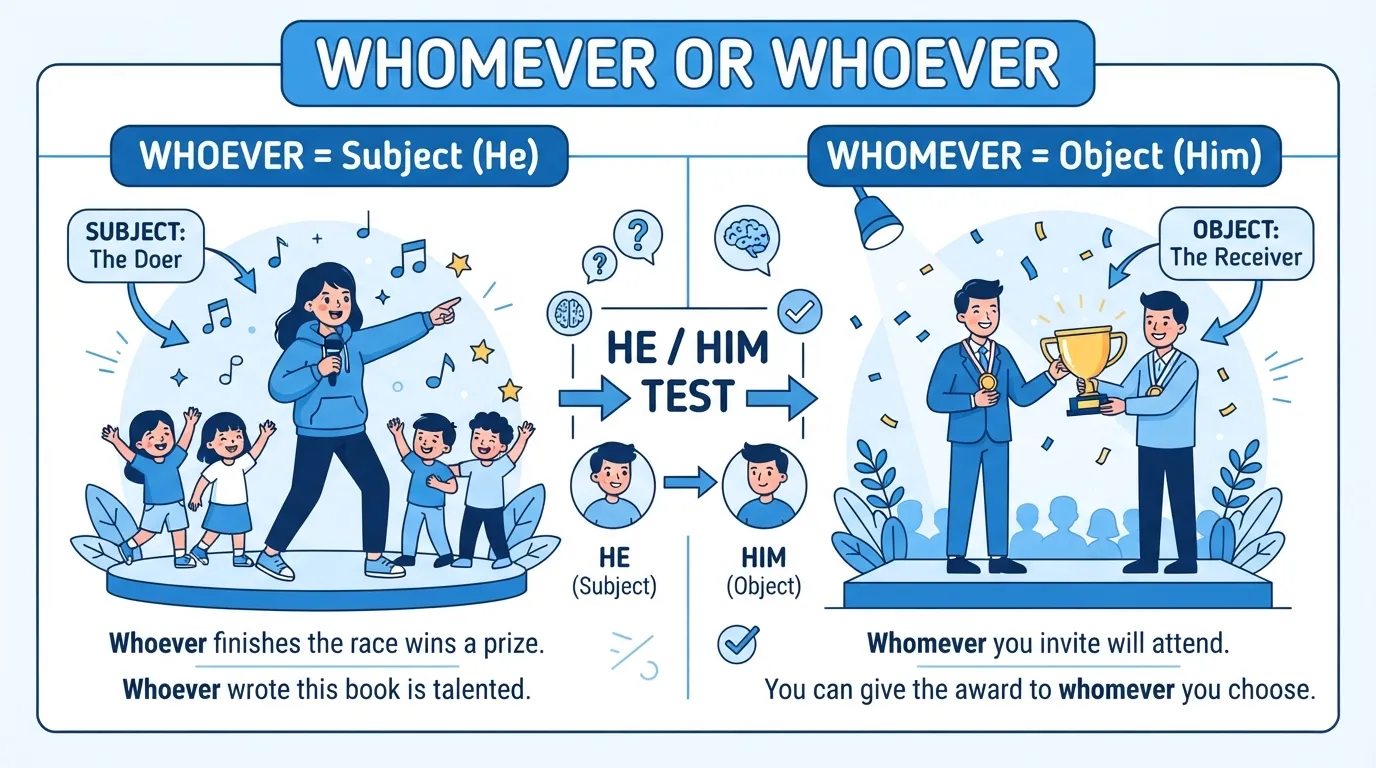
Whomever and whoever both refer to an unknown person, but whoever is used as a subject, while whomever is used as an object. Choosing the correct word depends on its role within the sentence, not on the sentence as a whole.
I remember proofreading an email from one of my students who had written, “Please give the award to whoever wins the interview.” He paused before sending it and asked, “Should it be whoever or whomever?” It was a great question because even experienced English speakers often hesitate over these two words.
The confusion comes from a simple fact: whoever and whomever look almost identical, but they have different grammatical jobs. Many people have heard that whomever sounds more formal, so they use it whenever they want to sound professional. Unfortunately, that often leads to mistakes.
The good news is that you don’t need to memorize dozens of grammar rules. Once you understand how these pronouns work inside a sentence, choosing the correct one becomes much easier.
In this guide, you’ll learn the difference between whomever and whoever, when to use each one, common mistakes to avoid, and plenty of real-world examples to help you use them with confidence.
Whomever or Whoever :Quick Answer
The basic rule is simple:
- Whoever is used when the word acts as the subject of a verb.
- Whomever is used when the word acts as the object of a verb or preposition.
Quick examples
✅ Whoever arrives first can choose the seats.
✅ Please give the tickets to whomever you select.
A helpful trick is to replace the word with he or him.
- If he fits, use whoever.
- If him fits, use whomever.
The Origin / Background of Whomever or Whoever
The words whoever and whomever developed from the older English pronouns who and whom.
In Old English, the language had a rich case system. Pronouns changed form depending on whether they acted as the subject, object, or possessor of a sentence. As English evolved, most of these case endings disappeared. However, a few survived in modern pronouns such as:
- he / him
- she / her
- they / them
- who / whom
The forms whoever and whomever follow the same grammatical pattern.
Today, however, whomever is much less common in everyday conversation. Many native speakers prefer whoever, even in situations where traditional grammar would recommend whomever. As a result, whomever is now seen more often in formal writing, legal documents, academic texts, and carefully edited publications.
This shift explains why so many English learners—and even native speakers—find the distinction confusing.
Whomever or Whoever Explained : Key Differences
Although these words look similar, they perform different grammatical functions.
What does whoever mean?
Whoever refers to any person and functions as the subject of a verb.
Examples:
- Whoever finishes first will receive a prize.
- Whoever called earlier didn’t leave a message.
- Invite whoever wants to join us.
In each example, whoever performs the action.
What does whomever mean?
Whomever also refers to any person, but it functions as the object of a verb or preposition.
Examples:
- Give the package to whomever you trust.
- Hire whomever the committee recommends.
- Speak with whomever you need.
Here, whomever receives the action instead of performing it.
The “He or Him” Test
One of the easiest ways to choose between whoever and whomever is the he/him test.
Ask yourself which replacement sounds correct.
Example 1
Whoever wants dessert may have some.
Replace the word:
He wants dessert.
✅ He works.
Therefore:
✅ Whoever is correct.
Example 2
Give the award to whomever you choose.
Replace the word:
You choose him.
✅ Him works.
Therefore:
✅ Whomever is correct.
This simple test solves most grammar questions involving these two words.
Comparison Table
| Term | Meaning | When to Use | Region/Context |
| Whoever | Any person acting as the subject | Subject of a verb | Standard English worldwide |
| Whomever | Any person receiving the action | Object of a verb or preposition | Mainly formal English |
| Who | Subject pronoun | Referring to a specific person | Everyday English |
| Whom | Object pronoun | Formal writing and edited English | Formal English |
Quick Memory Tip
Think of it this way:
- Whoever = He
- Whomever = Him
If he fits the sentence, choose whoever.
If him fits, choose whomever.
This trick works in most situations and is much easier than memorizing complex grammar rules.
Which Version Should You Use?
Choosing between whoever and whomever is easier than it seems. The key is to identify the word’s job in the sentence.
Ask yourself:
Is this word doing the action or receiving the action?
- If it does the action, use whoever.
- If it receives the action, use whomever.
Use whoever when the word is the subject
Whoever performs the action.
Examples:
- Whoever finishes first wins the prize.
- Whoever broke the window should apologize.
- I’ll support whoever becomes the team leader.
- Whoever calls first will get the appointment.
In each sentence, whoever is the one doing the action.
Use whomever when the word is the object
Whomever receives the action.
Examples:
- Give the certificate to whomever deserves it.
- Invite whomever you like.
- Speak with whomever is available.
- Hire whomever the manager recommends.
In these examples, whomever receives the action.
Which word do native speakers use?
Here’s something many grammar books don’t mention:
In everyday spoken English, most native speakers simply use whoever.
For example:
Give it to whoever you want.
Although some grammar experts prefer whomever here, whoever is very common in casual conversation and is widely accepted.
However, in formal writing, such as:
- Legal documents
- Academic papers
- Business reports
- Official correspondence
using whomever correctly can make your writing more precise.
Practical Recommendations
For English learners
Use this simple rule:
- Subject → whoever
- Object → whomever
Don’t worry if you occasionally hear whoever used where grammar books suggest whomever. Spoken English is often less strict.
For students
If you’re taking an English exam, follow the traditional grammar rule. Examiners usually expect the textbook answer.
For professionals
In emails and business communication, whoever is often acceptable unless you’re writing highly formal or legal documents.
For global English
Outside academic and legal writing, whoever is becoming more common worldwide. Many style guides recognize that whomever is gradually becoming less frequent in everyday usage.
Common Mistakes with Whomever or Whoever
These mistakes appear frequently, even in newspapers and professional writing.
| Mistake | Correct Version | Why It Happens |
| Give it to whoever you choose. | Give it to whomever you choose. | The word is the object of “choose.” |
| Whomever finishes first wins. | Whoever finishes first wins. | The word is the subject of “finishes.” |
| I don’t know whomever is calling. | I don’t know whoever is calling. | The word performs the action. |
| Choose whoever you trust. | Choose whomever you trust. | The word receives the action. |
| Use whomever because it sounds formal. | Use the grammatically correct word. | Formality doesn’t determine correctness. |
Mistake 1: Choosing whomever to sound smarter
Many people believe whomever always sounds more educated.
It doesn’t.
Using the wrong word actually creates a grammar mistake.
❌ Whomever arrives first gets the prize.
✅ Whoever arrives first gets the prize.
Mistake 2: Looking at the whole sentence
Many learners check the main sentence instead of the clause containing whoever or whomever.
Example:
Give the award to whoever wins.
Some people choose whomever because it follows to.
However, inside the clause:
Whoever wins
the word is the subject of wins.
So the correct sentence is:
✅ Give the award to whoever wins.
This is one of the most commonly tested grammar rules in English.
Mistake 3: Ignoring the He/Him Test
Always test the clause.
Example:
Hire whoever is qualified.
Replace it:
He is qualified.
Not:
Him is qualified.
Therefore:
✅ Whoever
Mistake 4: Assuming whomever is outdated
Although whomever is less common today, it is not incorrect.
It still appears regularly in:
- Court documents
- Government publications
- Academic writing
- Edited books
- Professional reports
Whomever or Whoever in Real-World Examples
Professional Email
Dear Hiring Manager,
Please forward this message to whoever is responsible for recruitment. If additional documents are required, send them to whomever you designate.
Thank you.
Notice that both words are correct because they have different grammatical roles.
News Headline
Whoever Wins the Election Will Face Major Economic Challenges
The winner performs the action.
Therefore:
✅ Whoever
Social Media Post
Congratulations to whoever solved today’s puzzle first! 🎉
This is a natural example of everyday English.
Formal Report
Funding should be awarded to whomever the review committee selects after completing its evaluation.
This sentence follows formal grammar rules.
Everyday Conversation
Emma:
Who should I ask?
David:
Ask whoever is available.
Classroom Example
Teacher:
Give your worksheet to whomever collects the assignments today.
Workplace Example
Manager:
Whoever completes the project first will present it to the client.
Whomever or Whoever :Data, Trends & Usage
The keyword whomever or whoever consistently attracts learners because it combines grammar, formal writing, and real-world usage.
Who searches for this topic?
Typical audiences include:
- English learners
- Students
- Teachers
- Editors
- Journalists
- Business professionals
- Academic writers
Where is it most relevant?
The distinction appears most often in:
- Academic writing
- Legal documents
- Government publications
- Business communication
- English grammar courses
- Style guides
Search Intent
| Category | Intent |
| Primary Intent | Informational |
| Secondary Intent | Grammar learning |
| Related Intent | Pronouns, formal writing, sentence structure, English usage |
Most users simply want to know:
Which word is correct in my sentence?
Why This Topic Matters Today
Although modern English increasingly favors whoever in casual conversation, understanding the traditional rule helps you write more accurately in formal contexts and recognize correct grammar in professional documents.
Standalone Comparison Table
| Term/Variant | Meaning | Region/Context | Best Used When |
| Whoever | Any person acting as the subject | Standard English worldwide | Subject of a verb |
| Whomever | Any person receiving the action | Formal English | Object of a verb or preposition |
| Who | Specific subject | Everyday English | Referring to a known person |
| Whom | Specific object | Formal English | Object in formal writing |
| Anyone | Any person | Informal English | When grammar simplicity is preferred |
Frequently Asked Questions (FAQs)
Q: What is the difference between whoever and whomever?
The main difference is grammar.
- Whoever is used as the subject of a verb.
- Whomever is used as the object of a verb or preposition.
Examples:
- Whoever arrives first can sit in the front row.
- Give the prize to whomever the judges choose.
Q: How do I know whether to use whoever or whomever?
The easiest method is the he/him test.
- If you can replace the word with he, use whoever.
- If you can replace it with him, use whomever.
Example:
Hire whoever is most qualified.
Test:
He is most qualified. ✅
So whoever is correct.
Q: Why do many people use whoever instead of whomever?
Modern English has become less strict about whom and whomever, especially in everyday speech. Many native speakers naturally choose whoever, even in sentences where traditional grammar would call for whomever.
This doesn’t mean whomever is wrong. It simply appears less often in casual conversation than it did in the past.
Q: Is whomever acceptable in formal writing?
Yes. In fact, whomever is most common in formal contexts such as:
- Legal documents
- Academic writing
- Government publications
- Business reports
- Carefully edited books
Using it correctly can make your writing more grammatically precise.
Q: Which is correct: “Give it to whoever wins” or “Give it to whomever wins”?
The correct sentence is:
✅ Give it to whoever wins.
Even though whoever follows the preposition to, it is the subject of the verb wins inside the clause “whoever wins.” The word’s role in its own clause determines the correct choice.
Q: Where do whoever and whomever come from?
Both words evolved from the older English pronouns who and whom, which have been part of the language since Old English. They follow the same grammatical pattern:
- who → whoever (subject)
- whom → whomever (object)
Although modern English uses whom and whomever less frequently than before, they are still part of standard grammar.
Q: Can I always use whoever instead of whomever?
In casual conversation, many people do exactly that, and you’ll hear it regularly from native speakers.
However, in formal or academic writing, it’s better to use the traditional grammar rule:
- Whoever = subject
- Whomever = object
Following this rule helps your writing appear polished and grammatically accurate.
Conclusion
Choosing between whoever and whomever doesn’t have to be difficult. The secret is to focus on the word’s role in its own clause, not the sentence as a whole.
Here are the key points to remember:
- Whoever acts as the subject of a verb.
- Whomever acts as the object of a verb or preposition.
- The he/him test is one of the easiest ways to choose the correct word.
- While whoever is common in everyday conversation, whomever still has an important place in formal and professional writing.
As English continues to evolve, you’ll see whoever used more frequently in casual contexts. Even so, understanding the traditional distinction will improve your grammar, strengthen your writing, and help you communicate more confidently.
Now you know exactly when to use whoever and whomever. Practice the he/him test with your own sentences, and bookmark this guide whenever you need a quick grammar reminder. If you found it helpful, share it with someone who has ever paused over these tricky pronouns.
Read More: This or That: Simple Meaning and Correct Usage

Muhammad Afzal is a language content writer specializing in English grammar, word usage, and vocabulary distinctions. With a strong command of linguistic nuance, Muhammad Afzal focuses on simplifying commonly confused word pairs to help readers communicate with clarity and confidence.