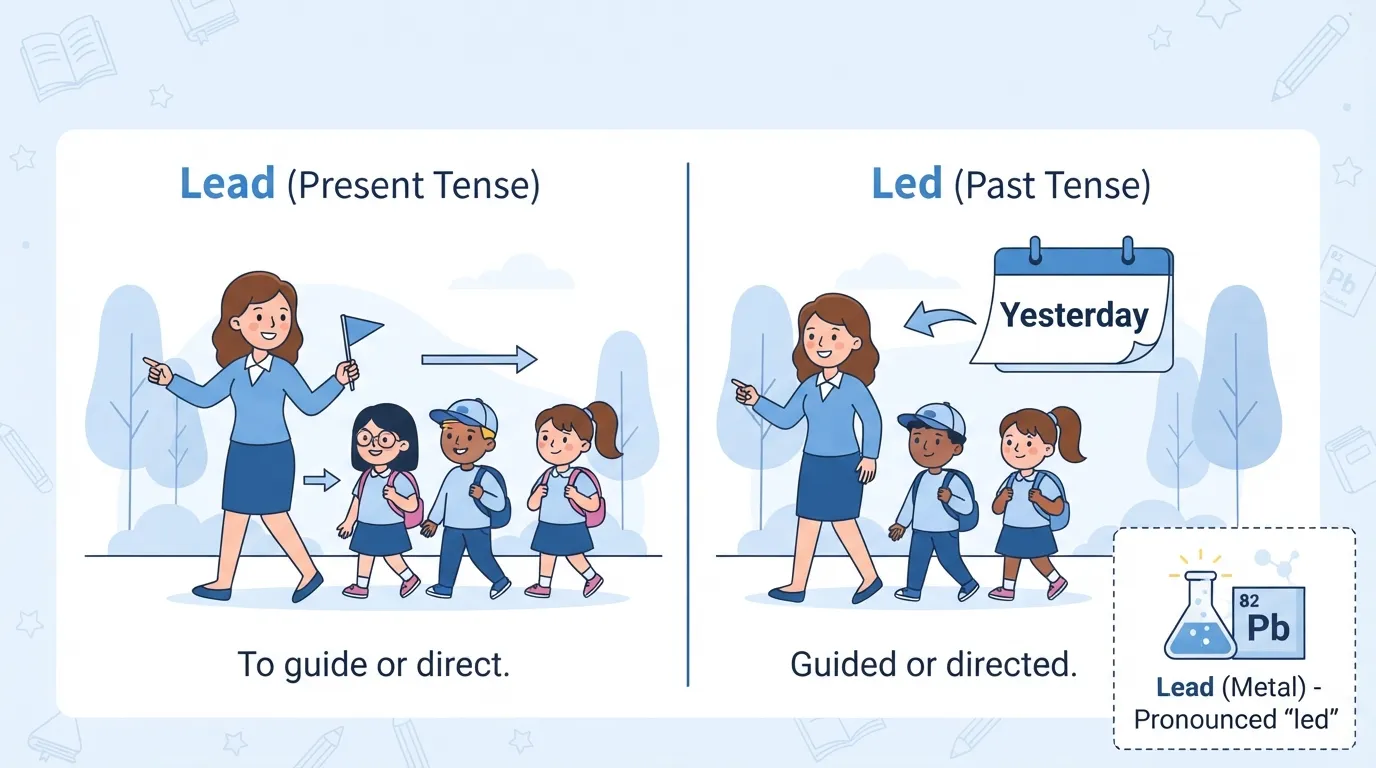
Led is the past tense of the verb lead, while lead can be a verb meaning to guide or a noun referring to a soft metal. The spelling stays the same, but the meaning and pronunciation change depending on how the word is used.
I still remember checking an essay written by one of my English students. Everything looked great until I read the sentence, “Yesterday, our teacher lead us through the science museum.” It was a tiny mistake, but one that many English learners—and even native speakers—make.
The confusion happens because lead has two different meanings. As a verb, it means to guide or direct someone. As a noun, it refers to a heavy metal used in batteries, pipes, and other products. To make things even trickier, the past tense of the verb lead is spelled led, not lead.
If you’ve ever stopped to wonder whether you should write led or lead, you’re not alone. This is one of the most searched grammar questions in English because the words look so similar but work differently.
By the end of this guide, you’ll know exactly when to use led and lead, how to avoid common mistakes, and how to remember the difference with confidence.
Led or Lead : Quick Answer
The difference is simple:
- Lead is usually the present tense of the verb meaning to guide.
- Led is the past tense of that verb.
- Lead can also be a noun that names a metal, but it is pronounced differently.
Quick examples
- She leads the team every Monday.
- Yesterday, she led the team to victory.
- The old pipes contain lead.
A simple way to remember it is this:
If the action happened in the past, use led. If it is happening now or in the future, use lead.
The Origin / Background of Led or Lead
The verb lead comes from Old English lǣdan, which meant to guide, bring, or show the way. English speakers have used this word for more than a thousand years.
Over time, its past tense became led. Although the pronunciation changed, English kept the shorter spelling. That is why we write:
- lead → led
instead of:
- lead → lead
The noun lead, meaning the metal, has a different history. It comes from another Old English word, lēad, which referred to the heavy gray metal.
Because both words ended up with the same spelling, modern English now has two completely different words written as lead:
- Lead (verb) – to guide someone.
- Lead (noun) – a heavy metal.
Fortunately, their pronunciations help distinguish them:
- Lead (verb) → /liːd/ (rhymes with “need”)
- Lead (metal) → /lɛd/ (rhymes with “bed”)
This unusual combination of spelling and pronunciation is the main reason so many writers confuse lead and led.
Led or Lead Explained : Key Differences
Although the words look alike, their meanings depend on grammar and context.
What does lead mean?
As a verb, lead means:
- to guide
- to direct
- to be in charge
- to show the way
Examples:
- Sarah will lead the meeting.
- Good teachers lead by example.
- The path will lead you to the lake.
What does led mean?
Led is simply the past tense and past participle of lead.
Examples:
- The guide led us through the museum.
- My coach led the team to the championship.
- She has led many successful projects.
Whenever the action already happened, led is the correct choice.
What does lead (the metal) mean?
As a noun, lead refers to a dense, soft metal.
Examples:
- The battery contains lead.
- Old houses may have lead paint.
- Workers removed the lead pipes.
Notice that this lead is pronounced exactly like led.
Comparison Table
| Term | Meaning | When to Use | Region/Context |
| Lead (verb) | To guide or direct | Present or future actions | Standard English worldwide |
| Led | Past tense of lead | Actions completed in the past | Standard English worldwide |
| Lead (noun) | A heavy metal | Talking about chemistry, construction, health, or manufacturing | Standard English worldwide |
Compare These Sentences
| Incorrect | Correct |
| Yesterday, she lead the group. ❌ | Yesterday, she led the group. ✅ |
| Tomorrow, she will led the group. ❌ | Tomorrow, she will lead the group. ✅ |
| The pipes contain led. ❌ | The pipes contain lead. ✅ |
An Easy Memory Trick
Think of this sentence:
Yesterday, I led. Today, I lead.
The word yesterday reminds you to use led, while today reminds you to use lead.
Another trick is to remember that led ends with -ed, just like many English past-tense verbs:
- walked
- played
- cleaned
- led
Even though led doesn’t follow the usual spelling pattern, it still signals that the action happened in the past.
Which Version Should You Use?
The correct choice depends entirely on how you’re using the word. Ask yourself two simple questions:
- Am I talking about guiding someone?
- Am I talking about something that happened in the past or is happening now?
If you answer these questions first, choosing between led and lead becomes easy.
Use lead when the action is happening now or will happen later.
Choose lead if you’re talking about:
- A present action
- A future action
- Someone guiding, directing, or being in charge
Examples:
- I lead a team of engineers.
- They lead by example.
- She will lead the discussion tomorrow.
- Good parents lead their children with patience.
Use led when the action already happened.
Choose led if you’re talking about:
- Yesterday
- Last week
- Last year
- Any completed action
Examples:
- Our captain led us to victory.
- The teacher led the students outside.
- She led the meeting yesterday.
- They led the rescue operation.
Use lead when talking about the metal.
This meaning has nothing to do with guiding people.
Examples:
- The toy was tested for lead.
- Drinking water should not contain lead.
- Many old buildings still have lead pipes.
Practical Recommendations
For English learners
Remember this simple rule:
- Present = lead
- Past = led
Don’t let the spelling confuse you.
For students
Always look for time words.
If you see:
- yesterday
- last night
- last month
- ago
you almost always need led.
For business writing
Use lead for current responsibilities.
Examples:
- She leads the marketing team.
- He will lead the project.
Use led when describing completed work.
Example:
- She led the project successfully.
For global English
Whether you’re writing American English or British English, the grammar stays exactly the same.
- ✅ lead
- ✅ led
There is no regional difference.
Common Mistakes with Led or Lead
Because lead has two meanings, many writers accidentally choose the wrong spelling.
Here are the mistakes you’ll see most often.
| Mistake | Correct Version | Why It Happens |
| Yesterday, she lead the team. | Yesterday, she led the team. | People forget the irregular past tense. |
| He led the meeting tomorrow. | He will lead the meeting tomorrow. | Mixing future and past tense. |
| The battery contains led. | The battery contains lead. | Confusing the metal with the verb. |
| She has lead many projects. | She has led many projects. | Using the base verb instead of the past participle. |
| We are leding the group. | We are leading the group. | Incorrect spelling of the present participle. |
Mistake 1: Using lead for yesterday
❌ Yesterday, our guide lead us through the forest.
✅ Yesterday, our guide led us through the forest.
Whenever the action is finished, use led.
Mistake 2: Using led for future actions
❌ She will led the meeting.
✅ She will lead the meeting.
After will, always use the base form of the verb.
Mistake 3: Forgetting the Present Perfect Rule
❌ She has lead several successful campaigns.
✅ She has led several successful campaigns.
After has, have, or had, use the past participle, which is led.
Mistake 4: Confusing the Metal
❌ These old pipes contain led.
✅ These old pipes contain lead.
When talking about the chemical element, always write lead.
Quick Grammar Check
Ask yourself:
Did the action already happen?
- Yes → led
Is the action happening now or later?
- Yes → lead
Am I talking about the metal?
- Yes → lead
This quick check helps you choose the correct word almost every time.
Led or Lead in Real World Examples
Here are examples from everyday English.
Professional Email
Hi Emma,
Thank you for volunteering to lead next week’s client presentation. Since you led the previous meeting so well, I’m confident this session will also be successful.
Best regards,
Notice how both words appear correctly.
- lead = future responsibility
- led = completed action
News Headline
Coach Led Team to Historic Championship Victory
The event already happened, so led is correct.
Social Media Post
Sarah led the marathon training group today! 🎉
Next month she’ll lead another beginner class.
This example shows both past and future usage naturally.
Formal Report
The project manager led the implementation phase and will lead the final review before launch.
Business reports often use both forms in the same sentence.
Classroom Example
Teacher:
Yesterday, who led your discussion group?
Student:
Emma led our group.
Workplace Example
Manager:
James will lead the new product launch.
Employee:
He led a similar project last year.
Science Example
The laboratory detected lead in several water samples collected from older buildings.
Here, lead refers to the chemical element, not the verb.
Led or Lead : Data, Trends & Usage
The keyword led or lead is searched by thousands of English learners because it combines grammar, spelling, and pronunciation into one confusing topic.
Who searches for this topic?
The audience includes:
- English learners
- Students
- Teachers
- Professional writers
- Editors
- Bloggers
- Job seekers
- Business professionals
Where is it commonly searched?
Interest is highest in countries where English is widely spoken or studied, including:
- United States
- United Kingdom
- Canada
- Australia
- India
- Pakistan
- Philippines
- South Africa
Search Intent
| Category | Intent |
| Primary | Informational |
| Secondary | Grammar learning |
| Related | Spelling, pronunciation, verb tenses, English writing |
Most users simply want to know which spelling is correct in a sentence.
Why This Topic Matters
Grammar checkers can catch many mistakes, but they don’t always explain why one word is correct. Understanding the rule behind led and lead helps you write with confidence in school, at work, and in everyday communication.
Standalone Comparison Table
| Term/Variant | Meaning | Region/Context | Best Used When |
| Lead (verb) | To guide or direct | Standard English worldwide | Present and future actions |
| Led | Past tense and past participle of lead | Standard English worldwide | Past actions and perfect tenses |
| Lead (noun) | A heavy metal | Science, health, construction | Referring to the chemical element |
| Leading | Present participle of lead | Everyday and professional English | Ongoing actions |
| Leader | A person who guides others | Business, education, sports | Referring to someone in charge |
Frequently Asked Questions (FAQs)
Q: What is the difference between led and lead?
Lead is the present tense of the verb to guide, while led is its past tense and past participle. The word lead can also be a noun that refers to a heavy metal.
Examples:
- She will lead the meeting.
- She led the meeting yesterday.
- The old pipes contain lead.
Q: Is it “led” or “lead” yesterday?
Use led because yesterday tells you the action happened in the past.
✅ Yesterday, our teacher led the class discussion.
❌ Yesterday, our teacher lead the class discussion.
Q: Why is the past tense of “lead” spelled “led”?
English has many irregular verbs. Instead of adding -ed to form the past tense, some verbs change their spelling completely.
Examples include:
- lead → led
- meet → met
- keep → kept
- feel → felt
The spelling led has been part of English for centuries.
Q: Is “lead” ever pronounced like “led”?
Yes. When lead refers to the metal, it is pronounced exactly like led.
Compare these:
- Lead (verb) → /liːd/ (rhymes with “need”)
- Lead (metal) → /lɛd/ (rhymes with “bed”)
Although the spelling is the same, the pronunciation changes with the meaning.
Q: Is “lead” acceptable in formal writing?
Yes. Both lead and led are correct in formal writing when used appropriately.
Examples:
- She will lead the research team.
- She led the research team last year.
Using the correct tense makes your writing clear and professional.
Q: Which is correct: “has lead” or “has led”?
The correct phrase is has led.
After has, have, or had, use the past participle of the verb.
✅ She has led many successful projects.
❌ She has lead many successful projects.
Q: Can “lead” mean something other than guiding people?
Yes. Lead has more than one meaning.
It can refer to:
- A verb meaning to guide or direct.
- A noun meaning a heavy metal.
- A noun meaning the main role in a movie or play.
Examples:
- She will lead the discussion.
- The pipes contain lead.
- He played the lead in the school drama.
Context tells the reader which meaning is intended.
Conclusion
The words led and lead may look similar, but they serve different purposes in English. Once you understand the basic grammar rule, choosing the correct word becomes much easier.
Here are the key points to remember:
- Lead is the present tense verb that means to guide or direct.
- Led is the past tense and past participle of lead.
- Lead can also be a noun that refers to a heavy metal, and in that case it is pronounced like led.
- Looking for time clues such as yesterday, last week, or tomorrow can help you choose the correct form.
A simple memory trick is to think:
Today I lead. Yesterday I led.
This sentence works in almost every situation involving the verb.
The more you read, write, and practice, the more natural the difference will become. Before long, you’ll recognize the correct form without even thinking about it.
Now you know exactly when to use led and lead. Try using both words in your next piece of writing, and bookmark this guide whenever you need a quick grammar refresher.
Read More: Choose or Chose: Easy Guide to Correct Usage

Muhammad Afzal is a language content writer specializing in English grammar, word usage, and vocabulary distinctions. With a strong command of linguistic nuance, Muhammad Afzal focuses on simplifying commonly confused word pairs to help readers communicate with clarity and confidence.