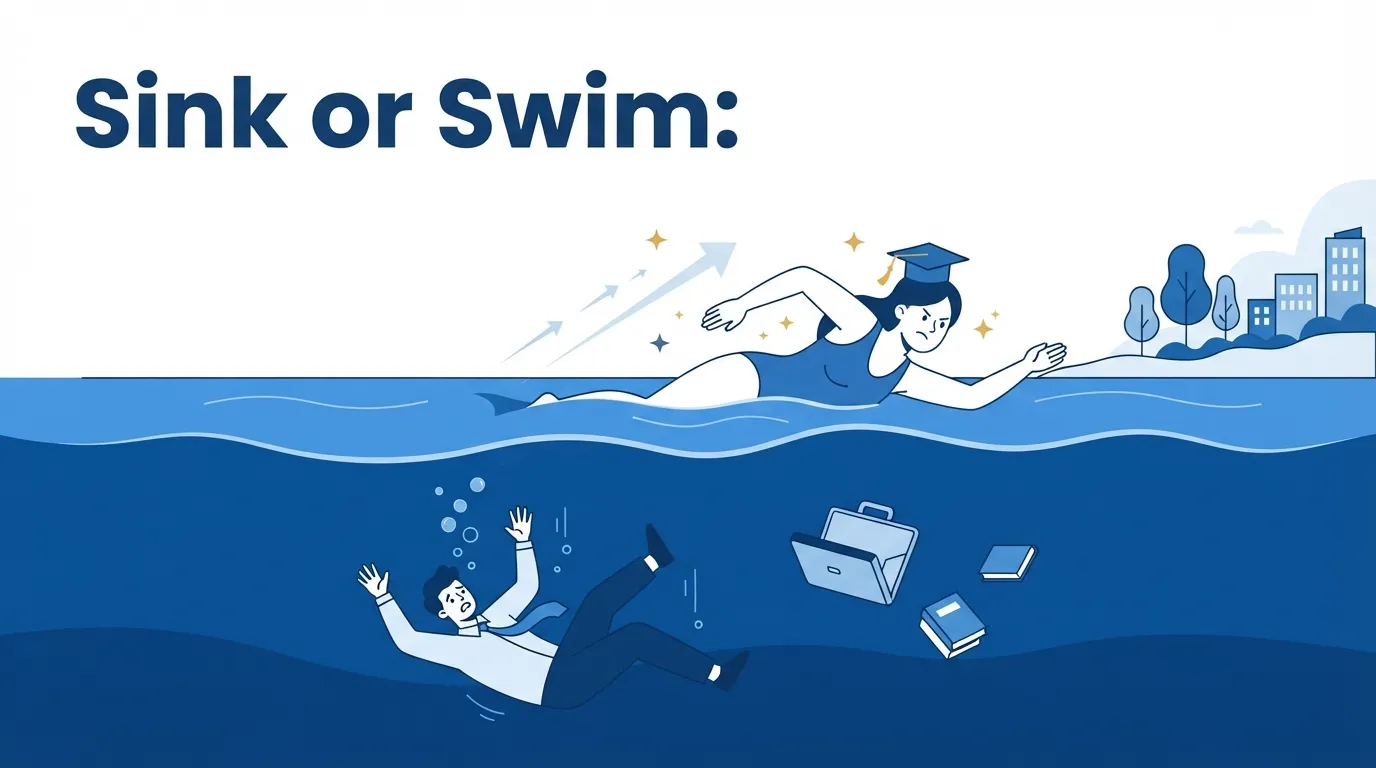
Sink or swim is an English idiom that means to succeed or fail through your own efforts, usually with little or no help. It describes situations where you must quickly adapt and prove yourself.
I still remember my first day as an English teacher. Instead of watching from the back of the classroom, I was asked to teach a full lesson on my own. There was no long training session or detailed guide. I had to figure things out as I went. At the end of the day, my mentor smiled and said, “Welcome to the real world. It’s sink or swim.”
At first, I wasn’t sure what he meant. Later, I realized it was one of the most common English idioms used to describe challenging situations. Whether you’re starting a new job, launching a business, or learning a new skill, there are moments when no one can do the work for you. You either adapt and succeed or struggle and fail.
Because the phrase uses two simple words, many English learners misunderstand its meaning or confuse it with expressions like “think or swim.” Fortunately, the idiom is easy to understand once you know the story behind it.
In this guide, you’ll learn what sink or swim means, where it came from, how to use it correctly, common mistakes to avoid, and real-life examples that will help you remember it with confidence.
Sink or Swim : Quick Answer
The idiom sink or swim means to either succeed or fail without much help from others. It is used when someone faces a difficult situation and must rely on their own skills to overcome it.
Simple examples
- Starting my first business was sink or swim.
- New employees often sink or swim during their first few weeks.
- Moving to another country can be a real sink or swim experience.
The phrase does not refer to actual swimming. Instead, it describes challenging situations where success depends on your own effort.
The Origin / Background of Sink or Swim
The expression sink or swim has been part of the English language for hundreds of years. It comes from the literal experience of being in deep water. If a person could swim, they survived. If they sank, they were in serious danger.
Over time, English speakers began using the phrase as a metaphor for life’s challenges. Instead of describing water, it came to describe situations where people must depend on themselves.
Today, the idiom is commonly used in education, business, sports, military training, and everyday conversation. It often describes moments when someone receives little guidance and must learn by doing.
Because the phrase is so common, it has become a symbol of resilience, independence, and personal growth. While the experience can be stressful, many people use sink or swim positively to describe opportunities that helped them become stronger.
Sink or Swim Explained :Meaning and Usage
The phrase sink or swim describes situations where success depends on your own ability to adapt.
What does sink or swim mean?
It means you have only two possible outcomes:
- Succeed through your own effort.
- Fail because you couldn’t adapt.
There is very little support in between.
Examples
- My first week as a manager was sink or swim.
- Starting university felt like sink or swim.
- Entrepreneurs often face sink or swim moments.
When do people use this idiom?
You’ll commonly hear sink or swim when talking about:
- Starting a new job
- Beginning college
- Launching a business
- Learning a new language
- Taking on leadership responsibilities
- Moving to a new country
In each case, the person must quickly adjust to a new environment.
Comparison Table
| Term | Meaning | When to Use | Region/Context |
| Sink or Swim | Succeed or fail through your own efforts | Challenging situations with little help | Standard English worldwide |
| Learn by Doing | Gain skills through practical experience | Training and education | Standard English |
| Trial by Fire | A difficult first experience that tests ability | Formal and business contexts | Standard English |
| On Your Own | Without assistance from others | Everyday conversation | Standard English |
Real-Life Example
Imagine your company hires a new employee and gives them very little training. They are expected to learn the job by observing others and solving problems independently.
A colleague might say:
“It’s a real sink or swim environment.”
This means the employee must quickly adapt or risk failing.
Which Version or Approach Should You Use?
Unlike spelling comparisons such as gray or grey or judgment or judgement, sink or swim has only one correct form as an English idiom.
If you’re trying to express the idea of succeeding or failing through your own efforts, always use “sink or swim.”
Use sink or swim when…
The idiom fits situations where:
- A person receives little guidance.
- Success depends on personal effort.
- Someone must quickly adapt to a new challenge.
- Failure is a real possibility.
Examples:
- My first teaching job was sink or swim.
- The startup was a sink or swim experience for everyone.
- New recruits quickly learned it was sink or swim.
Don’t use it when…
Avoid the idiom if you’re talking about:
- Actual swimming lessons.
- Water safety.
- Literal drowning situations.
- Small everyday choices.
Incorrect:
❌ I forgot my goggles, so it was sink or swim at the pool.
Better:
✅ I forgot my goggles, but I still enjoyed swimming.
Better Alternatives
Sometimes another expression fits better.
| Situation | Better Expression |
| Learning through experience | Learn by doing |
| Facing a very difficult first challenge | Trial by fire |
| Working independently | On your own |
| Adapting quickly | Hit the ground running |
| Having no second chance | Make or break |
Practical Recommendations
For English learners
Use sink or swim only as an idiom. Don’t translate it word for word into your native language.
For students
This idiom is common in essays, speaking exams, and everyday conversation.
Example:
Starting college was a sink or swim experience.
For professionals
The phrase is widely used in workplaces to describe limited training or high expectations.
Example:
The company has a sink or swim culture for new employees.
For global English
The idiom is understood in both American and British English, making it safe to use in international communication.
Common Mistakes with Sink or Swim
Even native speakers occasionally misuse this expression. Here are the most common mistakes.
| Mistake | Correct Version | Why It Happens |
| Think or swim | Sink or swim | Confusing similar words |
| Swim or sink | Sink or swim | Reversing the established idiom |
| Sink and swim | Sink or swim | Using the wrong conjunction |
| It’s about swimming | It’s a metaphor | Taking the idiom literally |
| Use it for every challenge | Use only for high-pressure situations | Overusing the expression |
Mistake 1: Saying Think or Swim
❌ Starting a business is think or swim.
✅ Starting a business is sink or swim.
This is the most common mistake because the words think and sink look similar.
Mistake 2: Reversing the Idiom
❌ Swim or sink
✅ Sink or swim
English idioms have a fixed order. Changing the order makes the expression sound unnatural.
Mistake 3: Using and Instead of or
❌ Sink and swim
✅ Sink or swim
The word or shows there are only two possible outcomes.
Mistake 4: Taking It Literally
Someone might think the idiom is about swimming.
Actually, it describes life challenges, not water.
Example:
Starting your own company is sink or swim.
No swimming is involved.
Mistake 5: Using It for Minor Problems
The idiom should describe serious challenges.
Less suitable:
Choosing a pizza topping was sink or swim.
Better:
Starting my first job was sink or swim.
Sink or Swim in Real-World Examples
Here are examples from different situations.
Professional Email
Hi Michael,
As you begin your new role, you’ll have plenty of opportunities to learn. While we provide support, some projects are naturally sink or swim experiences that help new team members grow.
Best regards,
News Headline
Small Businesses Face Sink or Swim Economy
The headline suggests companies must adapt or risk failure.
Social Media Post
My first week at university was definitely sink or swim. It was challenging, but I learned so much!
Formal Report
The organization adopted a sink-or-swim approach to leadership development, encouraging employees to solve problems independently.
Everyday Conversation
Emma: How was your first week at work?
James: Honestly, it was sink or swim, but I made it through.
Classroom Example
Teacher:
The science fair became a sink or swim moment for many students because they had to complete their projects independently.
Business Example
Launching the new product during a competitive market was a true sink or swim situation.
Sink or Swim :Data, Trends & Usage
The idiom sink or swim remains one of the most recognized expressions describing resilience and independence.
Who searches for this topic?
The audience includes:
- English learners
- Students
- Teachers
- Business professionals
- Writers
- Job seekers
- Entrepreneurs
Where is it commonly used?
You’ll find the idiom in:
- Business articles
- News reports
- Leadership books
- Motivational speeches
- Workplace discussions
- Academic writing
- Everyday conversations
It is widely understood across English-speaking countries.
Search Intent
| Category | Intent |
| Primary Intent | Informational |
| Secondary Intent | English idioms |
| Related Intent | Meaning, examples, origin, grammar, writing |
Most users want to understand the idiom’s meaning and learn how to use it naturally.
Why This Matters Today
Modern workplaces, startups, and universities often expect people to learn quickly with limited guidance. Because of this, sink or swim remains a relevant and frequently used expression in professional and educational settings.
Standalone Comparison Table
| Term/Variant | Meaning | Region/Context | Best Used When |
| Sink or Swim | Succeed or fail through your own efforts | Standard English worldwide | Describing high-pressure situations |
| Learn by Doing | Gain knowledge through experience | Education and training | Focusing on practical learning |
| Trial by Fire | A difficult first experience | Business, leadership, military | Emphasizing a tough beginning |
| Hit the Ground Running | Start quickly and effectively | Workplace and business | Highlighting a fast start |
| On Your Own | Without help from others | Everyday English | Describing independence |
Frequently Asked Questions (FAQs)
Sink or swim means to succeed or fail through your own efforts with little or no help from others. It describes situations where you must adapt quickly and prove your ability.
Q: What does “sink or swim” mean?
Example:
Starting my own business was a real sink or swim experience.
Q: How do you use “sink or swim” correctly?
Use sink or swim to describe a challenging situation where someone’s success depends on their own skills and determination.
Examples:
- New employees often sink or swim during their first month.
- Moving abroad was a sink or swim moment for our family.
- College can be sink or swim if you don’t manage your time well.
Q: Is “sink or swim” an idiom?
Yes. Sink or swim is a well-known English idiom. It does not refer to actual swimming. Instead, it uses water as a metaphor for life’s challenges.
Q: What is the difference between “sink or swim” and “trial by fire”?
Both expressions describe difficult experiences, but they are not identical.
- Sink or swim focuses on whether you will succeed or fail on your own.
- Trial by fire emphasizes a difficult first experience that tests your abilities.
Examples:
- My first management job was sink or swim because no one trained me.
- Giving a live presentation to 500 people was a trial by fire.
Q: Is “sink or swim” appropriate in formal writing?
Yes. The idiom is acceptable in formal and professional writing when used appropriately.
You might see it in:
- Business reports
- Leadership articles
- Newspapers
- Academic discussions
- Professional emails
However, if your audience prefers very formal or literal language, you can replace it with phrases such as “must succeed independently” or “required to adapt without extensive support.”
Q: Where did the phrase “sink or swim” come from?
The expression originated from the literal idea of being in deep water. A person would either sink or swim. Over time, English speakers began using it metaphorically to describe situations where success depended on individual effort and resilience rather than physical survival.
Q: Can “sink or swim” be used in business or education?
Absolutely. In fact, these are two of the most common contexts for the idiom.
Business Example:
The startup had a sink or swim culture where employees learned by solving real problems.
Education Example:
Many students describe their first semester at university as sink or swim because they must become independent quickly.
Conclusion
The idiom sink or swim has remained popular for centuries because it describes a situation almost everyone experiences at some point. Whether you’re beginning a new job, starting university, launching a business, or learning a new skill, there are moments when you must rely on your own determination to succeed.
Here are the most important points to remember:
- Sink or swim means to succeed or fail through your own efforts.
- It is a figurative expression, not a reference to actual swimming.
- The idiom is widely used in business, education, leadership, sports, and everyday conversations.
- It is understood in both American and British English and works well in both informal and many professional contexts.
Learning idioms like sink or swim helps your English sound more natural and expressive. The key is to understand the meaning behind the words instead of translating them literally.
Now you know exactly how to use sink or swim with confidence. Try adding it to your next conversation or piece of writing, and bookmark this guide whenever you need a quick refresher. If you found this article helpful, share it with someone who is learning English too.
Read More: Whomever or Whoever: Easy Guide to Correct Usage

Muhammad Afzal is a language content writer specializing in English grammar, word usage, and vocabulary distinctions. With a strong command of linguistic nuance, Muhammad Afzal focuses on simplifying commonly confused word pairs to help readers communicate with clarity and confidence.