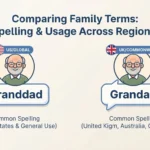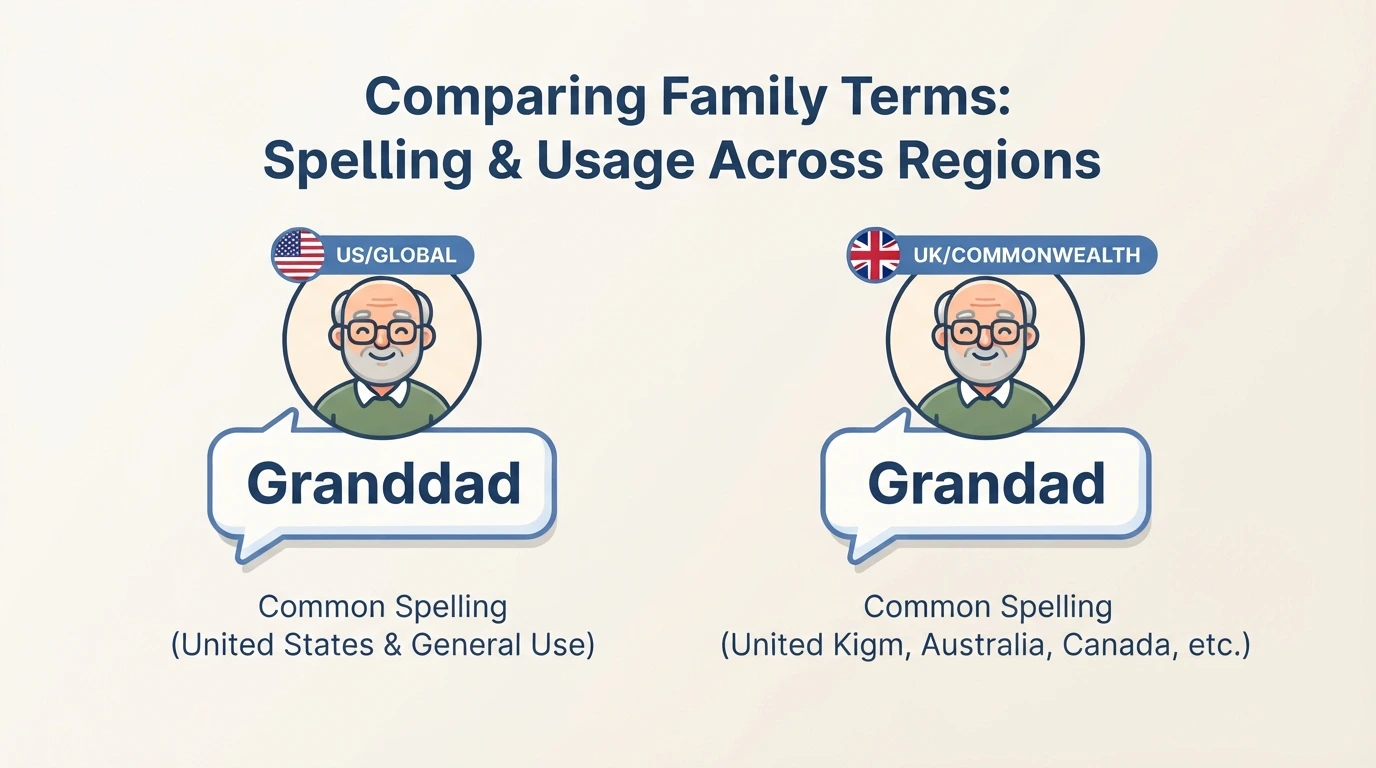
Both “granddad” (with two d’s) and “grandad” (with one d) are correct spellings of the informal word for grandfather. “Granddad” is the standard spelling in American English and widely used across all regions, while “grandad” is a popular alternative spelling in British, Australian, and Commonwealth English.
Have you ever written a holiday card or typed a message to a grandparent and paused to wonder whether it should be granddad or grandad? Because both spellings appear frequently in books, greeting cards, and everyday conversations, it is easy to wonder if one of them is a typo. The good news is that both forms are accepted in major English dictionaries. The choice comes down to regional spelling conventions, compound word rules, and personal preference. In this guide, you will learn the origin of both spellings, regional preferences, example sentences, common mistakes, and simple tips for picking the right word.
Quick Summary of Rules
- Granddad (Two D’s): The primary spelling in American English and standard across all English-speaking countries. It follows the natural compound word rule (grand + dad).
- Grandad (One D): A recognized variant spelling especially common in British, Australian, Canadian, and New Zealand English. It is rarely used in formal American publications.
What Does “Granddad” Mean?
The word granddad (spelled with a double “d”) is an informal noun that refers to one’s grandfather.
It is created by joining the prefix grand- (meaning one generation removed) to the informal noun dad.
- Part of Speech: Countable noun (plural: granddads)
- Formality Level: Informal / Conversational (the formal term is grandfather)
- Pronunciation:
/ˈɡræn.dæd/
Because it is formed by combining “grand” and “dad,” keeping both letters “d” reflects the compound word structure naturally.
Examples:
- My granddad taught me how to fish when I was seven years old.
- We are visiting my granddad for his 80th birthday this weekend.
What Does “Grandad” Mean?
The word grandad (spelled with a single middle “d”) shares the exact same definition and pronunciation as granddad.
Over time, spoken English combined the two “d” sounds into a single spoken sound. As a result, writers in the United Kingdom, Australia, and other Commonwealth regions dropped the second “d” in casual writing, making grandad a standard dictionary-recognized alternative.
- Part of Speech: Countable noun (plural: grandads)
- Formality Level: Informal / Conversational
- Regional Preference: British and Commonwealth English
Examples:
- My grandad loves working in his garden every afternoon.
- I sent a birthday card to my grandad yesterday.
Why Are There Two Spellings?
The existence of both granddad and grandad comes down to how compound words evolve in spoken versus written English.
1. The Compound Word Rule (Grand + Dad)
In English grammar, when you combine two words into a closed compound noun, you usually retain the full spelling of both root words.
- grand + daughter = granddaughter (keeps double d)
- grand + dad = granddad (keeps double d)
Because “granddaughter” always keeps both d’s, many editors prefer granddad for structural consistency across family terms.
2. Phonetic Simplification (Grandad)
When speaking naturally, people rarely pronounce two separate “d” sounds in “grand-dad.” Instead, the transition blends into a single sound (/ˈɡræn.dæd/). In British English especially, written forms often simplify to reflect spoken sound patterns, leading to the single-d variant grandad.
Regional Usage Breakdown
While both words are understood globally, regional preferences differ noticeably:
United States and Canada
In American English, granddad is by far the preferred spelling. American dictionaries like Merriam-Webster list “granddad” as the primary headword and treat “grandad” as a secondary or less common variant. American publishing houses, news outlets, and spellcheckers often flag “grandad” as an error.
United Kingdom, Australia, and New Zealand
In British and Commonwealth English, both spellings are widely used and accepted. Major British dictionaries—including the Oxford English Dictionary and Cambridge Dictionary—list both granddad and grandad. “Grandad” is extremely common on UK greeting cards, in children’s books, and in popular media.
Comparison Table
| Feature / Aspect | Granddad (Double D) | Grandad (Single D) |
| Primary Region | United States, Canada, Global | United Kingdom, Australia, New Zealand |
| Compound Rule | Follows grand + dad rule | Phonetic simplification |
| Formal Alternative | Grandfather | Grandfather |
| Plural Form | granddads | grandads |
| Possessive Form | granddad’s | grandad’s |
| Acceptance Level | 100% universal | Standard in UK/Commonwealth; informal in US |
Practical Examples
Here are natural sentences showing how both spellings appear in writing:
American English Contexts (Granddad)
- Our granddad served in the military during the 1950s.
- Every Sunday, my granddad pancake recipe brings the whole family together.
- I asked my granddad for advice about buying my first car.
British and Commonwealth Contexts (Grandad)
- We bought grandad a new sweater for Christmas.
- Her grandad lives in a quiet village in Yorkshire.
- The kids love listening to grandad’s stories about his childhood.
Formal vs. Informal Family Terms
Both granddad and grandad are informal words. When writing formal documents, academic papers, legal records, or obituaries, use the formal term grandfather.
| Style / Context | Recommended Term | Example |
| Formal / Legal / Academic | Grandfather | “The estate was inherited by his grandfather.” |
| Informal American | Granddad / Granddaddy | “My granddad took us to the baseball game.” |
| Informal British / Commonwealth | Grandad / Granddad | “We sent grandad a warm birthday message.” |
Common Mistakes
| Incorrect | Correct | Why |
| My grand-dad came to visit. | My granddad (or grandad) came to visit. | Do not hyphenate the word. It is written as a single closed compound word. |
| She loved her grand-daughter. | She loved her granddaughter. | Family terms with “grand-” are closed compounds without hyphens. |
| My grandads hat was on the table. | My grandad’s (or granddad’s) hat was on the table. | Use an apostrophe to show possession. |
Clear Usage Recommendation
When deciding which spelling to use in your text:
- If writing for an American or global audience: Choose granddad (with two d’s). It is universally accepted and matches the pattern of words like granddaughter.
- If writing for a British, Australian, or Commonwealth audience: Either granddad or grandad is correct. Choose whichever form is preferred in your household or local style guide.
- If writing formal documents: Use grandfather.
Memory Tip: Think of GRANDDAD as GRAND + DAD—two full words joined together with two D’s!
FAQ Section
Is “grandad” a spelling mistake in the US?
While not technically wrong, “grandad” with one “d” is considered non-standard in American English. Most US spellcheckers, schools, and publishers treat it as a misspelling of “granddad.”
Should “Granddad” or “Grandad” be capitalized?
Capitalize Granddad or Grandad when using it as a proper name or direct address (e.g., “Happy Birthday, Granddad!” or “I asked Grandad for help”). Use lowercase when preceded by a possessive pronoun or article (e.g., “my granddad,”“her grandad,”“a granddad”).
What is the difference between granddad and granddaddy?
“Granddaddy” (or “grandaddy”) is a regional variation—very popular in the Southern United States—that adds an endearing “-y” suffix. It shares the same meaning as granddad.
Why is granddaughter always spelled with two d’s?
Unlike “grandad,” the word “granddaughter” has never dropped its second “d” in any regional dialect. Writing “grandaughter” is always considered a spelling error worldwide.
Summary and Final Advice
Choosing between granddad and grandad comes down to region and personal style:
- Granddad (double “d”) is the standard, universal spelling worldwide.
- Grandad (single “d”) is a widely accepted regional spelling in British and Commonwealth English.
Whichever spelling you choose, keep it consistent throughout your writing!

Muhammad Afzal is a language content writer specializing in English grammar, word usage, and vocabulary distinctions. With a strong command of linguistic nuance, Muhammad Afzal focuses on simplifying commonly confused word pairs to help readers communicate with clarity and confidence.