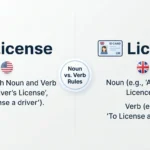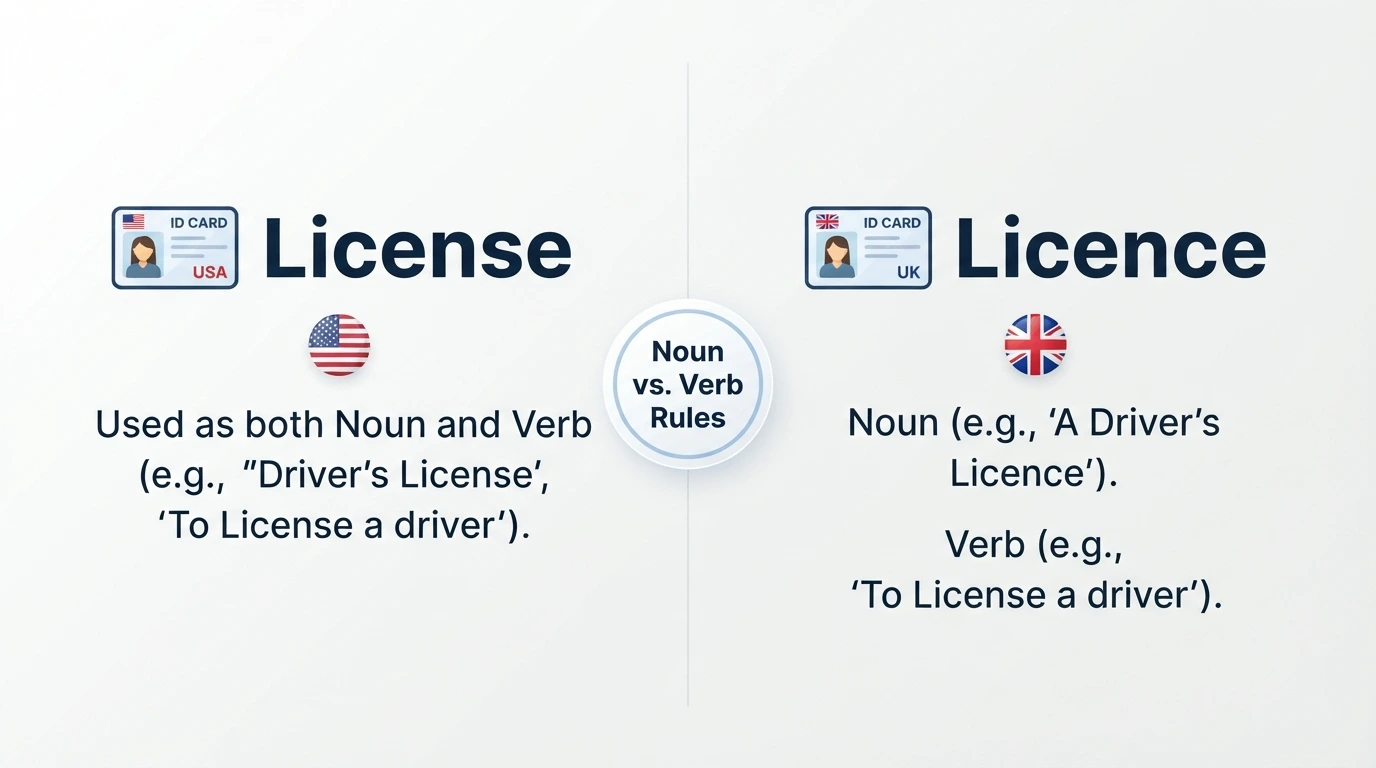
In American English, “license” (with an “s”) is used for both the noun and the verb. In British, Canadian, and Australian English, “licence” (with a “c”) is the noun, while “license” (with an “s”) is the verb.
Have you ever wondered whether to spell it license or licence on a form, resume, or official document? Because both spellings are widely used in legal and everyday contexts, choosing the right one can feel confusing. The correct choice depends on two things: your target region (American vs. British/Commonwealth English) and whether the word is acting as a noun or a verb in your sentence. In this guide, you will learn the exact definitions, regional differences, the noun-versus-verb rule, common mistakes, and easy memory tips to ensure you use the correct spelling every time.
Quick Summary of Rules
- American English (US): Always spell it license with an s, whether it is a noun (“a driver’s license”) or a verb (“to license a vehicle”). The spelling “licence” is rarely used in the United States.
- British and Commonwealth English (UK, Australia, Canada, New Zealand):
- Use licence (with a c) for the noun (“a driving licence”, “a dog licence”).
- Use license (with an s) for the verb (“to license a business”, “licensed premises”).
What Does “License” Mean?
The word license (spelled with an s) is always a verb in British/Commonwealth English and functions as both a verb and a noun in American English.
As a Verb (All Regions)
To license means to grant official, legal permission to someone to perform an action, run a business, own property, or use patented/copyrighted material.
- Base Verb: license
- Present Participle: licensing
- Past Tense / Past Participle: licensed
Examples:
- The state decided to license the new medical clinic.
- The software company licenses its software to school districts.
- He is licensed to practice law in California.
As a Noun (American English Only)
In American English, license refers to the official document, card, permit, or legal right granted by an authority.
Examples (US):
- Please show the officer your driver’s license.
- She renewed her real estate license last week.
What Does “Licence” Mean?
The word licence (spelled with a c) is strictly a noun used in British, Canadian, Australian, and other Commonwealth English dialects.
It refers to the formal certificate, permit, document, or legal authorization given by a government or governing body.
- Singular Noun: licence
- Plural Noun: licences
Examples (UK / Commonwealth):
- He forgot his driving licence at home.
- Every household watching live television in the UK requires a TV licence.
- The restaurant applied for a liquor licence.
The Noun vs. Verb Rule (C vs. S)
For readers and writers using British, Australian, or Canadian English, remembering whether to use c or s can be tricky. English actually follows this exact same pattern with several other common noun/verb pairs:
| Word Pair | Noun (Spelled with C) | Verb (Spelled with S) |
| Licence / License | a driving licence | to license a driver |
| Advice / Advise | helpful advice | to advise someone |
| Practice / Practise | dental practice | to practise piano |
| Device / Devise | tracking device | to devise a plan |
Memory Trick for Commonwealth Writers
- C is for Certificate or Card (Nouns) $\rightarrow$Licence
- S is for State action or Supervise (Verbs) $\rightarrow$License
Comparison Table
| Feature / Usage | American English (US) | British & Commonwealth English | Part of Speech | Example Sentence |
| The Official Card / Permit | license | licence | Noun | She renewed her driver’s license / licence. |
| The Action of Granting Permission | license | license | Verb | The board will license the new pharmacy. |
| Past Tense / Adjective Form | licensed | licensed | Verb / Adjective | He is a licensed electrician. |
| Ongoing Action (-ing) | licensing | licensing | Verb / Noun | The licensing department opens at 9 AM. |
Practical Examples
Here are natural sentences showing how both spellings are used correctly across different regional and grammatical contexts:
American English Examples
- Do you have a valid fishing license for this lake?
- The city will license street vendors starting next month.
- You need to present your marriage license at the government office.
- Software licensing fees increased this quarter.
British and Commonwealth English Examples
- You must display your taxi licence on the windscreen.
- The authority agreed to license the new radio station.
- She holds a valid pilot’s licence.
- The council refused to grant a late-night music licence.
Common Mistakes
| Incorrect | Correct | Why |
| I need to renew my driver’s licence. (In the US) | I need to renew my driver’s license. | American English uses “license” with an s for nouns. |
| The council will licence the venue next week. (In the UK) | The council will license the venue next week. | In British English, the verb form must be spelled with an s. |
| He is a licenced pilot. | He is a licensed pilot. | The past participle/adjective form is always spelled with an s in all regions. |
| She received her business licensee. | She received her business license / licence. | A licensee is the person who holds a license, not the document itself. |
Clear Usage Recommendation
When deciding which spelling to use in your text:
- If writing for an American audience: Use license with an s for every situation—nouns, verbs, and adjectives.
- If writing for a British, Canadian, Australian, or International audience:
- Use licence (with a c) when referring to the physical or official document, card, or legal right (the noun).
- Use license (with an s) when referring to the action of giving permission or when using participle forms like licensed or licensing (the verb).
FAQ Section
Is “licence” ever correct in American English?
“Licence” is considered a non-standard spelling or mistake in American English. American publications, courts, and government bodies (such as the DMV) exclusively use license.
How do Canada and Australia spell driver’s license?
Both Canada and Australia follow Commonwealth conventions. They spell the noun form with a c: driver’s licence (or driving licence in Australia). However, verb forms like licensed driver use an s.
What is the difference between a licensor and a licensee?
- A licensor (or licenser) is the authority or company that grants permission or rights.
- A licensee is the individual or business that receives the permission or holds the licence.
Why does American English use “license” for both forms?
During the 19th-century spelling reforms led by Noah Webster in the United States, many English word pairs ending in -ce and -se were simplified. Webster preferred the -se ending for “license,” eliminating the double spelling rule for American writers.
Summary and Final Advice
Mastering license versus licence comes down to region and part of speech:
- In the US, keep it simple: always use license.
- In the UK and Commonwealth, remember C for the Noun (licence) and S for the Verb (license).
Keeping this distinction clear will ensure your contracts, resumes, articles, and official forms remain professional and accurate. Explore our other word choice and regional spelling guides to continue building your writing skills!

Hassan Afzal has a background in English language instruction and writes to help non-native speakers and students master tricky grammar rules and word choices. Hassan Afzal’s writing style blends practical examples with clear explanations for everyday English learners.