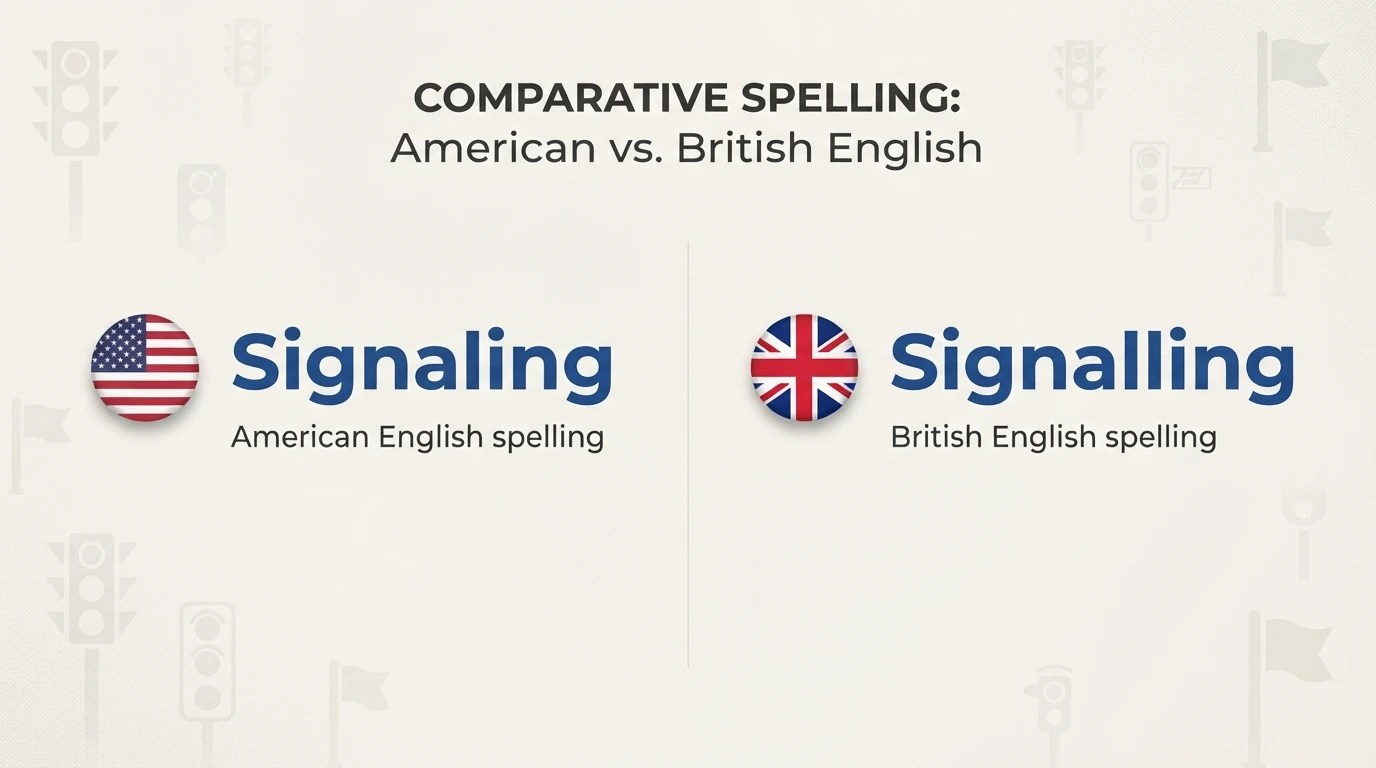
Both “signaling” and “signalling” are correct spellings of the present participle form of “signal.” “Signaling” (with one “l”) is standard in American English, while “signalling” (with two “l’s”) is standard in British, Canadian, and Australian English.
Have you ever noticed “signaling” spelled with a single “l” in one book and double “l’s” in another? Writers often stop and wonder whether one of these spellings is a mistake. Because both forms appear in reputable publications around the world, choosing between them can feel confusing. Fortunately, neither form is incorrect. The difference comes down entirely to regional spelling conventions between American English and British or Commonwealth English. In this guide, you will learn why this spelling variation exists, the grammar rules behind consonant doubling, practical sentence examples, and clear advice on which form to use for your audience.
What Does “Signaling” or “Signalling” Mean?
Both signaling and signalling are present participle forms of the verb signal. They can also function as nouns (gerunds) or as adjectives.
To signal means to convey a message, gesture, warning, or instruction to someone using sounds, actions, lights, or symbols. It can also describe devices sending electronic impulses or bodies sending chemical cues.
Here is how the base verb connects to its participle forms:
- Base Verb: signal
- Present Participle (American English):signaling
- Present Participle (British / Commonwealth English):signalling
- Past Tense (American English): signaled
- Past Tense (British / Commonwealth English): signalled
Because both forms share the exact same definition and pronunciation (/ˈsɪɡ.nəl.ɪŋ/), your choice depends strictly on your target location or preferred editorial style.
Why Do the Two Spellings Exist?
The difference between signaling and signalling comes from mid-19th-century spelling reforms in the United States, led by lexicographer Noah Webster. Webster aimed to simplify English spelling by making words match their natural spoken stress patterns more closely.
The American English Rule (Single “L”)
In American English, when adding a vowel suffix like -ing, -ed, or -er to a multi-syllable verb ending in -l, you only double the final consonant if the stress falls on the final syllable.
Look at the word sig-nal:
- The primary stress is on the first syllable (SIG-nal).
- Because the final syllable is unstressed, American English keeps a single l.
- Result: signal + ing = signaling
Other words following this American rule include:
- travel + ing = traveling
- cancel + ing = canceling
- label + ing = labeling
However, if the stress falls on the last syllable, American English doubles the consonant, just like British English:
- con-trol + ing = controlling (stress on trol)
- pre-fer + ing = preferring (stress on fer)
The British and Commonwealth Rule (Double “L”)
In British English (and standard usage across Canada, Australia, New Zealand, and South Africa), the rule is different. When a verb ends in a vowel followed by an l, you double the l before adding suffixes starting with a vowel, regardless of which syllable receives the stress.
- signal + ing = signalling
- travel + ing = travelling
- cancel + ing = cancelling
- label + ing = labelling
Because of this consistent rule, double-l forms like signalling remain standard across British literature, media, and academic style guides.
Regional Usage Breakdown
Understanding where each spelling is preferred helps you tailor your writing for specific readers around the globe.
United States
American publications, schools, and business communications use signaling almost exclusively. Major American style manuals, including The Chicago Manual of Style and The Associated Press (AP) Stylebook, mandate single-l spellings for verbs like signaling, signaled, and signaler.
United Kingdom and Ireland
In the UK and Ireland, signalling with two “l’s” is standard across news outlets, published books, and school curricula. Dictionaries such as the Oxford English Dictionary and Cambridge Dictionary list signalling as the primary headword for British readers.
Canada and Australia
Canadian English and Australian English follow British spelling conventions for words ending in -l. You will see signalling, travelling, and cancelling in Australian and Canadian government publications, news reporting, and academic papers.
Comparison Table
| Word Form | American English | British / Commonwealth English | Part of Speech | Example Sentence |
| Present Participle | signaling | signalling | Verb / Noun / Adjective | The driver was signaling / signalling before turning left. |
| Past Tense | signaled | signalled | Verb | She signaled / signalled for the waiter to bring the bill. |
| Noun (Person/Thing) | signaler | signaller | Noun | The railroad signaler / signaller monitored the track junction. |
| Base Verb | signal | signal | Verb | Ships use flags to signal each other across long distances. |
Practical Examples
Here are natural sentences demonstrating how to use signaling and signalling in everyday writing and professional communication:
American English Examples (Single “L”)
- The traffic light was signaling drivers to stop at the intersection.
- Market analysts noticed strong economic trends signaling recovery.
- Modern smartphones use radio waves for signaling between cell towers.
- She turned off her car’s turn signaling system after making the turn.
- The brain uses specialized neurons for signaling sensory information.
British and Commonwealth Examples (Double “L”)
- Railway workers checked the electronic signalling equipment along the track.
- The ref’s whistle was signalling the end of the second half.
- Coastal lighthouses were vital for signalling hazards to passing vessels.
- She sent a quick message, signalling that she had arrived safely.
- Researchers studied how chemical signalling works inside human cells.
Common Mistakes
| Incorrect | Correct | Why |
| The train suffered from a signaling error. (In British English) | The train suffered from a signalling error. | Use double “l” in British English for verb forms ending in -l. |
| He was signalling to his team. (In American English) | He was signaling to his team. | Use single “l” in American English when the final syllable is unstressed. |
| They are signalinging for help. | They are signaling / signalling for help. | Do not double the -ing suffix. Add -ing directly to the modified stem. |
| The light was signeling a turn. | The light was signaling / signalling a turn. | The root word ends in -al (signal), not -el. Keep the letter “a”. |
Clear Usage Recommendation
When deciding which spelling to select in your document or article:
- For an American audience: Use signaling (single “l”).
- For a British, Canadian, Australian, or Commonwealth audience: Use signalling (double “l”).
- For an international or global audience: Select one spelling standard—either American or British—and keep it consistent throughout your entire document. Avoid mixing single-l and double-l words within the same piece of writing (e.g., avoid using signaling alongside travelling).
Memory Tip: US = Single L (like “United States”), UK = Double L (like “United Kingdom”).
FAQ Section
Is “signalling” considered a spelling error in American English?
While most Americans will easily recognize and understand signalling, American spellcheckers and editors treat double-l forms like signalling, travelling, and cancelling as non-standard or misspelled. It is best to stick to signaling for US readers.
Is “signaling” acceptable in British English?
In British English, single-l spellings like signaling are understood, but they are viewed as Americanisms. Most British publications, publishers, and universities prefer signalling with two “l’s”.
Does the word “signal” change spelling in the past tense too?
Yes. The past tense follows the exact same regional rule. American English uses a single “l” (signaled), while British and Commonwealth English uses double “l’s” (signalled).
How do you spell “virtue signaling” or “virtue signalling”?
Both forms are correct following regional conventions. Write virtue signaling for American audiences and virtue signalling for British or Commonwealth audiences. The phrase refers to expressing opinions publicly to demonstrate moral character.
What about other words like “traveling” and “canceling”?
The exact same rule applies. Words like travel, cancel, label, counsel, and model use a single “l” in American English (traveling, canceling, labeling) and double “l’s” in British English (travelling, cancelling, labelling).
Are there any words where American English doubles the final “l”?
Yes. American English doubles the “l” when the stress falls on the second or final syllable of the base verb, such as compel (compelling), refer (referring), or control (controlling).
Summary and Final Advice
Choosing between signaling and signalling comes down to recognizing regional spelling preferences. Signaling with one “l” is the standard American spelling because the stress falls on the first syllable of signal. Signalling with two “l’s” is the standard British and Commonwealth spelling, where words ending in -l double the consonant before vowel suffixes.
Whichever form you choose, remain consistent across your document. Explore our other regional spelling guides to continue building your English writing confidence