Damnit or dammit means you are choosing between informal spellings of “damn it.” “Dammit” is the more standard spelling, while “damnit” appears as a less common variant. Both are informal and may be considered offensive.
Have you ever typed “damnit” and wondered if “dammit” looks more correct?
This is a common spelling question because both forms sound the same. They also come from the phrase “damn it.” People use the word when they are angry, annoyed, frustrated, or surprised.
The safer spelling is dammit. It is the form you will see more often in dictionaries and edited writing. Merriam-Webster defines dammit as an alteration of damn it and says it is used as a mild imprecation.
Damnit is not as standard. Cambridge lists damnit as another form under dammit, but the main entry is dammit.
This guide explains damnit or dammit in simple English. You’ll learn the correct spelling, meaning, tone, examples, common mistakes, and when to avoid the word.
Damnit or Dammit: Quick Answer
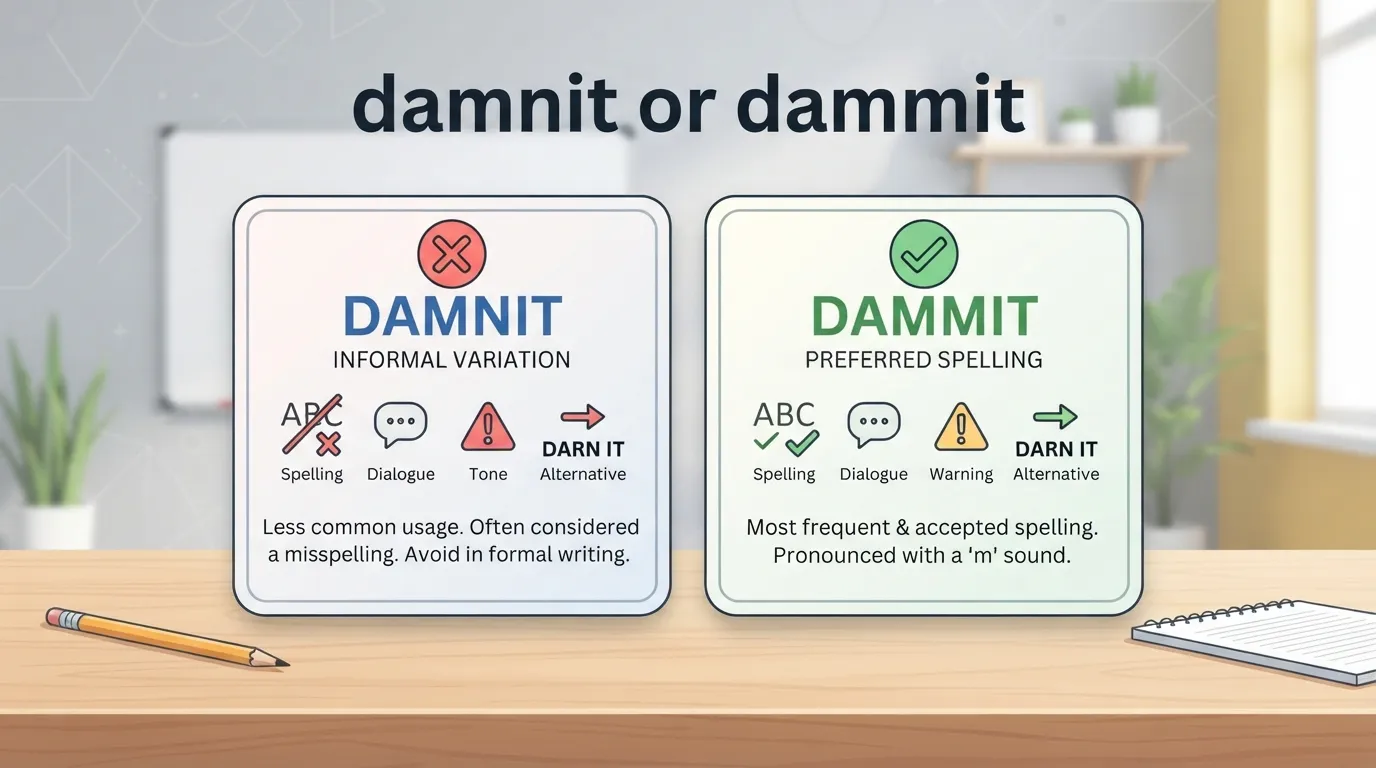
Use “dammit” in most casual writing. It is the more standard spelling. “Damnit” appears as a less common variant, but some readers may see it as a misspelling. Use “damn it” when you want the full two-word phrase.
Simple examples:
- Better: Dammit, I forgot my keys.
- Less standard: Damnit, I forgot my keys.
- Full phrase: Damn it, I forgot my keys.
- Softer option: Darn it, I forgot my keys.
Easy rule:
- Dammit = best one-word spelling
- Damnit = less common variant
- Damn it = full phrase
- Darn it = softer and cleaner
Cambridge notes that damn, damn it, and dammit can express anger or annoyance, and it also says the word may be considered offensive by some people.
The Origin / Background of Damnit or Dammit
The word “dammit” comes from the phrase “damn it.” Over time, fast speech made the two words sound like one word. That gave us the informal spelling “dammit.”
Merriam-Webster gives the etymology of dammit as an alteration of damn it. Merriam-Webster defines damn it as an informal and impolite phrase used to show anger or annoyance.
That means all three forms are connected:
- Damn it is the full phrase.
- Dammit is the common one-word form.
- Damnit is a less common alternate form.
The spelling dammit makes sense because it reflects the sound of the phrase when spoken quickly. The n sound in damn often blends into the next sound, so many people hear something closer to dam-mit than damn-it.
That is why dammit became the more familiar spelling.
Still, this word is not polite. It may be fine in dialogue, fiction, casual texting, or emotional writing. But it may not fit school essays, business emails, customer service messages, or professional pages.
Damnit or Dammit Explained: Key Differences or Variations
The main difference is spelling and tone. “Dammit” is the more accepted one-word form. “Damnit” is less common. “Damn it” is the full phrase. All are informal and can sound rude, depending on the situation.
| Term | Meaning | When to Use | Region/Context |
|---|---|---|---|
| Dammit | Informal expression of anger or annoyance | Casual writing, dialogue, fiction | More standard one-word form |
| Damnit | Variant spelling of dammit | Very casual writing | Less common spelling |
| Damn it | Full phrase | Casual speech or dialogue | Informal and impolite |
| Damn | Swear word or angry expression | Casual speech, emphasis | May offend some people |
| Darn it | Softer replacement | Polite casual writing | Cleaner alternative |
Collins describes dammit as a contracted form of damn it and says it is used to express anger, irritation, contempt, or disappointment.
Examples:
- Dammit, that hurt.
- Damn it, I left my wallet at home.
- Darn it, I missed the bus.
- He whispered, “Dammit, not again.”
For most writers, dammit is the best spelling if you want the one-word version.
Which Version Should You Use?
Use “dammit” if you want the standard informal spelling. Use “damn it” if you want the full phrase. Avoid both in formal writing. Use “darn it” or another softer phrase if you want a cleaner tone.
Here is the best practical advice:
- For fiction dialogue → use dammit if the character speaks casually.
- For text messages → dammit is more standard than damnit.
- For formal writing → avoid both.
- For school essays → use a cleaner phrase unless quoting.
- For business emails → do not use dammit or damnit.
- For family-friendly writing → use darn it.
- For SEO or grammar content → mention both spellings, but recommend dammit.
Good examples:
- Casual: Dammit, I forgot the meeting.
- Full phrase: Damn it, this file will not open.
- Polite: Darn it, I forgot the meeting.
- Formal: Unfortunately, I forgot the meeting.
If your goal is clean writing, use a softer word. If your goal is realistic dialogue, dammit may fit.
Common Mistakes With Damnit or Dammit
Most mistakes happen because writers spell the word as “damnit” based on the full phrase “damn it.” But the more standard one-word spelling is “dammit.” Another mistake is using this word in professional writing.
| Mistake | Correction | Why It Happens |
|---|---|---|
| Damnit, I lost it. | Dammit, I lost it. | More standard one-word spelling is dammit |
| Using dammit in a work email | Use “unfortunately” or “sorry” | Profanity sounds unprofessional |
| Thinking damnit is always the main form | Use dammit as default | Dictionary main entries favor dammit |
| Writing dam it | Write damn it or dammit | Missing the “n” changes the word |
| Using it in children’s content | Use darn it | Cleaner tone needed |
Mistake 1: Using “damnit” as the main spelling
Less standard:
Damnit, I dropped my phone.
Better:
Dammit, I dropped my phone.
Cambridge includes damnit as a form, but its main entry is dammit.
Mistake 2: Using “dammit” in formal writing
Too casual:
Dammit, the report is late.
Better:
Unfortunately, the report is late.
Professional writing should avoid swear words unless you are quoting someone.
Mistake 3: Confusing “dam” and “damn”
A dam is a wall that holds back water.
Damn is the swear word.
Wrong:
Dam it, I forgot.
Correct:
Damn it, I forgot.
Dammit, I forgot.
Damnit or Dammit in Real-World Examples
You can use dammit or damn it in casual speech, dialogue, or emotional writing. But you should avoid them in formal writing because the words are informal, impolite, and may offend some readers.
Fiction dialogue example
“Dammit,” she muttered, staring at the broken lock.
This works because dialogue often uses natural speech.
Casual text example
Dammit, I missed the bus again.
This is informal and emotional.
Softer text example
Darn it, I missed the bus again.
This is cleaner and more polite.
Professional email example
Too informal:
Dammit, I forgot to attach the file.
Better:
Sorry, I forgot to attach the file.
Social media example
Dammit, that ending made me cry.
This may fit a casual personal post, but not a brand post.
Full phrase example
Damn it, I knew I should have checked the address.
This uses the original two-word phrase.
Damnit or Dammit: Data, Trends & Usage
The search intent behind “damnit or dammit” is spelling-focused. Most readers want to know which spelling is correct, whether “damnit” is a real form, and which one looks better in writing.
People often search this phrase while writing:
- dialogue
- captions
- text messages
- fiction
- scripts
- comments
- grammar posts
- song-style lines
- emotional scenes
The useful answer is simple:
Dammit is the best default one-word spelling.
Merriam-Webster has a main dictionary entry for dammit and defines it as an alteration of damn it. Cambridge also lists dammit as the main entry, with damnit and damn it shown as alternate forms.
Tone matters too. Cambridge notes that damn may be considered offensive by some people.
So the spelling question has two parts:
- For spelling, choose dammit.
- For tone, avoid it when politeness matters.
Damnit or Dammit Comparison Table
A quick comparison makes the choice easy. Dammit is the standard one-word spelling. Damnit is less common. Damn it is the full phrase. Darn it is the safer polite alternative.
| Term/Variant | Meaning | Region/Context | Best Used When |
|---|---|---|---|
| Dammit | Informal expression of anger or annoyance | Casual English | You want the standard one-word spelling |
| Damnit | Variant spelling of dammit | Very informal English | You are copying someone’s exact wording |
| Damn it | Full phrase | Informal and impolite | You want the original two-word form |
| Damn | Swear word or emphasis word | Informal speech | Showing anger, surprise, or emphasis |
| Darn it | Softer replacement | Polite casual speech | Avoiding profanity |
| Unfortunately | Formal replacement | Professional writing | Business, school, or formal tone |
FAQs About Damnit or Dammit
Q: What does damnit or dammit mean?
A: Damnit or dammit is a spelling choice for an informal expression of anger, annoyance, or frustration.
Q: Is dammit correct?
A: Yes. Dammit is the more standard one-word spelling. Merriam-Webster defines it as an alteration of damn it.
Q: Is damnit correct?
A: Damnit appears as a variant form in Cambridge, but it is less standard than dammit.
Q: Damnit vs dammit: what is the difference?
A: The meaning is the same. The difference is spelling. Dammit is the better default spelling. Damnit is less common.
Q: Is it damn it or dammit?
A: Both can be used. Damn it is the full phrase. Dammit is the informal one-word form.
Q: Is dammit a bad word?
A: It is a mild swear word or impolite expression. Cambridge notes that damn may be considered offensive by some people.
Q: What is a polite alternative to dammit?
A: Use darn it, oh no, shoot, sorry, or unfortunately, depending on the sentence.
Conclusion
Now you know the difference between damnit or dammit.
The best one-word spelling is dammit. It is the spelling most readers expect and the spelling supported as the main dictionary form. Damnit exists as a less common variant, but it may look like a mistake to some readers.
Use damn it if you want the full two-word phrase. Use darn it if you want a softer, cleaner version.
Remember this simple rule:
- Dammit = best one-word spelling
- Damnit = less common variant
- Damn it = full phrase
- Darn it = polite alternative
Also remember the tone. This word is informal and may offend some people. It can work in dialogue, casual texts, or emotional scenes. It does not fit most professional emails, school papers, brand pages, or formal writing.
Now you know exactly how to use damnit or dammit. Check the spelling and tone before you publish or send it.

Zain Ali is an English content specialist with editorial experience in creating clear, accurate, and reader-friendly grammar guides. Zain is passionate about breaking down confusing English word pairs into simple, actionable explanations.