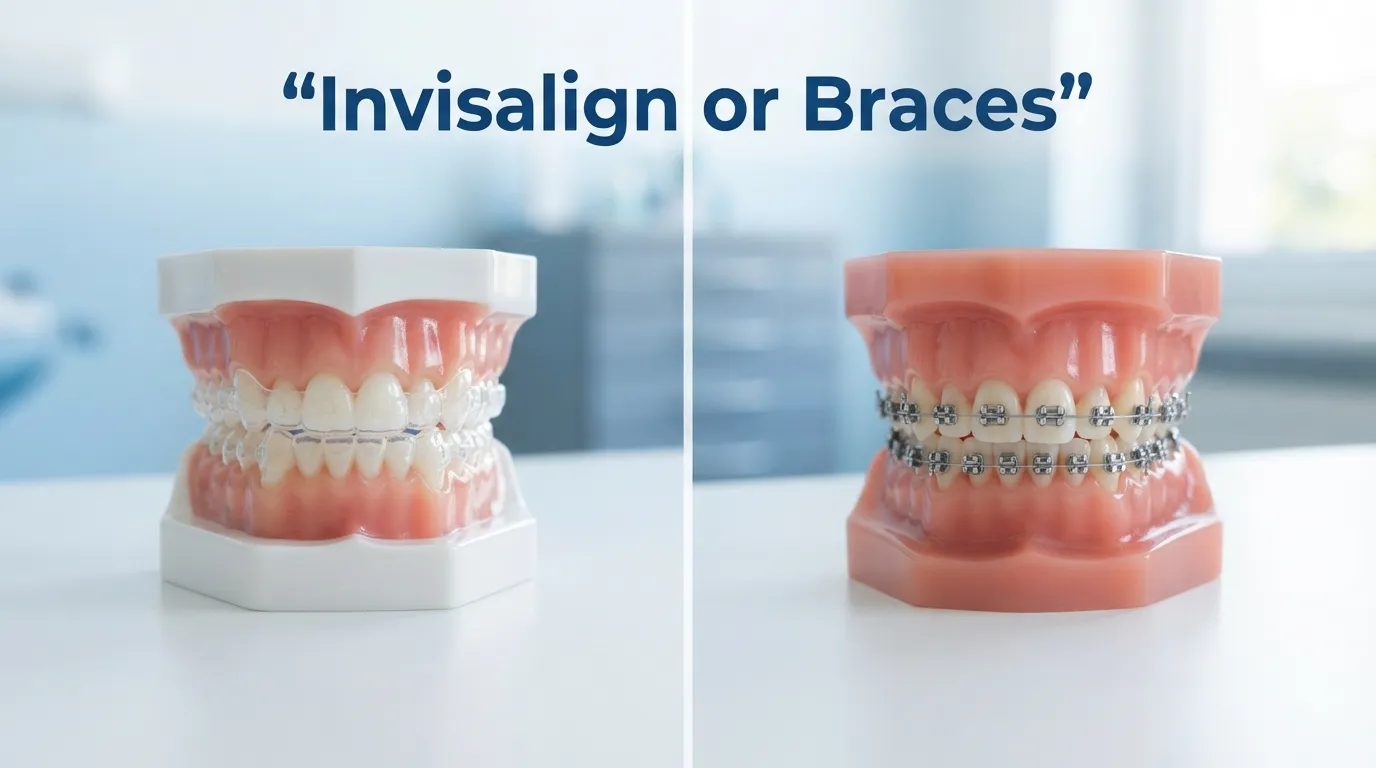
Neither Invisalign nor braces is better for everyone. Invisalign is removable and less noticeable, while braces stay fixed to the teeth and may be more predictable for complex alignment or bite problems. An orthodontist should recommend the safest option for your teeth.
Choosing between Invisalign and braces can feel difficult. Both treatments straighten teeth, improve alignment, and help correct certain bite problems. However, they work differently and require different levels of care and responsibility.
Invisalign may appeal to people who want a discreet, removable treatment. Traditional braces may be better for people who need complex tooth movements or do not want to remember to wear aligners every day. This guide compares appearance, comfort, cleaning, eating, effectiveness, cost, and daily care. It provides general information, not a personal diagnosis.
What Is the Difference Between Invisalign and Braces?
Invisalign uses a series of removable clear aligners, while braces use fixed brackets and wires attached to the teeth.
Invisalign is a well-known brand of clear aligner treatment. The aligners are custom-made plastic trays that fit over the teeth. Each set moves the teeth a small amount before the patient changes to the next set.
Traditional braces use small brackets connected by an orthodontic wire. The wire applies controlled pressure that gradually moves the teeth. The brackets normally remain attached throughout treatment. (American Association of Orthodontists)
| Feature | Invisalign | Traditional Braces |
|---|---|---|
| Appearance | Clear and less noticeable | Metal brackets and wires are visible |
| Removable | Yes | No |
| Eating | Removed before meals | Some foods must be avoided |
| Cleaning | Removed for brushing and flossing | Requires careful cleaning around brackets |
| Daily responsibility | Must be worn as directed | Works continuously because it is fixed |
| Complex cases | Suitable for many, but not all | Often useful for a wide range of cases |
| Comfort | Smooth trays, but pressure is still felt | May irritate cheeks and feel sore after adjustments |
| Retainer needed afterward | Yes | Yes |
How Does Invisalign Work?
Invisalign treatment uses a planned series of transparent aligners. Before treatment begins, the provider examines the teeth and jaws and may use photographs, X-rays, impressions, or digital scans to create a treatment plan.
Each set of aligners is designed to move the teeth gradually. Patients usually change aligners according to the schedule given by their orthodontist.
Clear aligners must normally be worn for around 20 to 22 hours per day, or for the exact time prescribed by the orthodontist. They should only be removed for eating, drinking certain beverages, brushing, flossing, and cleaning the trays. (American Association of Orthodontists)
Some patients also need small tooth-coloured attachments. These attachments are fixed to selected teeth and help the aligners apply pressure in the correct direction. This means Invisalign may be discreet, but it is not always completely invisible.
How Do Traditional Braces Work?
Traditional braces use brackets attached to the front of the teeth. An orthodontic wire connects the brackets and applies gentle pressure to move the teeth into planned positions.
The orthodontist adjusts the braces during treatment. Teeth may feel sore for a few days after the braces are first fitted or adjusted. This discomfort is usually temporary.
Because braces remain attached to the teeth, they work continuously. Patients do not need to remember to put them back in after meals. However, they must clean carefully around the brackets and wires to prevent plaque from collecting. (Ada)
Which Treatment Is More Effective?
Both Invisalign and braces can straighten teeth when they are properly planned, supervised, and used as instructed.
Clear aligners can treat many cases involving:
- Crooked teeth
- Small or moderate gaps
- Crowding
- Certain overbites
- Certain underbites
- Some crossbites
However, clear aligners are not suitable for every patient. Some complex tooth movements, severe bite problems, impacted teeth, or jaw-related conditions may be treated more predictably with braces or a combination of methods.
Braces give the orthodontist continuous control because they remain attached to the teeth. They can be used for simple treatment as well as many complicated cases.
The final result depends on more than the appliance. It also depends on:
- The condition of your teeth and jaws
- The skill and planning of your provider
- Your oral hygiene
- Your attendance at appointments
- Your cooperation with elastics or other instructions
- How consistently you wear clear aligners
Is Invisalign Faster Than Braces?
Invisalign is not automatically faster than braces.
Treatment time depends on the type and severity of the problem, the movements required, and how well the patient follows instructions. A simple case may take less time than a complex one, regardless of the appliance used.
Invisalign treatment can take longer than planned when patients:
- Do not wear their trays for the required hours
- Lose or damage aligners
- Change sets too early
- Leave aligners out for long periods
- Need extra sets, sometimes called refinements
Braces work continuously, but broken brackets, missed appointments, or failure to wear elastics may also delay progress.
Therefore, you should compare the treatment plan provided for your own teeth instead of assuming that one method is always faster.
Which Option Looks Better?
Invisalign is usually less noticeable because the trays are transparent. This makes it popular with people who feel uncomfortable wearing visible metal braces.
However, Invisalign should not be described as completely invisible. The trays may be noticeable at close range, and some patients need visible attachments or elastics.
Traditional metal braces are more noticeable. Patients who want a less visible fixed option may ask about ceramic braces or braces fitted behind the teeth. Availability and suitability vary by provider and case.
Which Is More Comfortable?
Neither treatment is completely painless. Teeth must receive controlled pressure to move, so temporary soreness is expected with both options.
Invisalign trays are made from smooth plastic, which may cause less irritation to the lips and cheeks than metal brackets. However, new trays can make the teeth feel tender, and the edges or attachments may occasionally irritate the mouth.
Braces may cause soreness after fitting and adjustments. Brackets and wires can also rub against the inside of the cheeks or lips, especially during the first few weeks. Orthodontic wax may help protect irritated areas.
Comfort is personal. Some patients prefer smooth removable trays, while others prefer fixed braces that they do not need to manage throughout the day.
Eating With Invisalign or Braces
Eating With Invisalign
Aligners are removed before eating, so patients can normally continue eating their usual foods. The teeth should be cleaned before the aligners are placed back in whenever possible.
You should not regularly drink sugary, acidic, or coloured drinks while wearing aligners. Liquid can become trapped between the trays and teeth, increasing the risk of staining or tooth damage. Poor cleaning can contribute to plaque and white marks on the teeth.
Eating With Braces
Patients with fixed braces may need to avoid foods that can damage brackets and wires, including:
- Hard sweets
- Ice
- Very sticky sweets
- Hard nuts
- Tough or chewy foods
- Biting directly into hard fruits or vegetables
Hard foods can often be eaten after being cut into small pieces. Your orthodontist will provide instructions based on your braces.
Which Is Easier to Clean?
Invisalign may make normal brushing and flossing easier because the trays can be removed. However, both the teeth and aligners must be cleaned properly.
Putting aligners over unclean teeth can trap food, plaque, sugar, and acid. This may increase the risk of bad breath, decay, staining, or white spots.
Braces require more detailed cleaning because food and plaque can collect around the brackets and beneath the wire. Patients may need an interdental brush, floss threader, or another tool recommended by their dental professional. Regular dental check-ups remain important during orthodontic treatment. (nhs.uk)
Invisalign or Braces for Teenagers
Both options may be suitable for teenagers.
Invisalign can be helpful for teenagers who:
- Feel concerned about visible braces
- Play certain sports or musical instruments
- Can keep track of their aligners
- Will wear the trays as instructed
- Can maintain good oral hygiene
Braces may be more practical for teenagers who:
- Might forget to wear aligners
- Frequently lose removable items
- Need more complex treatment
- Prefer a fixed appliance
- Do not want to remove trays before every meal
A teenager’s responsibility level is an important part of the decision. Clear aligners cannot work properly when they spend too much time outside the mouth.
Invisalign or Braces for Adults
Adults can be treated with either braces or clear aligners. Age alone does not decide which appliance is suitable.
Many adults choose Invisalign because it is discreet and can be removed for meals, photographs, or important events. However, removing aligners too often can delay treatment.
Braces may be recommended when an adult has complex alignment, bite, or jaw problems. Adults may also choose braces because they prefer a fixed treatment that works without daily tray management.
Which Option Costs More?
There is no universal price difference between Invisalign and braces.
The total cost may depend on:
- The difficulty of the case
- The expected treatment length
- The provider’s experience
- The type of braces or aligners
- Your country and location
- The number of appointments
- Additional scans, retainers, or refinements
- Insurance or public healthcare coverage
Clear aligners and other less visible orthodontic options may cost more in some clinics or healthcare systems. However, prices vary widely, so written estimates from qualified providers are more useful than general online price ranges.
When comparing quotes, check whether the price includes retainers, follow-up visits, replacement aligners, emergency appointments, and additional treatment if the first plan does not produce the expected result.
Practical Examples
Invisalign May Be Suitable When:
- You want a less noticeable treatment.
- You can wear trays for the prescribed number of hours.
- You want to remove the appliance when eating.
- You are willing to clean your teeth before replacing the trays.
- Your orthodontist confirms that aligners can treat your condition.
Braces May Be Suitable When:
- Your case requires complicated tooth movements.
- You do not want responsibility for removable trays.
- You may forget or lose aligners.
- You prefer a fixed appliance that works continuously.
- Your orthodontist expects braces to produce a more predictable result.
Either Treatment May Be Suitable When:
- Your alignment problem can be treated successfully with either method.
- You understand the care requirements.
- You can attend regular appointments.
- You are prepared to wear a retainer after treatment.
- You have discussed the benefits and limitations with an orthodontist.
Common Invisalign and Braces Mistakes
| Common Mistake | Correct Information | Why It Matters |
|---|---|---|
| Invisalign is completely invisible. | It is less noticeable, but trays, attachments, or elastics may still be seen. | Expectations should be realistic. |
| Invisalign only needs to be worn at night. | Aligners usually require about 20–22 hours of daily wear, unless instructed otherwise. | Insufficient wear can delay or prevent movement. |
| Braces are always faster. | Treatment time depends on the individual case. | Appliance type alone does not determine speed. |
| Invisalign is painless. | Both treatments may cause temporary pressure and soreness. | Tooth movement requires controlled force. |
| No retainer is needed after Invisalign. | Retainers are normally needed after either treatment. | Teeth can move back after active treatment. |
Which Should You Choose?
Choose Invisalign when appearance and removability are major priorities, you can follow the wear schedule carefully, and your orthodontist confirms that clear aligners can treat your condition predictably.
Choose braces when you need complex treatment, prefer a fixed appliance, or may struggle to wear and manage removable trays consistently.
Do not select treatment based only on advertising, price, or appearance. Moving teeth is a biological and medical process that requires a proper examination, diagnosis, treatment plan, and professional supervision. The American Association of Orthodontists advises consulting an orthodontist to determine whether braces, aligners, or a combined approach is best for the individual patient.
Frequently Asked Questions
Is Invisalign better than braces?
Invisalign is not universally better. It offers a less noticeable and removable design, but braces may provide more predictable control for certain complex cases. The better treatment is the one that safely meets your clinical needs.
Does Invisalign hurt more than braces?
Both treatments can cause temporary pressure or soreness. Invisalign may cause less rubbing against the cheeks because it uses smooth trays, while braces may cause irritation from brackets and wires. Individual experiences vary.
Can Invisalign fix an overbite?
Invisalign can treat some overbites, especially when aligners are combined with attachments or elastics. Severe or complicated bite problems may require braces or another treatment method. An orthodontic examination is necessary.
Can you eat while wearing Invisalign?
You should normally remove Invisalign aligners before eating. After the meal, clean your teeth and trays before putting the aligners back in whenever possible.
Do braces work without patient cooperation?
Braces remain fixed and move teeth continuously, but cooperation is still necessary. Patients must clean properly, attend appointments, avoid damaging foods, and wear elastics or other appliances when prescribed.
Will teeth stay straight after treatment?
Teeth may move after Invisalign or braces are removed. Retainers help hold them in their corrected positions and should be worn according to the orthodontist’s instructions. (nhs.uk)
Can adults get Invisalign or braces?
Yes. Adults can receive orthodontic treatment with either clear aligners or braces when their teeth, gums, and supporting structures are healthy enough for treatment. The provider will recommend an option based on the person’s needs.
Conclusion
Invisalign and braces can both straighten teeth and improve bite alignment. Invisalign is removable, discreet, and easier to take out for brushing and meals. Braces are fixed, work continuously, and may be more suitable for complicated tooth or bite movements.
Your lifestyle matters, but your clinical needs should guide the final decision. Choose Invisalign only if you can follow the daily wear schedule, and choose braces when fixed treatment offers better control or convenience. Arrange a full orthodontic assessment and compare personalised treatment plans before deciding.

Luqman Aleem holds a strong academic foundation in English language and linguistics. Luqman Aleem researches and writes in-depth comparisons of frequently misused words, drawing on formal grammar rules and real-world usage patterns to guide readers toward correct English.