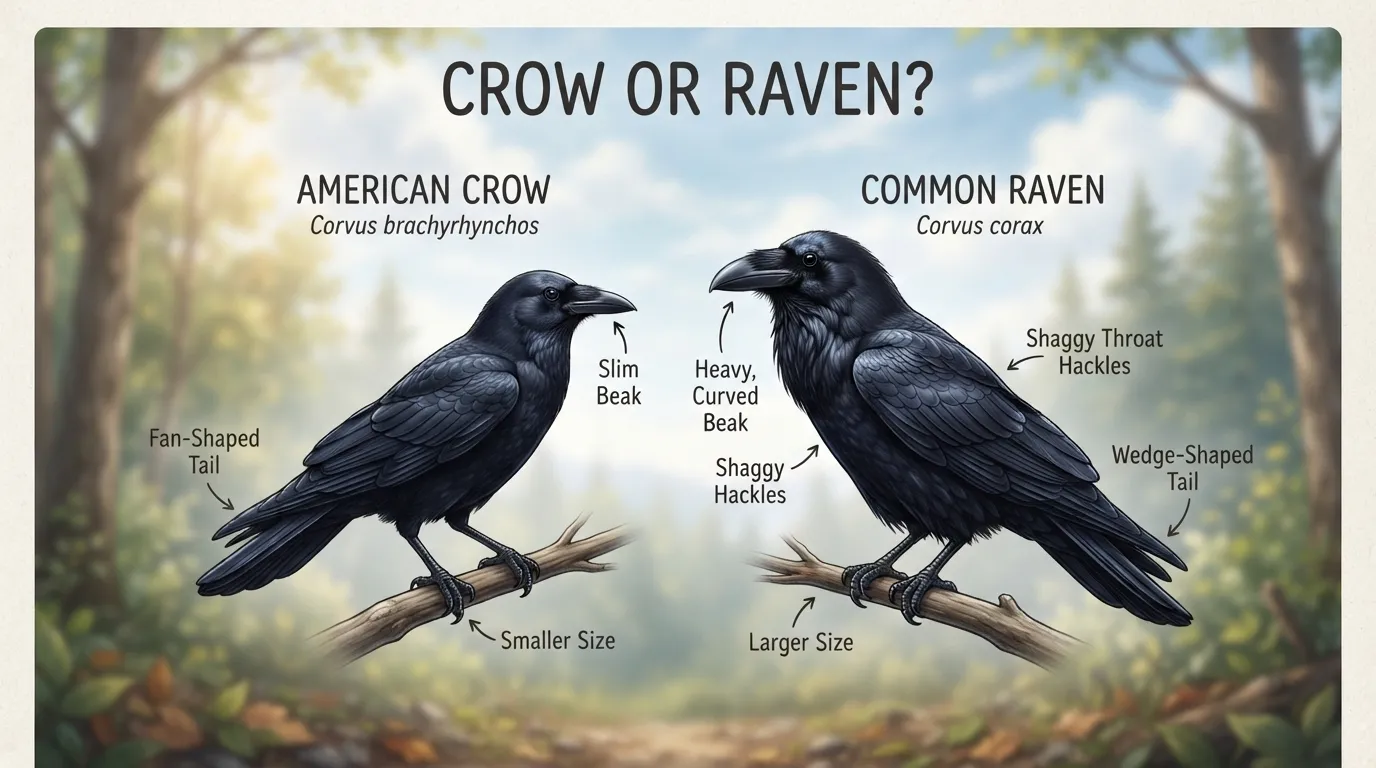
Crow or raven means you are trying to identify two similar black birds. Ravens are usually larger, with heavier beaks, shaggy throat feathers, wedge-shaped tails, and deep croaks, while crows are smaller, with slimmer beaks, fan-shaped tails, and sharper caws.
Have you ever seen a big black bird on a fence and thought, “Is that a crow or raven?”
I’ve had this exact moment on walks. At first, the bird just looks black, smart, and a little mysterious. Then it flies, calls, or turns its head, and you start to notice clues. The tail shape changes. The call sounds different. The beak may look heavier than expected.
That is why people search for crow or raven. These birds look close, especially from far away. Both are black. Both are clever. Both belong to the corvid family. But they are not the same bird.
The good news is that you do not need to be a bird expert to tell them apart. You only need a few simple field marks.
This guide will explain the difference between a crow and raven in clear English. You’ll learn size, sound, tail shape, beak shape, flight style, behavior, and real-world examples.
Crow or Raven: Quick Answer
A raven is usually bigger than a crow. It has a thicker curved beak, shaggy throat feathers, a wedge-shaped tail in flight, and a deep croaking call. A crow is smaller, has a slimmer beak, smoother throat feathers, a fan-shaped tail, and a sharper caw.
Cornell’s All About Birds guide lists the American Crow at about 20 inches long and the Common Raven at about 27 inches long. It also notes the crow’s shorter rounded tail and the raven’s tapered, diamond-like tail in flight. (Bird Academy)
Simple examples:
- If the bird says caw-caw, it is probably a crow.
- If the bird makes a deep croak, it may be a raven.
- If the tail looks like a fan, think crow.
- If the tail looks like a wedge, think raven.
The Origin / Background of Crow or Raven
Crows and ravens are related birds in the corvid group, which also includes jays and magpies. People confuse them because many species are black, intelligent, loud, and adaptable. Names can also vary by region, so size and sound are better clues than the name alone.
The most common comparison in North America is usually American Crow vs Common Raven. That is because both can look like large black birds, especially from a distance.
The word crow is often used for smaller black corvids. The word raven is often used for larger corvids. But common names are not a perfect science. The best way to identify the bird is to check visible field marks.
Bird experts often suggest using more than one clue. Do not rely only on color. Both birds are black. Do not rely only on “it looked big.” A crow nearby can look huge. A raven far away can look smaller.
Use these clues together:
- size
- call
- beak
- tail shape
- throat feathers
- flight style
- behavior
- location
Audubon notes that ravens have bigger, curvier beaks than crows, longer bristles at the base of the beak, and shaggier throat feathers. (Audubon)
Crow or Raven Explained: Key Differences or Variations
The key difference is not just size. Ravens are heavier-looking birds with deeper voices and wedge-shaped tails. Crows are smaller, more social in towns, and usually give sharper cawing calls. In flight, tail shape is often one of the easiest clues.
| Term | Meaning | When to Use | Region/Context |
|---|---|---|---|
| Crow | Smaller black corvid, often social and noisy | When the bird is smaller with a caw call | Common in towns, parks, farms |
| Raven | Larger black corvid with heavier bill and deep croak | When the bird is large with wedge tail | Common in wilder areas, cliffs, forests, deserts |
| American Crow | Common crow species in North America | Comparing with Common Raven | North America |
| Common Raven | Large raven species | Comparing with American Crow | North America and many northern regions |
| Corvid | Bird family group including crows, ravens, jays, magpies | General bird discussion | Scientific and birdwatching context |
Size
Ravens are usually larger than crows. Cornell’s guide gives the American Crow an average wingspan of about 36 inches, while the Common Raven has an average wingspan of about 46 inches. (Bird Academy)
Beak
Ravens have a bigger, heavier, more curved bill. Crows have a slimmer, straighter-looking bill. Audubon also points out that raven throat feathers often look shaggy. (Audubon)
Tail
This is one of the best clues in flight.
- Crow tail: fan-shaped or slightly rounded
- Raven tail: wedge-shaped or diamond-like
Sound
Cornell says American Crows have a strong, harsh caw, while ravens are known for deeper croaking sounds. (All About Birds)
Which Version Should You Use?
Use “crow” when the bird is smaller, gives a sharp caw, has a fan-shaped tail, and appears in groups near people. Use “raven” when the bird is much larger, has a heavy bill, croaks deeply, soars more, and shows a wedge-shaped tail.
Here is the practical advice:
- For beginner birdwatchers → start with sound. Crows caw. Ravens croak.
- For quick outdoor ID → watch the tail in flight.
- For photos → compare the beak and throat feathers.
- For urban birds → crow is often more likely, but not always.
- For wild open areas → raven may be more likely.
- For global readers → check your local species, because crow and raven types vary by country.
Examples:
- A small black bird yelling caw-caw near trash cans is likely a crow.
- A large black bird soaring high with a diamond tail may be a raven.
- A black bird with a huge bill and shaggy neck is probably a raven.
- A black bird in a noisy group on a neighborhood tree is often a crow.
If you only remember one rule, remember this:
Crows caw and have fan tails. Ravens croak and have wedge tails.
Common Mistakes With Crow or Raven
The most common mistake is using size alone. A crow can look large when it is close. A raven can look smaller when it is far away. Better identification comes from combining size, sound, beak, throat feathers, tail shape, and flight style.
| Mistake | Correction | Why It Happens |
|---|---|---|
| “It is big, so it must be a raven.” | Check tail, call, and beak too. | Distance can trick your eyes. |
| “All black birds are crows.” | Some black birds are ravens, grackles, or other species. | Color alone is not enough. |
| “Ravens and crows sound the same.” | Crows caw, ravens often croak. | Both are noisy corvids. |
| “Tail shape does not matter.” | Tail shape is one of the best flight clues. | People focus only on the body. |
| “Crows are not smart like ravens.” | Both are intelligent corvids. | Popular myths oversimplify them. |
Mistake 1: Judging only by color
Both birds are black. That does not solve the mystery.
Better clues include:
- voice
- body size
- beak shape
- tail shape
- flight style
Mistake 2: Ignoring the call
Sound can be the fastest clue. Cornell’s guide makes call difference a key part of crow and raven identification. (All About Birds)
Mistake 3: Missing the tail in flight
A flying raven often shows a pointed or wedge-like tail. A flying crow usually shows a fan-like tail. Audubon also notes that ravens tend to soar more, while crows do more steady flapping. (Audubon)
Crow or Raven in Real-World Examples
You can use crow or raven correctly by matching the word to the bird’s field marks. In writing, “crow” often suggests a smaller cawing bird near people. “Raven” often suggests a larger, wilder bird with a deeper voice and heavier shape.
Professional email example
Hi team,
I spotted a large black bird near the trail this morning. Its wedge-shaped tail and deep croak suggest it was a raven, not a crow.
Nature article example
A crow called from the streetlight while a larger raven circled high above the ridge.
Social media post example
Saw a huge black bird today. Deep croak, big beak, wedge tail. Pretty sure it was a raven.
Formal report example
Observers recorded several crows near the parking area and one possible raven near the cliff edge.
Field note example
Bird black, large, heavy bill, shaggy throat, soaring flight. Likely Common Raven.
Crow or Raven: Data, Trends & Usage
The search intent behind “crow or raven” is informational. Most readers want quick identification help. They want to know which bird they saw, how to compare the two, and what field marks matter most in real life.
People often search this topic after seeing a black bird:
- in a backyard
- on a roof
- near a road
- in a forest
- at a park
- around a farm
- during a hike
The topic matters because both birds are common in human stories, myths, and daily life. They are also very smart birds, which makes people even more curious about them.
The most useful answer is not “ravens are bigger.” That helps, but it is not enough.
A better answer is:
Look at the tail, beak, throat feathers, call, and flight style.
Cornell’s field marks for American Crow and Common Raven include size, bill, tail, wings, and flight features, which makes these clues practical for real bird identification. (Bird Academy)
Crow or Raven Comparison Table
A side-by-side table makes the difference easy. Ravens are larger, heavier, deeper-voiced birds with wedge tails and shaggy throat feathers. Crows are smaller, sharper-voiced birds with fan-shaped tails and smoother throats.
| Term/Variant | Meaning | Region/Context | Best Used When |
|---|---|---|---|
| Crow | Smaller black corvid | Towns, parks, farms, open areas | Bird is smaller, caws, and has fan tail |
| Raven | Larger black corvid | Wild areas, cliffs, forests, deserts, mountains | Bird is larger, croaks, and has wedge tail |
| American Crow | Common North American crow | North America | Identifying a smaller cawing corvid |
| Common Raven | Large raven species | North America and many northern regions | Identifying a large croaking corvid |
| Crow call | Harsh caw | Bird sound ID | You hear a sharp caw |
| Raven call | Deep croak | Bird sound ID | You hear a low croak |
Crow vs Raven Quick Field Checklist
The fastest way to decide is to check five things: size, sound, tail, beak, and flight. You do not need every clue. If three or four signs point the same way, you can make a good guess.
Think crow if the bird has:
- smaller body
- slimmer beak
- smoother throat
- fan-shaped tail
- sharp caw
- more flapping flight
- groups near people
Think raven if the bird has:
- larger body
- heavier curved beak
- shaggy throat feathers
- wedge-shaped tail
- deep croak
- more soaring flight
- pair or solo behavior
FAQs About Crow or Raven
Q: What does crow or raven mean?
A: Crow or raven is a bird identification question. It asks whether a black corvid is a crow or a raven based on size, sound, tail shape, beak, and behavior.
Q: How do you tell a crow from a raven quickly?
A: Listen and watch the tail. Crows usually make a sharp caw and have a fan-shaped tail. Ravens often make a deep croak and have a wedge-shaped tail.
Q: Crow vs raven: what is the biggest difference?
A: Size is one big difference. Ravens are usually larger than crows, with longer wings and heavier bills. Cornell lists Common Ravens as larger than American Crows in body length and wingspan.
Q: Is a raven just a big crow?
A: No. Ravens and crows are related, but they are different birds. Ravens usually have heavier bills, shaggier throat feathers, deeper calls, and wedge-shaped tails.
Q: Which is smarter, crow or raven?
A: Both crows and ravens are intelligent corvids. It is better to say both are smart in different ways than to treat one as always smarter.
Q: Do crows and ravens live in the same places?
A: They can overlap, but crows are often easier to see around towns, farms, and neighborhoods. Ravens are often associated with wilder areas, cliffs, forests, deserts, and open landscapes.
Q: Can crows and ravens both be black?
A: Yes. Many crows and ravens look black, sometimes with glossy blue or purple shine. Color alone is not enough to identify them.
Conclusion
Now you know how to choose between crow or raven.
The easiest answer is this: a crow is usually smaller, sharper-voiced, and has a fan-shaped tail. A raven is usually larger, deeper-voiced, and has a wedge-shaped tail.
Do not rely only on size. Use several clues together. Listen for the call. Watch the bird fly. Look at the tail. Check the beak. Notice whether the throat looks smooth or shaggy.
Remember this simple rule:
- Crow = caw, smaller body, fan tail
- Raven = croak, larger body, wedge tail
The next time you see a large black bird, pause for ten seconds. Listen first. Then watch the tail as it flies. You may be surprised how easy the answer becomes.
Bookmark this guide so you can identify crow or raven with more confidence on your next walk.
Read More: Roofs or Rooves: Easy Correct Spelling Guide

Muhammad Afzal is a language content writer specializing in English grammar, word usage, and vocabulary distinctions. With a strong command of linguistic nuance, Muhammad Afzal focuses on simplifying commonly confused word pairs to help readers communicate with clarity and confidence.