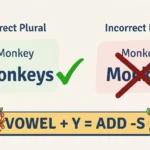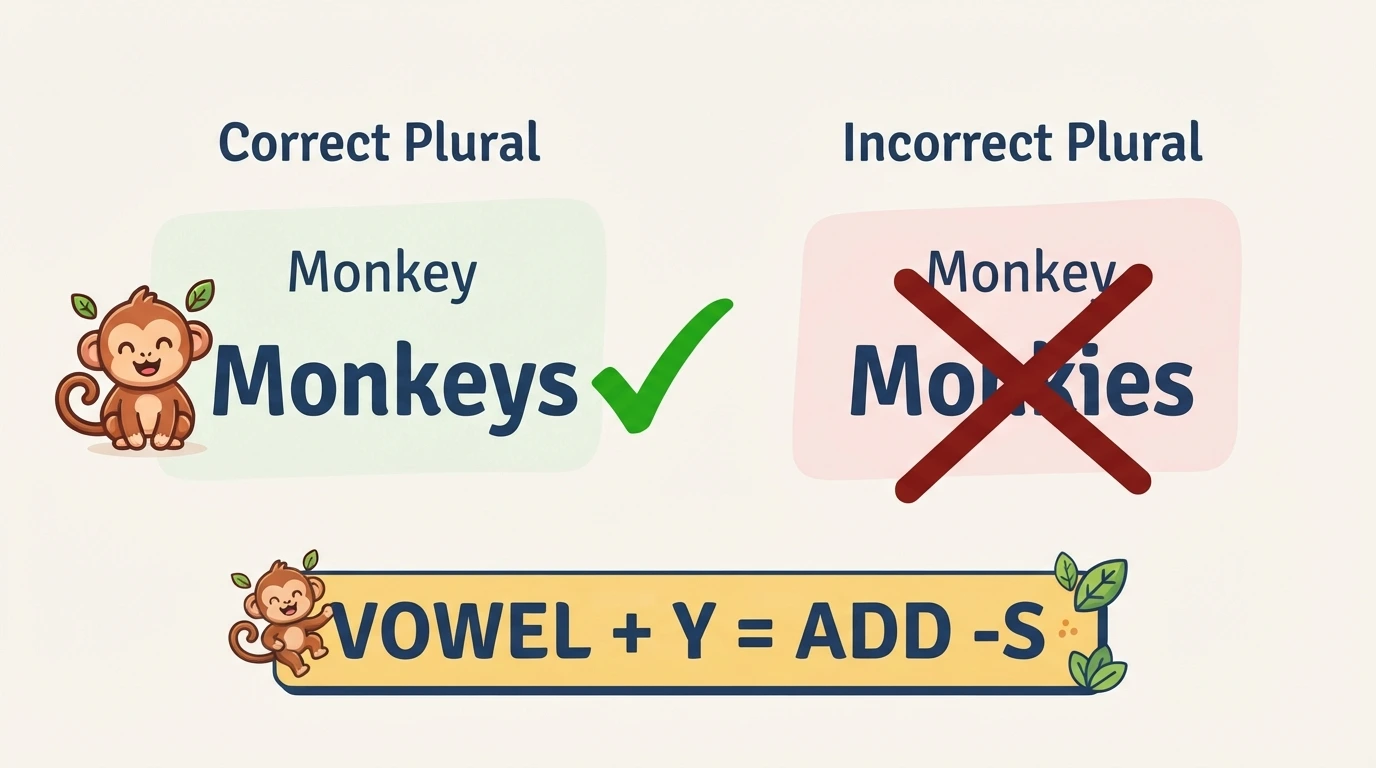
“Monkeys” is the only correct plural spelling of the noun “monkey,” while “monkies” is a common spelling mistake. In English grammar, when a word ends in a vowel followed by “y” (such as -ey), you simply add “s” to make it plural.
Have you ever stopped while typing a sentence, wondering whether to write monkeys or monkies? Because many English nouns ending in “y” change their ending to “-ies” in the plural form, swapping the ending by mistake is very easy to do. However, typing “monkies” creates a clear spelling error in school essays, professional emails, and casual writing. Fortunately, learning one simple spelling rule about words ending in “y” will help you choose the right spelling every time. In this guide, you will learn why “monkeys” is the only correct form, how the vowel-plus-y rule works, practical examples, and easy memory tips to write with complete confidence.
What Does “Monkeys” Mean?
The word monkeys is the plural noun form of monkey.
A monkey is a playful, highly intelligent mammal belonging to the primate family. Most monkeys have long tails, live in tropical forests or savannahs, and are known for their ability to climb trees quickly.
- Singular Noun: monkey (one animal)
- Plural Noun:monkeys (two or more animals)
- Verb Form (Present Participle): monkeying (as in “monkeying around”)
- Verb Form (Past Tense): monkeyed
In addition to describing real animals, the word appears in common English expressions. For example, “monkey business” refers to mischievous or dishonest behavior, and a “barrel of monkeys” describes something fun and chaotic.
Why “Monkies” Is Incorrect: The “Y” Plural Rule
To understand why monkeys is correct and monkies is wrong, you need to look at how English nouns ending in the letter y form their plurals.
Many people remember a general grammar rule that says: “Change the ‘y’ to ‘i’ and add ‘-es’.” While that rule is true for many English words, it only applies when a consonant comes right before the “y.”
When a vowel comes right before the “y,” you follow a different rule entirely.
Rule 1: Consonant + Y (Change “Y” to “-ies”)
If a word ends in a consonant (letters like b, c, d, f, g, t, p) followed by y, drop the “y” and add -ies.
Look at these examples:
- ba-b-y$\rightarrow$babies (The letter b is a consonant.)
- ci-t-y$\rightarrow$cities (The letter t is a consonant.)
- sto-r-y$\rightarrow$stories (The letter r is a consonant.)
- par-t-y$\rightarrow$parties (The letter t is a consonant.)
Rule 2: Vowel + Y (Simply Add “-s”)
If a word ends in a vowel (a, e, i, o, u) followed by y, leave the “y” alone and simply add an -s.
Look at the word mon-k-e-y:
- The letter right before “y” is e, which is a vowel.
- Because a vowel comes before “y,” you do not drop the “y” or add “-ies.”
- You simply add -s.
- mon-key + s = monkeys
Other common words following this exact same vowel-plus-y rule include:
- key$\rightarrow$keys (The letter e is a vowel.)
- boy$\rightarrow$boys (The letter o is a vowel.)
- toy$\rightarrow$toys (The letter o is a vowel.)
- day$\rightarrow$days (The letter a is a vowel.)
- donkey$\rightarrow$donkeys (The letter e is a vowel.)
- turkey$\rightarrow$turkeys (The letter e is a vowel.)
- valley$\rightarrow$valleys (The letter e is a vowel.)
Because “monkey” ends in -ey, changing it to “monkies” breaks standard English spelling guidelines.
Comparison Table
| Word / Form | Correct Spelling? | Underlying Grammar Rule | Example Sentence |
| monkeys | Yes | Vowel (e) + y$\rightarrow$ Add -s | The monkeys climbed up the fruit tree. |
| monkies | No | Incorrectly applying the -ies rule | None (avoid in all formal and informal writing) |
| donkeys | Yes | Vowel (e) + y$\rightarrow$ Add -s | Two donkeys rested near the barn door. |
| turkeys | Yes | Vowel (e) + y$\rightarrow$ Add -s | Farmers raised wild turkeys on the hill. |
| babies | Yes | Consonant (b) + y$\rightarrow$ Change to -ies | The twin babies laughed together. |
| cities | Yes | Consonant (t) + y$\rightarrow$ Change to -ies | We visited three large cities on our trip. |
Practical Examples
Here are natural sentences showing how to use monkeys correctly in daily conversation, science topics, and creative writing:
- The zoo opened a new large enclosure for the monkeys.
- Scientists observed how capuchin monkeys use small rocks to crack open nuts.
- Hearing a group of howling monkeys in the jungle excited the visitors.
- The children were acting like a bunch of wild monkeys at the birthday party.
- Many species of monkeys live high in the tropical rainforest canopy.
- The sanctuary provides care for rescued monkeys and other primates.
Notice that whether you are writing an academic report about biology or typing a text message about a visit to the zoo, monkeys is always the spelling you should use.
Common Mistakes
| Incorrect | Correct | Why |
| We saw five monkies at the zoo yesterday. | We saw five monkeys at the zoo yesterday. | “Monkey” ends in a vowel + y (ey), so add “-s” instead of “-ies.” |
| Farmers loaded two donkies onto the trailer. | Farmers loaded two donkeys onto the trailer. | Like monkeys, donkeys ends in -ey and only requires an “-s.” |
| They were monkying around in the backyard. | They were monkeying around in the backyard. | Do not drop the letter “e” when turning monkey into a verb (monkeying). |
| The monkey’s in the trees were making noise. | The monkeys in the trees were making noise. | Do not use an apostrophe to make a noun plural. |
Clear Usage Recommendation
Always write monkeys in every context.
- For American English: Write monkeys.
- For British and Commonwealth English: Write monkeys.
- For academic essays, stories, and work emails: Write monkeys.
The spelling monkies is never accepted in any standard English dictionary, region, or style manual.
A simple memory tip to remember: Vowel before Y means S stays nearby! Because “monkey” has an e before the y, just add an s.
Regional Usage
Both monkeys and monkies follow identical rules across all regions. Monkeys is standard in American English, British English, Canadian English, and Australian English. There are no regional variations or alternative national spellings for this word.
FAQ Section
Is “monkies” ever correct in British English?
No, “monkies” is not correct in British English or any other English dialect. Standard British English follows the exact same spelling rule as American English: words ending in a vowel plus “y” take an “-s” to form a plural. Therefore, monkeys is the only correct form worldwide.
Why do “baby” and “monkey” form plurals differently?
“Baby” and “monkey” form plurals differently because of the letter that comes right before the “y.” In “baby,” the letter before “y” is a consonant (b), so it changes to babies. In “monkey,” the letter before “y” is a vowel (e), so it simply adds an s to become monkeys.
What is the possessive form of “monkeys”?
The plural possessive form (meaning something belonging to more than one monkey) is monkeys’ with the apostrophe after the s (e.g., “The monkeys’ food was delivered”). The singular possessive form (belonging to one monkey) is monkey’s (e.g., “The monkey’s tail was long”).
How do you spell the verb form “monkeying”?
The verb form is spelled monkeying (as in “stop monkeying around”). You keep the entire base word “monkey” and add the suffix “-ing.”
What are other words that follow the same plural rule as “monkeys”?
Words ending in -ey or any vowel plus y follow the same rule. Examples include donkeys, turkeys, keys, toys, boys, valleys, traleys (or trolleys), and chimneys.
How do you make proper names ending in “y” plural?
When making proper family names ending in “y” plural, you usually add “-s” without changing the “y” to “-ies,” regardless of whether a consonant or vowel comes first. For example, the Kennedy family becomes “the Kennedys” (not Kennedies), and the Flannery family becomes “the Flannerys.”
Summary and Final Advice
Choosing between monkeys and monkies comes down to remembering one fundamental spelling rule. When a noun ends in a vowel followed by “y” (-ey), you simply add an s. Because “monkey” has the vowel e before the y, the only correct plural form is monkeys. The spelling “monkies” is always an error.
Remembering this rule will also help you spell related words like donkeys, turkeys, and keys correctly. Save this guide or explore our other English grammar and spelling guides to keep building your vocabulary confidence!