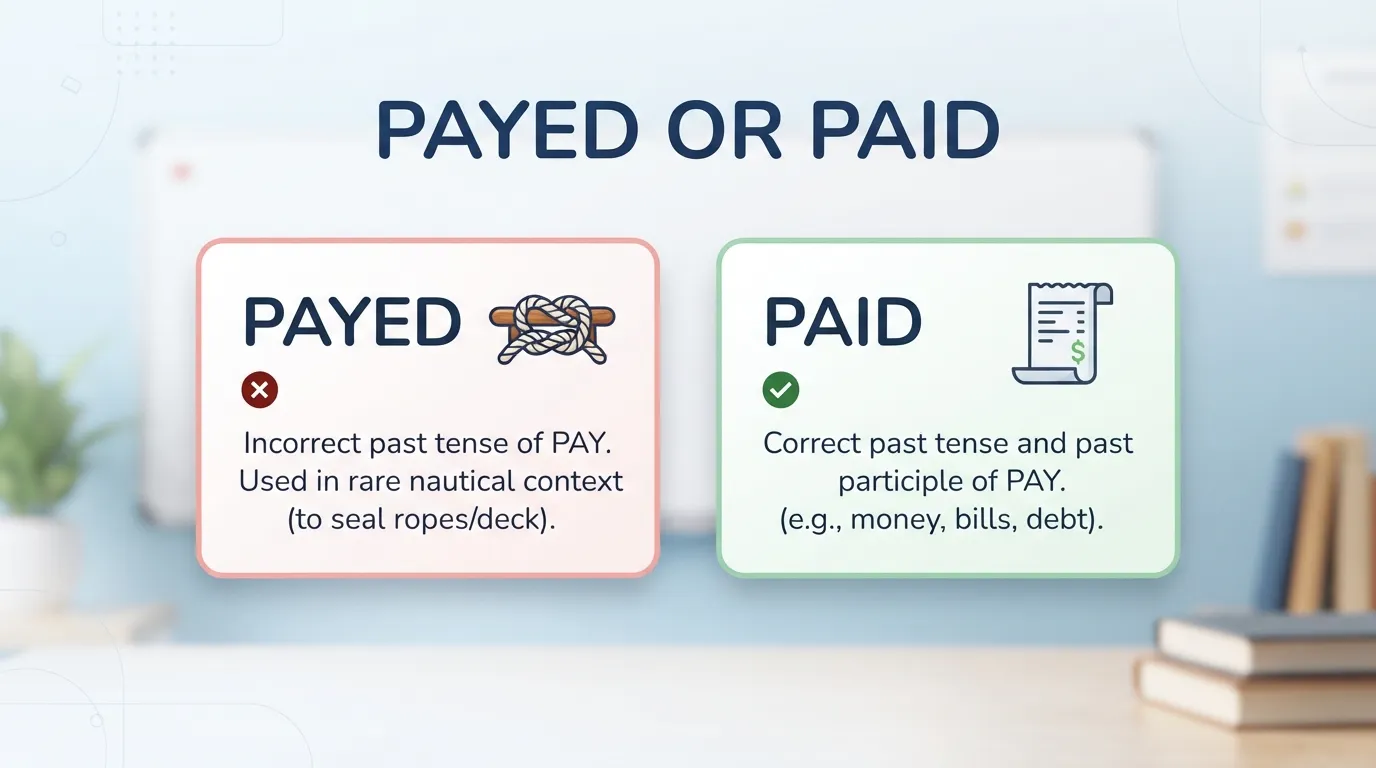
Payed or paid means you are choosing between a rare spelling and the standard past tense of “pay.” In everyday writing, “paid” is correct. “Payed” is only used in special nautical meanings, such as letting out rope or sealing a ship surface.
Have you ever written “payed” and then wondered why it looked strange?
I’ve seen this spelling mistake many times in student work, emails, invoices, and blog drafts. The sentence usually makes sense. The writer means that someone gave money, settled a bill, or received wages. But the spelling still feels off.
That happens because many English verbs ending in -ay change in different ways. We say played, stayed, and prayed. So it feels natural to write payed too. But English is not always that simple.
The correct past tense of pay, when money is involved, is paid. You paid a bill. You got paid for work. The company paid the invoice.
Still, payed is not completely fake. It has a rare technical use in boating and nautical language. This guide will show you the difference in plain English, with examples you can use right away.
Payed or Paid: Quick Answer
Use “paid” when you mean money, work, bills, salaries, fees, or attention. Use “payed” only in rare nautical contexts, such as paying out a rope or sealing part of a ship. For most students, writers, and professionals, “paid” is the correct spelling.
Cambridge defines paid as the past simple and past participle of pay. It also uses paid for work or activity that receives money.
Simple examples:
- Correct: I paid the bill yesterday.
- Correct: She was paid for her work.
- Wrong in everyday use: I payed the bill yesterday.
A quick rule helps:
- Paid = money, bills, salary, work, attention
- Payed = rare rope or ship use
If your sentence is about money, always choose paid.
The Origin / Background of Payed or Paid
The confusion exists because many English verbs form the past tense by adding “-ed.” Since “play” becomes “played” and “stay” becomes “stayed,” many people assume “pay” becomes “payed.” But the standard money-related past tense is “paid.”
English has many irregular forms. Pay is one of them.
You do not write:
- payed the rent
- payed the worker
- payed for dinner
You write:
- paid the rent
- paid the worker
- paid for dinner
Merriam-Webster lists paid as the main past tense and past participle of pay. It also notes payed for a specific sense of pay, such as letting out rope.
That is why both words exist, but they do not work the same way.
In normal writing, paid is the word readers expect. It is used in schools, offices, banks, invoices, articles, resumes, and emails.
Payed belongs to a narrow technical area. Most people will never need it unless they write about boats, ropes, cables, or ship maintenance.
Payed or Paid Explained: Key Differences or Variations
The main difference is context. “Paid” is the standard spelling for money and most common meanings of pay. “Payed” is a rare technical spelling used in nautical language. The two words may sound the same, but they are not equally useful in daily writing.
| Term | Meaning | When to Use | Region/Context |
| Paid | Past tense of pay | Money, bills, wages, fees, attention | Standard English |
| Payed | Rare past form of pay | Letting out rope or sealing ship parts | Nautical or technical writing |
| Paid for | Gave money for something | Buying goods or services | Everyday English |
| Paid off | Cleared a debt or got a result | Loans, effort, plans | General English |
| Payed out | Let rope or cable run out | Sailing, boating, ship work | Nautical English |
Merriam-Webster shows paid as the normal past tense of pay and includes payed only in a special sense.
Examples:
- I paid the school fee.
- The client paid the invoice.
- The sailor payed out the rope slowly.
The third example is rare. Most everyday sentences need paid.
Which Version Should You Use?
Use “paid” almost every time. It is correct for money, work, bills, fees, salaries, debts, services, and attention. Use “payed” only if you are writing about a rope, cable, or ship-related action. When in doubt, choose “paid.”
Here is the practical advice:
- For students: use paid in essays and assignments.
- For business owners: use paid on invoices and payment pages.
- For blog writers: use paid in articles, reviews, and guides.
- For employees: use paid when talking about salary or wages.
- For formal writing: use paid unless the topic is nautical.
- For marine or boating topics: payed may be correct in special uses.
Correct examples:
- I paid my tuition fee.
- The customer paid online.
- She gets paid every Friday.
- We paid close attention during training.
- The loan was paid in full.
Rare technical example:
- The crew payed out the cable from the deck.
If your sentence does not involve rope, cable, or ship sealing, payed is probably wrong.
Common Mistakes with Payed or Paid
Most mistakes happen because “payed” looks like a regular past tense verb. Writers copy the pattern from words like “played” and “stayed.” But “pay” does not follow that pattern when it means giving money.
| Mistake | Correction | Why It Happens |
| I payed the bill. | I paid the bill. | Writer adds “-ed” like a regular verb |
| She got payed yesterday. | She got paid yesterday. | “Payed” sounds logical |
| The invoice is payed. | The invoice is paid. | Business spelling error |
| He payed attention. | He paid attention. | Fixed phrase confusion |
| I have payed for the order. | I have paid for the order. | Past participle mistake |
Mistake 1: Writing “payed” for money
Wrong:
I payed for the tickets online.
Correct:
I paid for the tickets online.
Mistake 2: Writing “payed” for salary
Wrong:
She was payed for the project.
Correct:
She was paid for the project.
Mistake 3: Writing “payed attention”
Wrong:
The students payed attention in class.
Correct:
The students paid attention in class.
Paid attention is a fixed phrase. It never becomes payed attention in standard English.
Mistake 4: Using “paid” in the rare rope meaning
In common writing, paid is correct. But in old or technical nautical use, you may see payed out the rope.
For most writers, this rare exception is not important. But it explains why payed still appears in dictionaries.
Payed or Paid in Real-World Examples
You will see “paid” in almost every real-world writing situation. It appears in emails, news headlines, invoices, reports, job posts, and social media captions. “Payed” appears mainly in technical boating or nautical writing.
Professional email example
Hi Daniel,
I have paid the invoice and attached the receipt for your records.
Please confirm once the payment appears in your system.
This is clear, professional, and correct.
News headline example
Company Says Workers Were Paid After Payroll Delay
News writing uses paid because the topic is wages.
Social media post example
Finally paid off my laptop. Small wins still count.
This is natural and casual.
Formal document example
All application fees must be paid before the deadline.
This is the correct form for official writing.
Nautical example
The sailor payed out the rope as the boat moved away from the dock.
This is the rare case where payed may be correct.
Payed or Paid: Data, Trends & Usage
The search intent behind “payed or paid” is informational. Most readers want a fast spelling answer. They are asking which form is correct, whether “payed” is a real word, and how to avoid using the wrong spelling in school or work.
This topic matters because the mistake is easy to notice.
A reader may understand your sentence if you write payed, but the spelling can make your writing look weak. That matters in:
- resumes
- job emails
- school essays
- invoices
- payment pages
- business reports
- professional blog posts
The most searched question is usually simple:
Is it payed or paid?
The answer is also simple:
Use paid for money and almost all everyday meanings.
Cambridge lists paid as the past simple and past participle of pay, which supports the standard use in everyday English.
This matters now because people write quickly on phones, forms, and websites. A small spelling error can slip into public content. Learning this one rule helps your writing look cleaner.
Payed or Paid Comparison Table
A side-by-side table makes the choice easy. “Paid” is the correct word for normal English. “Payed” is a rare technical form. If your sentence is about money, bills, salary, or attention, use “paid” every time.
| Term/Variant | Meaning | Region/Context | Best Used When |
| Paid | Past tense and past participle of pay | Standard English | Talking about money, work, fees, bills, or attention |
| Payed | Rare past form of pay | Nautical English | Talking about letting rope or cable run out |
| Paid for | Gave money to buy something | Everyday English | Talking about purchases |
| Paid off | Cleared debt or achieved a result | General English | Talking about loans or successful effort |
| Paid attention | Listened or focused carefully | School, work, daily life | Talking about focus |
| Payed out | Let rope or cable out | Sailing or technical marine use | Writing about boats or ship handling |
FAQs About Payed or Paid
Q: What does payed or paid mean?
A: Payed or paid is a spelling choice. In everyday English, paid is correct. Payed is rare and mostly used in nautical writing.
Q: Is payed a real word?
A: Yes, payed is a real word, but it has a narrow technical use. It can mean letting out rope or cable in nautical contexts. For money, use paid.
Q: How do you use paid correctly?
A: Use paid when someone gives money, receives wages, clears a bill, or gives attention. Example: “I paid the rent yesterday.”
Q: Payed vs paid: what’s the difference?
A: Paid is the standard past tense of pay for money and common meanings. Payed is a rare nautical form used with rope, cable, or ship-related actions.
Q: Is payed acceptable in formal writing?
A: Not for normal formal writing. Use paid in essays, reports, emails, invoices, and resumes. Use payed only if the technical nautical meaning is intended.
Q: Which version is correct: payed or paid?
A: Paid is correct in almost every case. Write “I paid the bill,” not “I payed the bill.”
Q: Where does payed come from?
A: Payed comes from a special sense of the verb pay used in nautical language. It is not the standard past tense when the meaning is about money.
Conclusion
Now you know the difference between payed or paid.
The safe answer is paid. Use it when you talk about money, wages, fees, bills, purchases, debt, or attention. It is the standard spelling in school, business, and daily writing.
Payed is not the normal past tense of pay. It only has a rare technical use in nautical writing, such as paying out a rope or cable. Unless you are writing about that special meaning, avoid it.
Remember this simple rule:
- Paid = money and normal use
- Payed = rare rope or ship use
If you want your writing to look clean and professional, choose paid.
Now you know exactly how to use payed or paid. Check your next email, invoice, or article before you send it.
Read More: Thru or Through: Easy Correct Spelling Guide

Zain Ali is an English content specialist with editorial experience in creating clear, accurate, and reader-friendly grammar guides. Zain is passionate about breaking down confusing English word pairs into simple, actionable explanations.