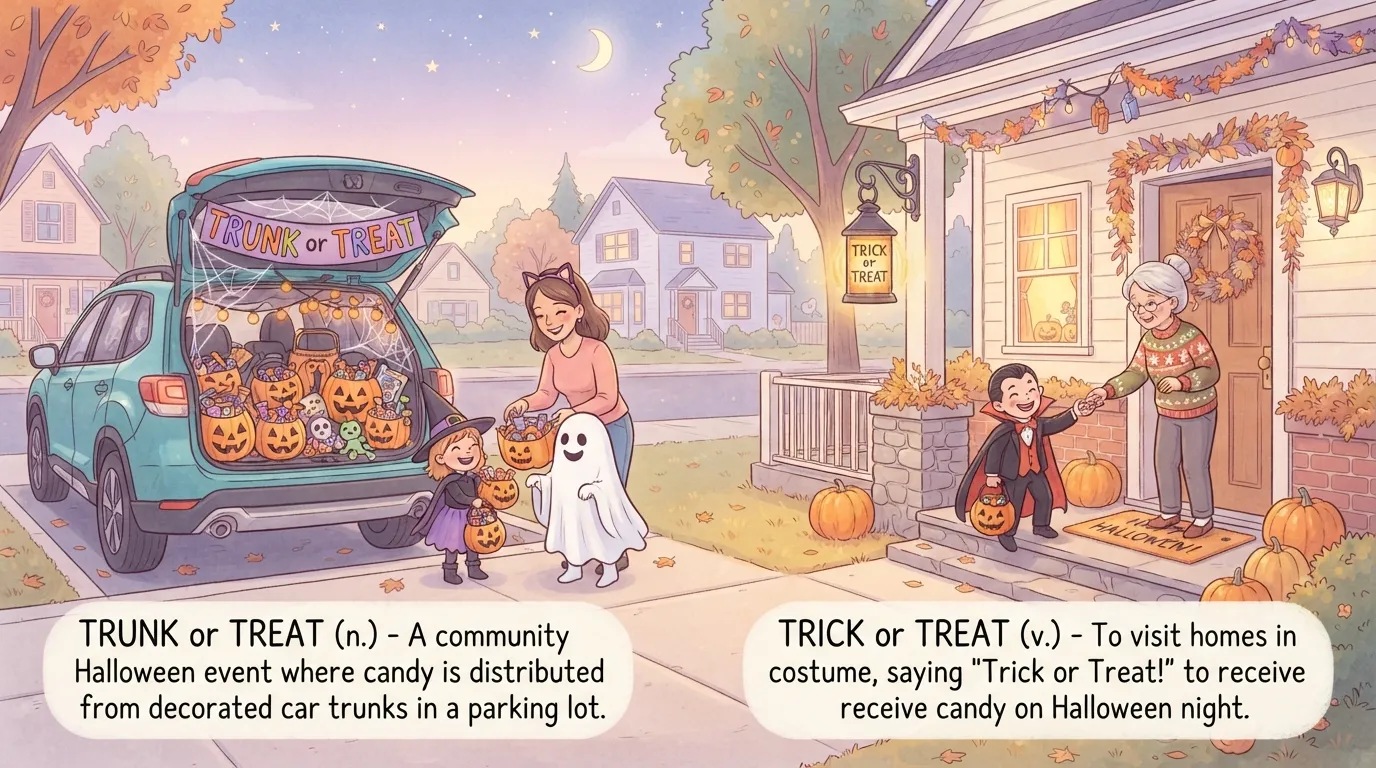
“Trunk or treat” (often hyphenated as “trunk-or-treat”) is a Halloween event where children collect candy from decorated vehicle trunks in a parking lot rather than walking door-to-door. Use hyphens when the term functions as a compound adjective before a noun (e.g., “a trunk-or-treat event”) or as a verb (e.g., “they are trunk-or-treating”).
As Halloween approaches, community flyers and school calendars often advertise a “trunk or treat” alongside traditional trick-or-treating. Because this term is relatively recent compared to centuries-old Halloween traditions, many writers wonder how it differs from trick-or-treating and how to spell, hyphenate, and pluralize it correctly. Using proper grammar and punctuation ensures your event invitations, newsletters, and announcements remain polished and professional. In this guide, you will learn the exact meaning of a trunk-or-treat, its key differences from trick-or-treating, simple hyphenation rules, and practical usage examples.
What Is a Trunk or Treat?
A trunk or treat is a community Halloween gathering, usually held in a school, church, or park parking lot. During the event, adults park their cars, decorate the open trunks or tailgates with spooky or themed decorations, and hand out candy as dressed-up children walk from car to car.
The phrase functions in several grammatical forms:
- Noun: “We are attending a trunk-or-treat on Friday.”
- Plural Noun: “Our city is hosting three trunk-or-treats this weekend.”
- Compound Adjective: “Join us for a trunk-or-treat party.”
- Verb: “The children loved trunk-or-treating with their classmates.”
Origins of the Event
The tradition began in the United States during the 1990s as a organized, safe alternative to traditional neighborhood trick-or-treating. Churches, schools, and civic groups created these events to give parents a controlled environment with limited traffic, shorter walking distances, and predictable supervision.
Trunk or Treat vs. Trick or Treat: What Is the Difference?
While both activities involve costumes, candy, and festive Halloween fun, they differ in location, structure, and tradition.
1. Trick or Treat (Traditional)
- Location: Neighborhood streets and residential sidewalks.
- Activity: Children walk door-to-door to individual homes, knock or ring doorbells, and shout “Trick or treat!”
- Timing: Typically occurs on Halloween night (October 31st).
2. Trunk or Treat (Modern Alternative)
- Location: Parking lots of schools, churches, community centers, or car parks.
- Activity: Children walk between decorated parked vehicles while parents socialise nearby.
- Timing: Often scheduled during the days or weekend preceding Halloween.
Hyphenation and Grammar Rules
Knowing when to use hyphens in “trunk or treat” keeps your writing clean and accurate.
1. When to Use Hyphens
Use hyphens when the phrase acts as a compound adjective describing a noun that immediately follows it.
- a trunk-or-treat event
- a trunk-or-treat flyer
- a trunk-or-treat station
You should also hyphenate the phrase when using it as a verb or a person noun:
- They spent two hours trunk-or-treating. (Verb)
- Every young trunk-or-treater received a bag of treats. (Noun)
2. When Hyphens Are Optional
When the phrase is used as a standalone open noun at the end of a sentence, you may write it without hyphens or with hyphens, depending on style preference:
- “Are you going to the trunk or treat tonight?” (Open noun)
- “Are you going to the trunk-or-treat tonight?” (Hyphenated noun)
Major dictionaries accept both forms, though hyphenating compound terms consistently helps maintain visual clarity.
Comparison Table
| Term / Form | Part of Speech | Correct Hyphenation | Example Usage |
| trunk or treat | Standalone Noun | Optional (trunk or treat or trunk-or-treat) | We gathered at the school trunk or treat. |
| trunk-or-treat | Compound Adjective | Required before a noun | Please bring candy to the trunk-or-treat booth. |
| trunk-or-treating | Verb / Gerund | Required | The kids are excited to go trunk-or-treating. |
| trunk-or-treater | Noun (Person) | Required | Each trunk-or-treater wore a costume. |
| trunk-or-treats | Plural Noun | Required or Open | Local churches organised several trunk-or-treats. |
Regional Usage
Understanding how this activity is recognized across different regions helps you tailor your communication to global readers.
- United States and Canada: The phrase trunk or treat is widely recognized and used across schools, churches, and municipalities.
- United Kingdom and Australia: Traditional trick-or-treating remains the primary term. Because British English uses the word “boot” instead of “trunk” for the rear storage compartment of a car, some UK communities refer to similar events as boot or treat or car boot trick-or-treating, though trunk or treat is gaining international awareness.
If writing for a global audience, using “trunk-or-treat (parking lot Halloween event)” provides immediate clarity.
Practical Examples
Here are natural sentences showing how to use trunk or treat and its related forms in everyday contexts:
- Our neighborhood council is organizing a trunk-or-treat event for local families.
- The school parking lot was filled with children trunk-or-treating from car to car.
- Who won the prize for best decorated car at the trunk or treat last night?
- Over two hundred trunk-or-treaters visited our vehicle during the festival.
- Many parents prefer attending trunk-or-treats because they offer a safe environment for younger toddlers.
Common Mistakes
| Incorrect | Correct | Why |
| We attended a trunks or treat last night. | We attended a trunk or treat last night. | The word “trunk” stays singular in the compound phrase, even if multiple car trunks are present. |
| The children love trunking or treating. | The children love trunk-or-treating. | Add the “-ing” suffix to the end of the entire compound phrase, not to individual words. |
| Please sign up for the trunk or treat event. | Please sign up for the trunk-or-treat event. | Use hyphens when the phrase modifies the noun “event.” |
| He is a energetic trunk-or-treaters. | He is an energetic trunk-or-treater. | Use singular “treater” when referring to one child. |
Clear Usage Recommendation
When deciding how to write this phrase in your document or invitation:
- For adjective use before a noun: Always hyphenate (trunk-or-treat event, trunk-or-treat flyer).
- For action verbs: Always hyphenate (trunk-or-treating, trunk-or-treated).
- For general event names: Use title case without hyphens on bold posters (Trunk or Treat) or hyphenate lowercase text in standard body prose (trunk-or-treat).
Memory Tip: If two or more words work together as one descriptive unit before a noun, connect them with hyphens!
FAQ Section
Is “trunk or treat” one word, two words, or hyphenated?
“Trunk or treat” is a multi-word compound phrase. It is written as separate words when used as a standard noun phrase (“attend a trunk or treat”) and hyphenated when used as an adjective before a noun (“a trunk-or-treat festival”) or as a verb (“trunk-or-treating”).
What is the plural form of “trunk or treat”?
The plural form is trunk-or-treats (or trunk or treats). You simply add an “s” to the end of “treat,” referring to multiple events or gatherings.
Why do churches and schools host trunk-or-treat events?
Churches, schools, and local groups host trunk-or-treat events to provide a safe, centralized, and enclosed area for children to celebrate Halloween. It reduces pedestrian traffic concerns and provides an accessible option for younger children or tight-knit communities.
Is “trunk-or-treating” a real dictionary word?
Yes. Major dictionaries, including Merriam-Webster, recognize “trunk or treat” as both a noun and an intransitive verb, along with derivative forms like “trunk-or-treater” and “trunk-or-treating.”
How do you capitalize “Trunk or Treat” on flyers?
Capitalize every major word (Trunk or Treat or Trunk-or-Treat) when using it as a title or event heading on promotional materials. In standard sentences, use lower case unless it begins a sentence.
What is the UK equivalent of trunk or treat?
In the UK, where the back of a vehicle is called a “car boot” rather than a “trunk,” these gatherings are sometimes called boot or treat or car boot Halloween events, though the American phrasing is increasingly understood.
Summary and Final Advice
Understanding trunk or treat comes down to knowing its structure and function. It refers to a parking-lot-based Halloween gathering where children collect candy from decorated car trunks. Use hyphens when combining the words into an adjective before a noun (trunk-or-treat gathering) or a verb (trunk-or-treating).
Keep your punctuation consistent across your event invitations, social posts, and school notices. Explore our other confusing-word and punctuation guides to keep your everyday writing clear and accurate!

Zain Ali is an English content specialist with editorial experience in creating clear, accurate, and reader-friendly grammar guides. Zain is passionate about breaking down confusing English word pairs into simple, actionable explanations.