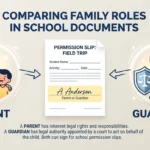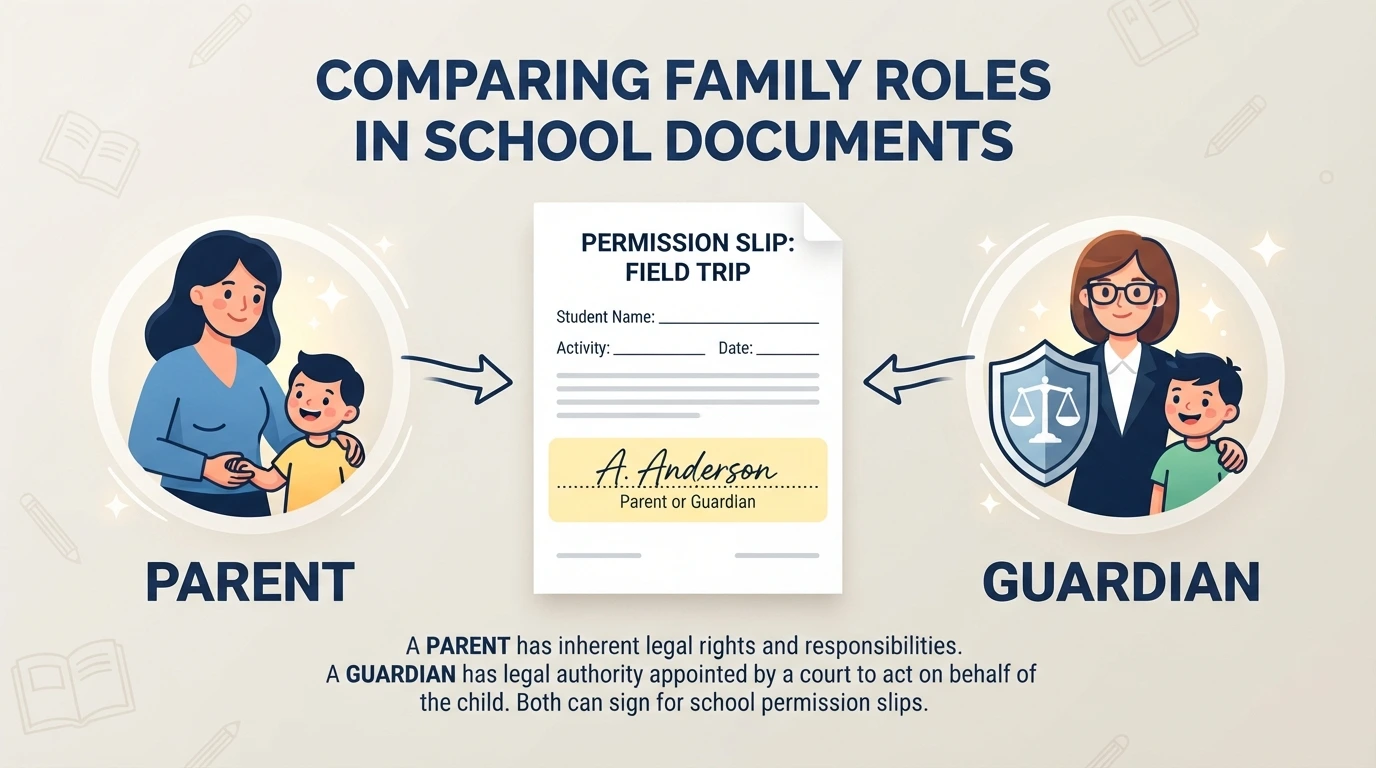
A parent is a biological or adoptive mother or father, whereas a guardian is an adult legally appointed to care for a minor when the parents cannot do so. Schools, hospitals, and organizations use the phrase “parent or guardian” on official documents to ensure that whichever adult holds legal authority over a child can grant consent.
Have you ever filled out a school permission slip, medical form, or registration document and noticed the phrase “signature of parent or guardian”? While these two terms refer to adults responsible for a child, they carry distinct legal and social meanings. Confusing them can lead to mistakes on official paperwork or misunderstandings about who has legal authority over a minor. In this guide, you will learn the exact definitions of both terms, why forms pair them together, key legal differences, practical sentence examples, and answers to frequently asked questions.
What Is a Parent?
A parent is a mother or father who is connected to a child through birth or legal adoption.
In both everyday speech and legal settings, a parent has natural or legally recognized duties to care for, support, and raise their child.
- Biological Parent: A mother or father who provided the genetic material to create the child.
- Adoptive Parent: An adult who legally adopts a child, gaining full, permanent legal rights and responsibilities identical to those of a biological parent.
- Part of Speech: Countable noun (plural: parents).
Under standard laws worldwide, parents automatically hold legal custody and decision-making rights for their minor children unless a court modifies or removes those rights.
What Is a Guardian?
A guardian (often called a legal guardian) is an adult who has been given legal authority by a court or legal document to care for a minor or dependent person.
Guardians are appointed when biological or adoptive parents are unable to care for a child. This can happen due to illness, death, deployment, travel, or legal suspension of parental rights.
- Who Can Be a Guardian? Grandparents, aunts, uncles, older adult siblings, foster parents, or trusted family friends.
- Legal Origin: Legal guardianship is usually granted by a judge in a court of law or designated in a legal will.
- Part of Speech: Countable noun (plural: guardians).
Guardian vs. Caregiver or Babysitter
It is important to note that a legal guardian is different from a temporary caregiver, such as a babysitter, teacher, or camp chaperone. A temporary caregiver watches a child for a short period, but they do not hold legal authority to make long-term decisions regarding the child’s education, healthcare, or upbringing. A legal guardian holds that formal court-granted authority.
Why Official Forms Say “Parent or Guardian”
Organizations write “parent or guardian” on permission slips, medical forms, and registration documents to ensure inclusivity and legal validity.
Not every child lives with their biological or adoptive parents. Millions of children around the world are raised by grandparents, relative caregivers, foster parents, or legal guardians.
By writing “signature of parent or guardian,” an organization ensures that:
- The person signing has the lawful right to grant permission for the child.
- No child is excluded from an activity simply because their primary legal caregiver is not a parent.
- The document remains legally binding in courts, hospitals, and administrative offices.
Key Differences Between a Parent and a Guardian
While parents and guardians often perform the exact same daily caregiving duties—such as cooking meals, driving children to school, and providing emotional support—their legal status differs in a few important ways.
1. Source of Legal Authority
- Parents gain legal authority naturally through birth or through formal legal adoption proceedings.
- Guardians gain legal authority through a court order, legal decree, or designated appointment in a parent’s will.
2. Permanence
- Parental status is generally permanent. Even if a parent loses custody temporarily, they remain the legal parent unless rights are formally terminated by a court.
- Guardianship can be temporary or long-term. A court can end a guardianship if the biological parents become able to resume care or if the court decides a change is in the child’s best interest.
3. Financial and Inheritance Rights
In many jurisdictions, adoptive and biological parents have automatic legal obligations to support their children financially. Inheritance laws also treat parents and children differently than legal guardians and wards, unless specified in a legal will.
Comparison Table
| Feature | Parent | Guardian (Legal Guardian) |
| Primary Definition | Biological or adoptive mother/father | Adult legally appointed to care for a minor |
| How Authority Is Granted | Birth or legal adoption process | Court order, legal decree, or will |
| Duration of Status | Permanent (unless terminated by court) | Can be temporary, fixed-term, or long-term |
| Everyday Role | Raises, supports, and protects child | Raises, supports, and protects child |
| Common Examples | Birth mother, birth father, adoptive parent | Grandparent, aunt, uncle, foster parent |
| Form Usage | “Parent” on family forms | “Guardian” on court/legal documents |
Practical Examples
Here are natural sentences showing how parent, guardian, and the compound phrase parent or guardian are used in real writing and daily conversation:
- Each student must return the permission slip signed by a parent or guardian before Friday.
- After her parents passed away, her aunt became her legal guardian.
- The clinic requires consent from a parent or guardian before administering vaccines to minors.
- Biological parents automatically have legal rights unless a court rules otherwise.
- The summer camp sent welcome letters to every parent or guardian on the mailing list.
- As her court-appointed guardian, he signed the school registration forms on her behalf.
Common Mistakes
| Incorrect | Correct | Why |
| Please bring a note signed by your parents or guardian. | Please bring a note signed by your parent or guardian (or parents or guardians). | Keep singular and plural nouns balanced across the conjunction “or.” |
| My babysitter is my legal guardian for the weekend. | My babysitter is my caregiver for the weekend. | Babysitters are temporary caregivers, not court-appointed legal guardians. |
| Stepparents are automatically legal guardians. | Stepparents must undergo formal legal procedures to gain guardianship or adopt. | Marriage to a parent does not automatically grant legal guardianship rights over a stepchild. |
| A child can only have a parent, not a guardian. | A child may live with a parent, a guardian, or both depending on legal circumstances. | Legal guardianship is a standard and recognized family structure worldwide. |
Clear Usage Recommendation
When deciding which phrase to use in your document, email, or formal notice:
- For general forms, policies, and permissions involving minors: Always use “parent or guardian” (or the plural “parents or guardians”). This phrase covers all lawful home situations and protects your organization legally.
- When speaking about a specific biological or adoptive mother/father: Use parent.
- When speaking about an adult legally appointed by a court to care for a child: Use guardian (or legal guardian).
Memory Tip: Think of PARENT as family by birth or adoption, and GUARDIAN as someone appointed to GUARD and protect a child by law!
FAQ Section
Can a parent also be a legal guardian?
In daily speech, parents act as guardians, but legally, the term “guardian” specifically refers to an adult appointed when parents cannot fulfill their role. A parent already possesses natural legal custody, so they do not need to be appointed as a “guardian” for their own biological or adopted child unless special legal conditions apply.
Is a stepparent automatically a legal guardian?
No. Marrying a child’s biological parent does not automatically grant a stepparent legal guardianship or parental rights. To gain legal authority to sign medical or educational documents, a stepparent must either complete a legal adoption or be granted formal guardianship by a court.
Why do forms use singular “Parent or Guardian” instead of plural?
Forms use “parent or guardian” in the singular so that a signature from just one legal adult is sufficient to grant permission. Using the plural “parents” might imply that both parents must sign, which can cause confusion for single-parent households.
What happens when a child turns 18?
When a child reaches the age of majority (usually 18 years old in many countries), they become a legal adult. At that point, both parental custody and legal guardianship over a minor automatically end, unless adult guardianship is granted due to severe medical or physical disabilities.
What is the difference between legal custody and legal guardianship?
Legal custody usually refers to the rights and responsibilities of biological or adoptive parents after a divorce or separation. Legal guardianship refers to granting caregiving authority to a non-parent adult when neither parent is able to care for the child.
Should “Parent or Guardian” be capitalized on forms?
Capitalize Parent or Guardian when it appears as a form section heading, label, or signature line title (for example: “Signature of Parent or Guardian”). In standard sentence prose, write it in lowercase letters (for example: “You must ask a parent or guardian for help”).
Summary and Final Advice
Understanding parent or guardian comes down to recognizing legal authority. A parent is a mother or father connected by birth or adoption. A guardian is an adult given legal power by a court to care for a child. Organizations combine both terms into “parent or guardian” so that any legal adult raising a child can sign official paperwork.
Using this inclusive phrase ensures your forms and notices remain professional, legal, and respectful of all family structures. Save this guide or explore our other vocabulary and usage articles to continue improving your writing skills!

Luqman Aleem holds a strong academic foundation in English language and linguistics. Luqman Aleem researches and writes in-depth comparisons of frequently misused words, drawing on formal grammar rules and real-world usage patterns to guide readers toward correct English.