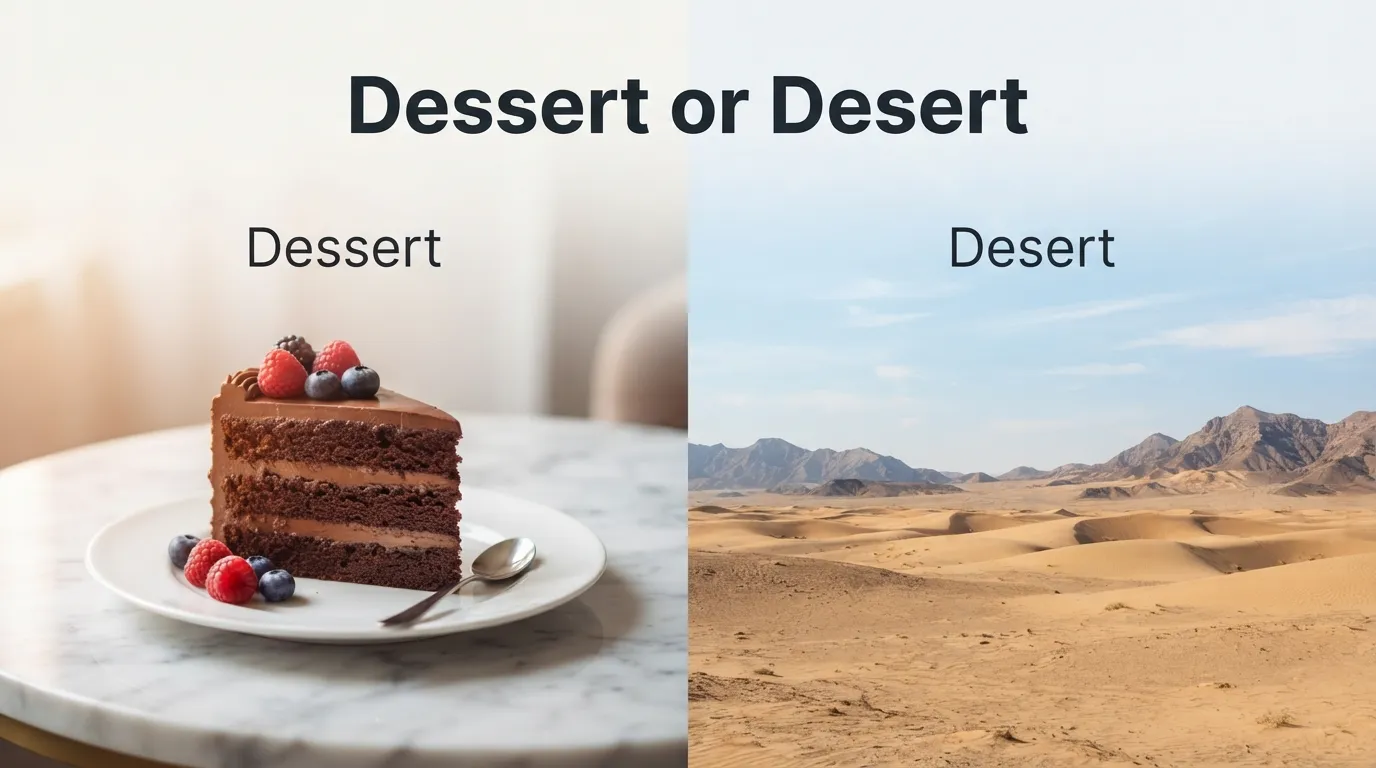
“Dessert” is a sweet course eaten after a meal, while “desert” is a dry area of land with little rain. “Desert” can also be a verb meaning to leave someone or something behind.
Dessert and desert look almost the same, so they are easy to confuse. The main spelling difference is one extra s, but the meanings and pronunciations are different.
You may eat chocolate cake for dessert, travel across a hot desert, or say that someone deserted their team. Learning the meaning of each word will help you choose the correct spelling. This guide explains the difference, pronunciation, grammar, examples, and simple memory tricks.
What Is the Difference Between Dessert and Desert?
Dessert usually means sweet food served after a meal. Desert usually means a dry place with very little rain.
The word desert can also be a verb. As a verb, it means to leave a person, place, group, or responsibility.
| Word | Meaning | Part of Speech | Example |
|---|---|---|---|
| Dessert | Sweet food eaten after a meal | Noun | We had cake for dessert. |
| Desert | A dry area with little rainfall | Noun | Camels can survive in the desert. |
| Desert | To leave or abandon | Verb | The soldiers did not desert their post. |
The extra s in dessert changes both its meaning and pronunciation.
What Does Dessert Mean?
Dessert is a noun that refers to sweet food normally eaten at the end of a meal.
Common desserts include:
- Cake
- Ice cream
- Pie
- Pudding
- Fruit
- Cookies
- Chocolate
- Custard
Examples:
- We ordered ice cream for dessert.
- Her favourite dessert is chocolate cake.
- Would you like to see the dessert menu?
- The restaurant serves several traditional desserts.
- I was too full to eat dessert.
Dessert is not always unhealthy or full of sugar. Fresh fruit, yoghurt, or another light dish may also be served as dessert.
Is Dessert Countable?
Dessert can be countable or uncountable.
Use it as an uncountable noun when talking about the course in general:
- We had dessert after dinner.
- I usually skip dessert.
Use it as a countable noun when talking about different dishes or types:
- The café offers five desserts.
- These fruit desserts are easy to prepare.
What Does Desert Mean as a Noun?
As a noun, a desert is a region that receives very little rain. Deserts often have limited plant life and large areas of sand, rock, gravel, or dry soil.
Not all deserts are hot. Some deserts are cold because the word describes low rainfall, not temperature.
Examples:
- The travellers crossed the desert.
- Very few plants grow in this desert.
- The Sahara is a large desert.
- Temperatures can fall quickly at night in the desert.
- Some animals are specially adapted to desert life.
The plural form is deserts:
- Africa contains several deserts.
- Hot and cold deserts have different climates.
What Does Desert Mean as a Verb?
As a verb, desert means to leave or abandon someone, something, or a place.
Examples:
- He promised that he would never desert his family.
- The crew had to desert the damaged ship.
- Several workers deserted the project.
- She felt that her friends had deserted her.
- Soldiers may be punished for deserting their post.
The verb can describe leaving a responsibility, group, person, or location, especially when support or duty is expected.
Its common forms are:
- Base form: desert
- Third-person form: deserts
- Past tense: deserted
- Past participle: deserted
- Present participle: deserting
How Are Dessert and Desert Pronounced?
Dessert and desert do not always sound the same.
Dessert Pronunciation
Dessert is pronounced:
dih-ZURT
The stress falls on the second syllable.
- We ate dessert after dinner.
Desert as a Noun
When desert means a dry area, it is usually pronounced:
DEZ-urt
The stress falls on the first syllable.
- They travelled through the desert.
Desert as a Verb
When desert means to abandon, it is pronounced:
dih-ZURT
The stress falls on the second syllable.
- Do not desert your team.
This means dessert and the verb desert have similar pronunciations, but the noun desert sounds different.
| Word and Use | Pronunciation | Stress |
|---|---|---|
| Dessert: sweet food | dih-ZURT | Second syllable |
| Desert: dry land | DEZ-urt | First syllable |
| Desert: to abandon | dih-ZURT | Second syllable |
Dessert or Desert in Practical Sentences
Examples With Dessert
- Mum made apple pie for dessert.
- The children shared a chocolate dessert.
- We should save room for dessert.
- This restaurant is famous for its desserts.
- Fruit can be a simple and refreshing dessert.
- The waiter brought the dessert menu.
Examples With Desert as a Place
- The road passes through a rocky desert.
- Water is difficult to find in the desert.
- The plant can survive harsh desert conditions.
- They spent three days exploring the desert.
- A cold desert may receive snow.
- Many desert animals rest during the hottest part of the day.
Examples With Desert as a Verb
- Good leaders do not desert their teams.
- The villagers deserted their homes during the storm.
- He was accused of deserting his duties.
- The frightened passengers did not desert the bus.
- She refused to desert her friend during a difficult time.
A Simple Way to Remember Dessert and Desert
A common memory trick is:
Dessert has two s letters because you may want two servings.
- Dessert = sweet food
- Desert = dry land
You can also connect the two letters in dessert with sweet stuff:
- S + S = sweet stuff
- Dessert contains two s letters.
For desert, remember that a dry desert has less water and one less s.
These tricks are not grammar rules, but they make the spellings easier to remember.
Common Mistakes
| Incorrect | Correct | Why |
|---|---|---|
| We had cake for desert. | We had cake for dessert. | Sweet food has two s letters. |
| Camels live in the dessert. | Camels live in the desert. | Dry land has one s in the middle. |
| The captain did not dessert the ship. | The captain did not desert the ship. | The verb meaning “abandon” has one s. |
| I ordered three deserts after dinner. | I ordered three desserts after dinner. | Sweet dishes use the plural “desserts.” |
| The Sahara dessert is very large. | The Sahara Desert is very large. | Use “desert,” and capitalize it as part of the proper name. |
Mistake 1: Using Desert for Sweet Food
Incorrect:
- Chocolate cake is my favourite desert.
Correct:
- Chocolate cake is my favourite dessert.
Remember that the food spelling contains two s letters.
Mistake 2: Using Dessert for a Dry Region
Incorrect:
- The travellers ran out of water in the dessert.
Correct:
- The travellers ran out of water in the desert.
The geographical word contains only one s in the middle.
Mistake 3: Adding an Extra S to the Verb
Incorrect:
- He would never dessert his family.
Correct:
- He would never desert his family.
The verb meaning “leave” or “abandon” uses the same spelling as the dry-land noun.
Mistake 4: Confusing Deserts and Desserts
Both plural forms are correct, but they have different meanings:
- Deserts = more than one dry region
- Desserts = more than one sweet dish
Examples:
- Scientists study the world’s deserts.
- The bakery sells many delicious desserts.
What Does “Just Deserts” Mean?
The expression just deserts means the reward or punishment that someone deserves.
Example:
- The dishonest manager finally received his just deserts.
Many people incorrectly write “just desserts” because they connect the phrase with sweet food. However, the correct expression uses deserts with one s in the middle.
In this expression, “deserts” comes from an older sense connected with things that are deserved. It is pronounced like desserts.
This phrase is mainly used when someone receives a result that matches their actions, often a punishment.
Is It Dessert Menu or Desert Menu?
Use dessert menu for a list of sweet dishes offered after a meal.
- Could we see the dessert menu?
A desert menu would mean a menu connected with a dry geographical region. It might be used for a desert trip or themed event, but it does not normally refer to cakes, pies, or ice cream.
Which Word Should You Use?
Use dessert when referring to sweet food served during or after a meal:
- We had pudding for dessert.
Use desert when referring to dry land:
- The animal lives in the desert.
Use desert as a verb when you mean leave or abandon:
- They refused to desert their responsibilities.
Check the meaning before choosing the spelling. The pronunciation may help, but context is the most reliable guide.
Frequently Asked Questions
Is dessert spelled with one s or two?
Dessert is spelled with two s letters. It refers to sweet food such as cake, pie, pudding, or ice cream.
Is desert spelled with one s?
The middle of desert contains one s. It may refer to a dry region or act as a verb meaning to abandon.
Why does dessert have two s letters?
The spelling developed from the word’s language history, but learners often remember it with the phrase “sweet stuff.” Both words begin with s, just as dessert has two s letters.
Are desert and dessert homophones?
Not in every use. Dessert and the verb desert are pronounced similarly, but desert as a dry region has stress on the first syllable.
What is the plural of dessert?
The plural is desserts.
- The café serves several homemade desserts.
What is the plural of desert?
The plural is deserts.
- Some deserts are hot, while others are cold.
Is “just desserts” correct?
The traditional expression is just deserts, not “just desserts.” It means receiving the result or treatment that one deserves.
Conclusion
Dessert and desert are both correct English words, but they have different meanings. Dessert with two s letters is sweet food, while desert with one s is a dry region or a verb meaning to abandon.
Remember the simple clue: you may want two servings of dessert, so it has two s letters. Always check the sentence’s meaning before choosing the spelling. Save this guide and practise by writing one sentence about a dessert, one about a desert, and one using desert as a verb.

Hassan Afzal has a background in English language instruction and writes to help non-native speakers and students master tricky grammar rules and word choices. Hassan Afzal’s writing style blends practical examples with clear explanations for everyday English learners.