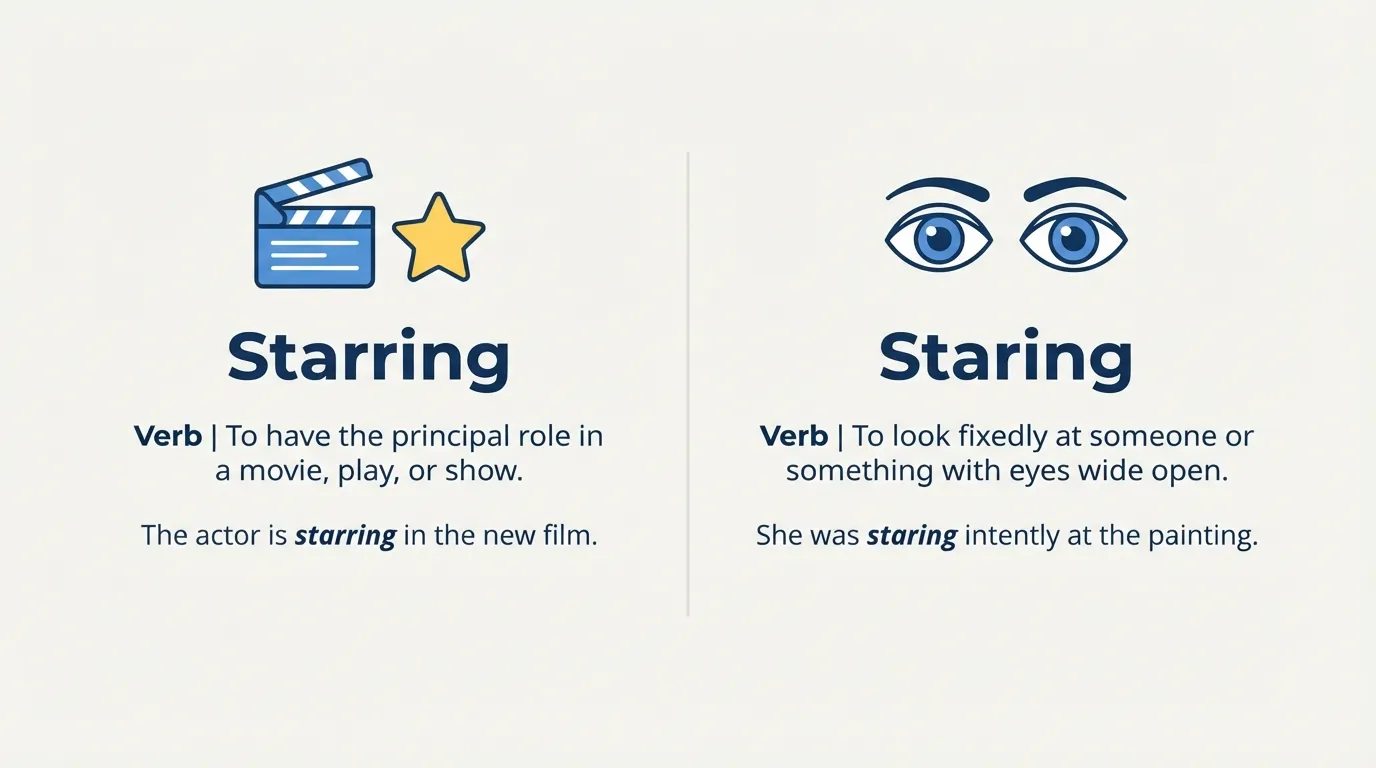
“Starring” (with two r’s) means featuring as a main actor or performer in a movie, show, or play, while “staring” (with one r) means looking fixedly at someone or something with wide eyes. The spelling depends on the base word: “star” doubles the ‘r’ to become “starring,” whereas “stare” drops the silent ‘e’ to become “staring.”
Have you ever paused while writing a sentence, unsure whether to type starring or staring? Because these two words look so similar and differ by only a single letter, swapping them by accident is very common. However, confusing them can completely change the meaning of your sentence—transforming a movie lead into someone looking fixedly across a room! In this guide, you will learn the exact meanings of both words, the simple spelling rules behind them, and practical ways to use each word correctly every time.
What Does “Starring” Mean?
The word starring is the present participle form of the verb star. It can also function as an adjective.
When you use starring, you are describing someone who plays a leading role in a movie, play, television show, or musical performance. It can also refer to highlighting a main attraction or feature.
Here is how the base word connects to the suffix:
- base word: star
- spelling rule: double the final ‘r’ before adding “-ing”
- result: starring
Word Origins and Context
The verb “star” comes from the noun “star,” referring to bright celestial bodies in the night sky. In the 19th century, theater producers began calling famous actors “stars” because they shone brightly above others on stage. Eventually, “starring” became standard phrasing on theater posters and movie credits to highlight the main actors.
What Does “Staring” Mean?
The word staring is the present participle form of the verb stare. It can also function as an adjective.
When you use staring, you are describing the action of looking directly and continuously at someone or something, often with wide eyes due to surprise, anger, deep thought, or curiosity.
Here is how the base word connects to the suffix:
- base word: stare
- spelling rule: drop the silent ‘e’ before adding “-ing”
- result: staring
Word Origins and Context
The verb “stare” comes from Old English starian, which meant “to look fixedly or gaze.” Over centuries, the basic meaning has remained unchanged: gazing intently without looking away easily.
The Spelling Rules Behind the Difference
Understanding why starring has two r’s while staring has only one makes remembering the difference much easier.
1. The CVC Rule (Doubling the Consonant for “Starring”)
The word star is a one-syllable word that ends in a Consonant-Vowel-Consonant (CVC) pattern:
- t (consonant)
- a (vowel)
- r (consonant)
When adding “-ing” to a one-syllable word that ends in a CVC pattern, English spelling rules require you to double the final consonant. This keeps the vowel sound short or open as intended.
Examples following this rule:
- star + ing = starring
- run + ing = running
- sit + ing = sitting
2. The Drop-the-E Rule (Removing Silent ‘E’ for “Staring”)
The word stare ends in a silent letter e.
When adding “-ing” to a word ending in a silent ‘e’, you drop the ‘e’ before adding the suffix. You do not double the consonant.
Examples following this rule:
- stare + ing = staring
- care + ing = caring
- share + ing = sharing
Comparison Table
| Word | Base Word | Meaning | Spelling Rule | Example Sentence |
| starring | star | Playing a lead role; featuring | Double the final ‘r’ (CVC rule) | She is starring in the new movie. |
| staring | stare | Looking fixedly or gazing intently | Drop the silent ‘e’ before “-ing” | He was staring out the window. |
Practical Examples
Here are standard examples showing how to use starring and staring correctly in everyday sentences:
Examples of “Starring”
- The new film starring Tom Hanks opens in theaters this weekend.
- She landed a starring role in the school musical.
- The chef posted a menu starring fresh local vegetables.
- Who is starring as the detective in the new drama series?
Examples of “Staring”
- Stop staring at the computer screen without taking breaks.
- The cat sat on the porch, staring at a small bird.
- He stood in front of the art piece, staring in admiration.
- Why are you staring at me like that?
Common Mistakes
| Incorrect | Correct | Why |
| He was starring at the blank page for hours. | He was staring at the blank page for hours. | Gazing at a page requires “staring” (from stare). |
| The movie is staring two famous actors. | The movie is starring two famous actors. | Featuring lead performers requires “starring” (from star). |
| She went stairing up the escalator. | She went walking up the stairs. | “Stairing” is not a valid English verb; stairs are physical steps. |
| They were stareing at the night sky. | They were staring at the night sky. | You must drop the silent ‘e’ before adding “-ing”. |
Clear Usage Recommendation
When deciding which word to use in your writing, ask yourself what base action you are describing:
- If the topic is acting, theater, or main features: The base word is star. Double the ‘r’ and write starring.
- If the topic is looking, gazing, or eye contact: The base word is stare. Drop the ‘e’ and write staring.
Memory Tip: Starring has two r’s because a movie star deserves double the attention! Staring has one ‘r’ because you look with your eyes through one line of sight.
Regional Usage
Both starring and staring are spelled identical in American English, British English, Canadian English, and Australian English. There are no regional spelling variations for either word.
FAQ Section
Why does “starring” have two r’s while “staring” only has one?
“Starring” comes from “star,” a one-syllable word ending in consonant-vowel-consonant, which doubles the final consonant when adding “-ing.” “Staring” comes from “stare,” which ends in a silent ‘e’ that gets dropped before adding “-ing.”
Is “stairing” a real word in English?
No, “stairing” is not a recognized word in standard English. Physical steps you climb are called “stairs” (a noun), but climbing them is described using verbs like “walking,” “climbing,” or “heading up the stairs.”
What are the past tense forms of “star” and “stare”?
The past tense of “star” is starred (doubling the ‘r’ according to the CVC rule). The past tense of “stare” is stared (adding ‘d’ to the word ending in ‘e’).
How do you pronounce “starring” versus “staring”?
“Starring” is pronounced with an open “ah” vowel sound (/ˈstɑːrɪŋ/), rhyming with “jarring.” “Staring” is pronounced with an “air” vowel sound (/ˈsteərɪŋ/), rhyming with “caring” or “bearing.”
Can “starring” be used for things other than movies?
Yes, “starring” can be used figuratively to describe key ingredients or primary highlights in events, menus, or promotional material (e.g., “a dinner menu starring seasonal seafood”).
Do style guides prefer one form over the other?
All major editorial style guides (including Chicago Manual of Style, APA, and AP Stylebook) follow the exact same rules: use “starring” for lead roles and “staring” for looking fixedly.
Summary and Final Advice
Choosing between starring and staring comes down to the root word you need. Starring comes from star and describes a lead actor or key feature, using two r’s. Staring comes from stare and describes looking intently at something, using one ‘r’.
Remembering the underlying spelling rules—doubling the consonant for short CVC words and dropping the silent ‘e’—will ensure your writing remains clear, accurate, and professional. Keep practicing your spelling with related confusing word guides to build your language confidence!

Luqman Aleem holds a strong academic foundation in English language and linguistics. Luqman Aleem researches and writes in-depth comparisons of frequently misused words, drawing on formal grammar rules and real-world usage patterns to guide readers toward correct English.