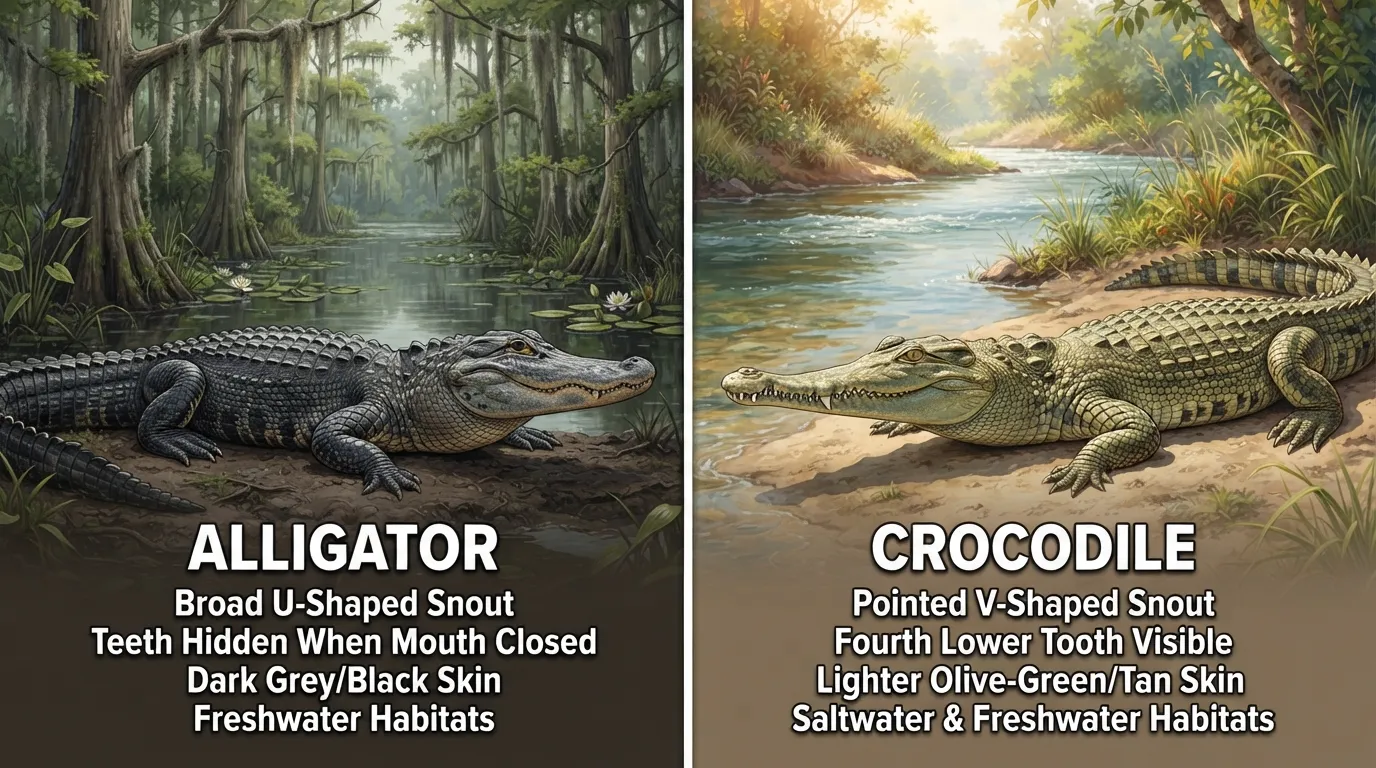
The main difference between an alligator and a crocodile is their snout shape and natural habitat. Alligators have wide, rounded U-shaped snouts and live in freshwater, while crocodiles have pointed V-shaped snouts, visible teeth when their mouths are closed, and prefer saltwater.
Have you ever looked at a picture of a large, scaly reptile floating in the water and wondered whether to call it an alligator or a crocodile? These two famous animals look very similar at first glance. People frequently mix up their names in writing, conversation, and nature studies. Understanding the clear differences between an alligator and a crocodile helps you choose the correct word with confidence every time you speak or write.
What Is an Alligator?
An alligator is a large aquatic reptile belonging to the order Crocodilia and the family Alligatoridae. The word “alligator” comes from the Spanish phrase el lagarto, which means “the lizard.”
Alligators are large animals with dark skin, broad heads, and wide snouts. They are primarily found in freshwater environments like swamps, marshes, rivers, and lakes. There are only two living species of alligators in the world: the American alligator and the Chinese alligator.
When writing, “alligator” is a countable noun. The plural form is alligators, and the informal shortened nickname is gator.
What Is a Crocodile?
A crocodile is a large aquatic reptile belonging to the family Crocodylidae. The word “crocodile” comes from the Ancient Greek word krokodilos, which originally meant “pebble worm,” referring to the animal’s rough skin.
Crocodiles are generally lighter in color than alligators, often showing olive, brown, or tan skin tones. They have longer, narrower snouts shaped like the letter V. Special glands on their tongues allow them to filter out extra salt, which lets them thrive in saltwater habitats like ocean coasts, mangrove swamps, and river estuaries.
In English grammar, “crocodile” is a countable noun. The plural form is crocodiles, and the informal shortened term is croc.
Key Physical Differences
While both animals are powerful reptiles, several distinct physical traits make them easy to identify.
1. Snout Shape
- Alligators have wide, broad snouts shaped like a U. This rounded snout gives them extra strength to crush hard-shelled prey like turtles.
- Crocodiles have longer, narrower snouts shaped like a V. Their pointed snout is ideal for grabbing fish and fast-moving prey.
2. Tooth Position
- When an alligator closes its mouth, its lower teeth fit neatly into sockets in the upper jaw. This means you mostly see only the top teeth pointing downward.
- When a crocodile closes its mouth, the large fourth tooth on each side of the lower jaw stays visible on the outside. This gives the crocodile a toothy, interlocking smile.
3. Skin Color
- Alligators usually have dark grey, charcoal, or almost black skin. This dark coloring helps them camouflage in murky swamp waters.
- Crocodiles usually have lighter olive-green, tan, or light brown skin. Their lighter color suits coastal areas and sunlit riverbanks.
Habitat and Regional Usage
Knowing where these animals live makes choosing the right word much easier.
Where Alligators Live
Alligators live almost exclusively in two regions:
- The United States: Particularly the southeastern states, such as Florida, Louisiana, Georgia, and Texas.
- China: In the eastern Yangtze River basin (though the Chinese alligator is rare).
If you are reading about an animal native to a swamp in Florida, the correct word is almost certainly alligator.
Where Crocodiles Live
Crocodiles have a much broader global footprint because they tolerate saltwater. They are native to tropical regions in:
- The Americas: Central America, South America, the Caribbean, and southern Florida.
- Africa: Including the famous Nile crocodile.
- Asia and Australia: Including the large saltwater crocodile found across Southeast Asia and northern Australia.
Southern Florida is the only place in the world where wild alligators and wild crocodiles naturally coexist in the same ecosystem.
Comparison Table
| Feature | Alligator | Crocodile |
| Snout Shape | Wide, rounded U-shape | Pointed, narrow V-shape |
| Visible Teeth (Closed Mouth) | Only upper teeth visible | Lower 4th tooth visible on the outside |
| Water Preference | Freshwater (lakes, rivers, swamps) | Saltwater or brackish water |
| Skin Color | Dark grey, charcoal, or black | Light olive, brown, or tan |
| Global Regions | United States and China | Africa, Asia, Australia, Americas |
| Informal Word | Gator | Croc |
Practical Examples
Here is how to use alligator and crocodile correctly in everyday sentences:
- We saw an alligator swimming quietly in the freshwater lake.
- The tour guide pointed out a huge crocodile resting on the sunny riverbank.
- American alligators live in the swamps of Louisiana.
- Saltwater crocodiles are native to northern Australia.
- The child bought a toy alligator with a wide, rounded snout.
- A Nile crocodile can survive in both fresh and salty water.
Common Mistakes
| Incorrect | Correct | Why |
| Australian alligators live in rivers. | Australian crocodiles live in rivers. | Alligators are not native to Australia; Australia is home to freshwater and saltwater crocodiles. |
| The alligator showed its lower teeth when its mouth was closed. | The crocodile showed its lower teeth when its mouth was closed. | Only crocodiles have a visible lower fourth tooth when the mouth is shut. |
| He saw a wild crocodile in a lake in Ohio. | He saw a wild alligator in a lake in the South (or a turtle/other reptile). | Wild crocodilians do not live naturally in northern US states like Ohio due to cold winter temperatures. |
Clear Usage Recommendation
When deciding which word to use in your writing, keep these simple guidelines in mind:
- For exact scientific or educational writing: Check the animal’s physical traits or geographic location. Use alligator for U-shaped snouts and US/China freshwater locations. Use crocodile for V-shaped snouts, visible lower teeth, and global saltwater or tropical habitats.
- For general crocodilian references: If you are talking about the entire group of animals that includes alligators, crocodiles, and caimans, use the general term crocodilian.
- For informal or creative writing: Short forms like gator or croc are widely understood in conversational English.
FAQ Section
Are alligators and crocodiles in the same animal family?
No, they belong to different scientific families. Both animals belong to the order Crocodilia, but alligators belong to the family Alligatoridae, while crocodiles belong to the family Crocodylidae.
Which animal is larger, an alligator or a crocodile?
On average, adult crocodiles grow larger than alligators. The saltwater crocodile is the largest living reptile in the world, reaching lengths of over 20 feet (6 meters). American alligators typically reach 10 to 15 feet (3 to 4.5 meters).
Is a caiman an alligator or a crocodile?
A caiman is closely related to the alligator. Caimans belong to the same family (Alligatoridae) as alligators and are native to Central and South America.
What is a group of alligators or crocodiles called?
A group of alligators on land or in water can be called a congregation. A group of crocodiles resting on land is often called a bask, while a group in the water is called a float.
Can you use “gator” and “croc” in formal writing?
No, “gator” and “croc” are informal slang terms. Use the full words alligator and crocodile in academic essays, news articles, and formal writing.
Do alligators live in Australia?
No, alligators do not naturally live in Australia. Australia is home to two species of crocodiles: the freshwater crocodile and the saltwater crocodile.
Summary and Final Advice
Choosing between alligator and crocodile comes down to remembering a few clear physical and geographic facts. Alligators have broad U-shaped snouts, darker skin, and live in freshwater habitats primarily in the US and China. Crocodiles have pointed V-shaped snouts, visible lower teeth, lighter skin, and live across tropical regions worldwide.
Remember this quick visual tip: U for alligator snout (broad), V for crocodile snout (pointed). Using these simple memory cues will ensure your writing remains accurate and natural!

Muhammad Afzal is a language content writer specializing in English grammar, word usage, and vocabulary distinctions. With a strong command of linguistic nuance, Muhammad Afzal focuses on simplifying commonly confused word pairs to help readers communicate with clarity and confidence.