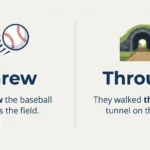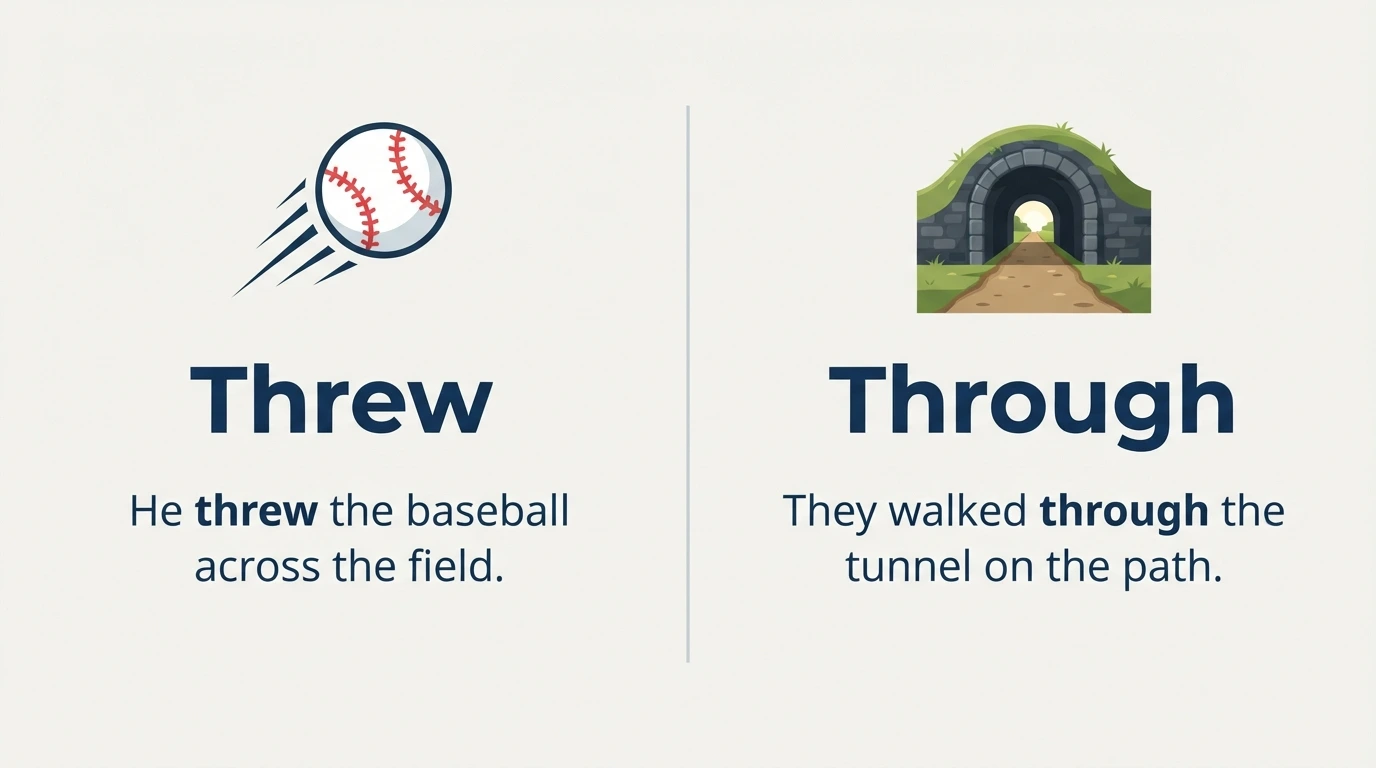
“Threw” is the past tense of the verb “throw” (meaning launched or tossed something), while “through” is a preposition or adverb that describes moving into and out of a space, period of time, or process.
Have you ever paused while writing a sentence, wondering whether to type threw or through? Because these two words are homophones—meaning they sound exactly the same—swapping them by accident is one of the most common spelling errors in English writing. However, using the wrong word completely alters your sentence structure. One word describes an action that already happened, while the other describes movement, location, or completion. In this guide, you will learn the exact meanings of both words, simple grammar rules, practical examples, and easy memory tips to choose the correct spelling with confidence.
What Does “Threw” Mean?
The word threw is the past tense form of the action verb throw.
When you use threw, you are describing an action in the past where someone or something propelled an object through the air using a arm, hand, or physical force. It can also mean causing someone or something to fall or enter a specific state suddenly.
Here is how the base verb connects to its past tense form:
- Present Tense: throw (or throws)
- Past Tense:threw
- Past Participle: thrown
Grammatical Role
Because threw is strictly an action verb in the simple past tense, it always requires a subject (a person or thing performing the action) and usually acts on an object (the item being tossed).
- Subject + Verb + Object: “Marcus threw the baseball.”
Figurative Meanings of “Threw”
In addition to physically tossing an object, threw appears in several common English idioms:
- Threw a party: Organized or hosted a celebration (e.g., “They threw a surprise birthday party”).
- Threw off: Confused or distracted someone (e.g., “The sudden noise threw off her concentration”).
- Threw away: Discarded something into the trash (e.g., “He threw away the old newspapers”).
What Does “Through” Mean?
The word through is a versatile word that functions primarily as a preposition, an adverb, or an adjective. It never functions as an action verb.
Depending on how it is used in a sentence, through generally refers to moving into one side of a location and exiting the other side, continuing across a time period, or reaching the end of an activity.
1. Moving In and Out of a Space (Preposition/Adverb)
When describing physical movement, through shows that an object or person passes inside a space, obstacle, or opening.
- The train passed through the dark tunnel.
- She walked through the front doors.
2. Passing Across a Period of Time (Preposition)
You can also use through to indicate that an action continued from the beginning to the end of a time frame.
- The store is open Monday through Friday.
- The baby slept through the entire night.
3. Finished or Completed (Adjective)
In informal and daily English, through often describes being finished with a task or relationship.
- I am finally through with my homework!
- Are you through eating your lunch?
The Grammar Difference: Verb vs. Preposition
Understanding the part of speech for each word makes choosing between them simple:
- Threw is a verb: It shows physical action in the past. If you can replace the word with “tossed” or “pitched,” use threw.
- Through is a preposition, adverb, or adjective: It shows direction, time, or state of completion. If you can replace the word with “inside,” “across,” or “finished,” use through.
Simple Test: The “Tossed” Replacement Test
If you are unsure which word to pick, replace the word in your sentence with tossed:
- Sentence: She (threw / through) the paper into the trash bin.
- Test: She tossed the paper into the trash bin. (This makes complete sense!)
- Result: Use threw.
Now try replacing it in a directional sentence:
- Sentence: We drove (threw / through) the city center.
- Test: We drove tossed the city center. (This makes no sense!)
- Result: Use through.
Comparison Table
| Word | Part of Speech | Core Meaning | Quick Replacement Word | Example Sentence |
| threw | Verb (Past Tense) | Tossed or propelled an object | Tossed / Pitched | The pitcher threw a fast strike. |
| through | Preposition | Moving into and out of an opening | Across / In and out of | Water flows through the pipe. |
| through | Preposition | Extending across a duration of time | Until / During | She worked through the weekend. |
| through | Adjective | Complete, finished, or done | Done / Finished | We are through with the test. |
Memory Tips to Remember the Difference
Using visual or spelling clues will help you pick the right spelling every time:
- Threw has “EW”: Think of the letters EW in threw as standing for “Expressing Winging” or “Extra Wild”—actions involved in tossing something with your hand.
- Through has “ROUGH”: The word through contains the word rough inside it. You often have to go through a rough patch or a rough road to reach your destination!
Practical Examples
Here are standard sentences showing how to use threw and through correctly in everyday conversation and writing:
Examples of “Threw”
- The quarterback threw a long pass down the field.
- She accidentally threw her house keys into the recycling bin.
- The dog ran after the stick that his owner threw.
- Our teacher threw out the damaged textbooks.
- Hearing the unexpected news threw him into deep thought.
Examples of “Through”
- Light shined brightly through the bedroom window.
- We hiked through the dense forest for three hours.
- The customer service desk is open Tuesday through Saturday.
- He read through the entire contract before signing.
- She stayed calm all through the stressful exam.
Common Mistakes
| Incorrect | Correct | Why |
| The bird flew threw the open window. | The bird flew through the open window. | Passing inside an opening requires the preposition “through.” |
| He through the ball to first base. | He threw the ball to first base. | Propelling an object in the past requires the action verb “threw.” |
| I am threw with my project for the day. | I am through with my project for the day. | Meaning finished or completed requires the adjective “through.” |
| We walked threw the city park together. | We walked through the city park together. | Moving across a spatial area requires “through.” |
Regional Usage and Informal Alternatives
Both threw and through are spelled identically across American English, British English, Canadian English, and Australian English.
However, you may occasionally see the shortened informal spelling thru:
- Thru: This is an informal, simplified spelling of through commonly seen on road signs (e.g., “Drive-Thru” or “Thru Traffic”).
While thru is widely accepted on commercial signage and text messages, it should never be used in academic essays, formal business emails, or professional publication. Always write out the full word through in standard writing.
Clear Usage Recommendation
When deciding which word to choose in your document or assignment:
- For past-tense action: Use threw whenever you are describing an action where an object was tossed, launched, or thrown in the past.
- For direction, space, time, or completion: Use through whenever you mean going inside an opening, continuing across time, or being done with a task.
Memory Reminder: Threw is an action verb; through shows a path!
FAQ Section
Are “threw” and “through” pronounced the same?
Yes. Threw and through are exact homophones in English. Both words are pronounced as /θruː/, rhyming with words like “blue,” “flew,” and “shoe.”
What is the difference between “through” and “thru”?
“Through” is the standard spelling used in all formal and standard English writing. “Thru” is an informal phonetic spelling primarily used on commercial signs, drive-through restaurants, and casual texting.
Is “threw” ever used as a noun?
No, threw is strictly a past-tense verb. If you need a noun that refers to the action of tossing an item, use the word throw (e.g., “That was an incredible throw by the player”).
What is the past participle of “throw”?
The past participle of “throw” is thrown (used with helping verbs, such as “has thrown,” “was thrown,” or “had thrown”). Threw is the simple past form used without a helping verb (e.g., “She threw the ball”).
How do you use “through” as an adverb?
When through modifies a verb without a following object noun, it functions as an adverb showing continuation or complete passage (e.g., “Please let us through” or “He slept all the way through“).
How can I easily remember which word to use for throwing things?
Remember that threw shares its last two letters with flew and grew. Just as a bird flew in the past, a ball threw through the air is an action that happened in the past!
Final Advice
Choosing between threw and through comes down to identifying the job the word performs in your sentence. Use threw when describing the physical action of tossing something in the past. Use through when describing movement across a space, a duration of time, or reaching the end of an activity.
Keeping this distinction clear in your mind will make your writing accurate and professional. Practice using both forms in your own practice sentences, and check out our other confusing-word guides to continue building your English language confidence!