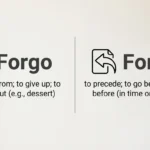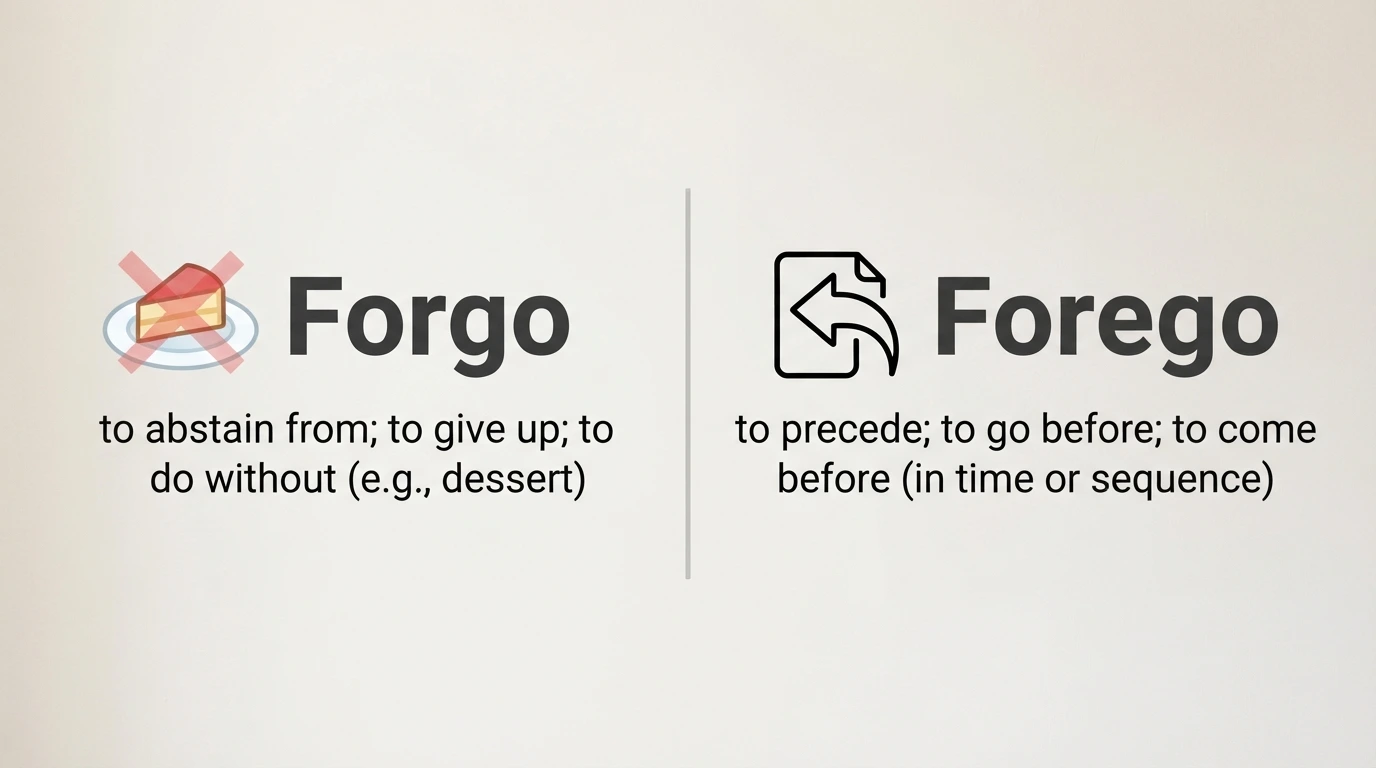
“Forgo” (without an “e”) means to give up, abstain from, or do without something, while “forego” (with an “e”) means to go before or precede in time or space. Although some dictionaries list “forego” as a minor variant spelling for “forgo,” formal writing style guides strictly separate the two words based on their prefixes.
Have you ever paused while writing an email or essay, unsure whether to type forgo or forego? Because these two words sound identical and differ by only a single letter, mixing them up is very common. However, adding or dropping that single letter “e” actually changes the word’s prefix and historical meaning. Using the wrong spelling can confuse your reader or make your text look unedited. In this guide, you will learn the exact definitions of both words, how their prefixes work, practical sentence examples, common errors, and simple memory tips to pick the right word every time.
What Does “Forgo” Mean?
The word forgo (spelled without an “e”) is an action verb that means to refrain from, pass up, abstain from, or give up something voluntarily.
When you forgo something, you decide not to have it, use it, or enjoy it.
- Base Verb: forgo
- Present Participle: forgoing
- Past Tense: forwent
- Past Participle: forgone
Understanding the Prefix “For-“
The prefix for- in Old English means “away,” “off,” “completely,” or “refraining from.” It appears in several other English verbs that involve turning away or abstaining from something:
- for-sake$\rightarrow$ to turn away from or abandon
- for-bid$\rightarrow$ to command away or prohibit
- for-give$\rightarrow$ to give away anger or pardon
- for-go$\rightarrow$ to go away from / pass up
Because forgo uses the prefix for-, it literally means to “go without” or “turn away from” an opportunity or item.
What Does “Forego” Mean?
The word forego (spelled with an “e”) is a verb that means to go before, precede, or come ahead in time, place, or order.
While forego is rarely used as a standalone action verb in modern daily speech, its participle forms appear frequently in formal writing, law, and publishing.
- Base Verb: forego
- Present Participle: foregoing (meaning “listed above” or “preceding”)
- Past Tense: forewent
- Past Participle: foregone (meaning “already determined in advance”)
Understanding the Prefix “Fore-“
The prefix fore- in English means “before,” “front,” or “ahead of time.” You see this exact prefix in many familiar words related to position or time:
- fore-head$\rightarrow$ the front part of the head
- fore-cast$\rightarrow$ to predict ahead of time
- fore-word$\rightarrow$ introductory text placed before a book
- fore-go$\rightarrow$ to go before in time or order
When you see the “e” in fore-, think of words that deal with time or placement beforehand.
The Key Prefix Difference: “For-” vs. “Fore-“
Remembering the job of each prefix makes choosing between these two words easy:
- For- (No “E”): Means away or refrain. Use forgo when you are passing on a dessert, skipping a trip, or giving up a privilege.
- Fore- (With “E”): Means before or front. Use forego (or foregoing) when referring to something that comes earlier in a document or in time.
Style Guide Preferences and Regional Usage
If you check a modern dictionary, you might notice a note stating that “forego” can sometimes serve as an alternative spelling for “forgo.”
However, major editorial style guides—including The Chicago Manual of Style, The Associated Press (AP) Stylebook, Garner’s Modern English Usage, and the Oxford English Dictionary—strongly advise writers to keep the two words separate.
- For American English: Standard professional and academic writing uses forgo for giving something up and foregoing / foregone for preceding things.
- For British and Commonwealth English: The distinction is maintained identically. Forgo means abstain, while forego means precede.
- For Global Audiences: Maintaining the distinction ensures your writing remains clear, accurate, and professional worldwide.
Comparison Table
| Word / Form | Prefix Meaning | Definition | Memory Aid | Example Sentence |
| forgo | For- (away / refrain) | To give up, skip, or do without | Forgo = go without | I will forgo coffee this morning. |
| forego | Fore- (before / front) | To go before or precede | Fore- = forehead / forecast | Read the foregoing paragraph carefully. |
| forgoing | For- (away) | Giving up or skipping (present participle) | Skipping an option | By forgoing dessert, she saved money. |
| foregoing | Fore- (before) | Preceding or stated above | Located earlier in text | Based on the foregoing evidence, the court ruled. |
| foregone | Fore- (before) | Settled in advance | Foregone conclusion | The election outcome was a foregone conclusion. |
Practical Examples
Here are natural sentences showing how to use forgo and forego (along with their related forms) in everyday writing, business communications, and academic reports:
Examples of “Forgo” (Giving Something Up)
- She decided to forgo her lunch break to finish the urgent report.
- Many travelers choose to forgo checked bags to save time at the airport.
- The company decided to forgo annual bonuses during the economic downturn.
- By forgoing late-night television, he improved his sleep quality.
- He forwent his right to appeal the decision.
Examples of “Forego” and “Foregoing” (Preceding or Going Before)
- Please review the foregoing terms and conditions before signing the agreement.
- As stated in the foregoing section of this chapter, solar energy is renewable.
- The events that forewent the revolution were studied by historians.
- The jury reached a decision based on the foregoing testimony.
Example of “Foregone” (Determined Ahead of Time)
- Victory seemed like a foregone conclusion after the team scored five goals.
Common Mistakes
| Incorrect | Correct | Why |
| I will forego dessert tonight because I am full. | I will forgo dessert tonight because I am full. | Use “forgo” (without an “e”) when you mean skipping or giving something up. |
| Please refer to the forgoing statement on page 2. | Please refer to the foregoing statement on page 2. | Use “foregoing” (with an “e”) when referring to text that came before. |
| It was a forgone conclusion that they would win. | It was a foregone conclusion that they would win. | The fixed idiom is “foregone conclusion” (meaning settled in advance). |
| He forewent his turn during the game. | He forwent his turn during the game. | The past tense of “forgo” (skip a turn) is “forwent” without an “e.” |
Clear Usage Recommendation
When deciding which spelling to use in your text:
- When you mean “give up,” “skip,” “pass on,” or “do without”: Always write forgo (no “e”).
- When you mean “precede,” “stated above,” or “settled in advance”: Always write forego, foregoing, or foregone (with an “e”).
Memory Tip: FORGO means FORgetting or FORfeiting something! FOREGO has an E like Earlier or Existing before!
FAQ Section
Is “forego” ever correct when I mean to pass on something?
While some dictionaries list “forego” as a recognized variant spelling of “forgo,” most editors, style guides, and spellcheckers treat it as an error in formal, academic, and business contexts. Stick to forgo without an “e” when you mean giving something up.
What does the phrase “foregone conclusion” mean?
A foregone conclusion is an outcome or result that is predictable or inevitable before it actually happens. Because it refers to something determined beforehand, it always uses the prefix fore- with an “e.”
What is the past tense of “forgo”?
The past tense of “forgo” is forwent (e.g., “He forwent his salary during the crisis”). The past participle is forgone (used with helping verbs, such as “She has forgone sweet snacks”).
How do you spell the “-ing” form of “forgo”?
The “-ing” form is forgoing (without an “e”). For example: “By forgoing extra expenses, they saved money.” Do not confuse this with foregoing, which means “mentioned earlier.”
Do American and British English differ on “forgo” vs. “forego”?
No. American English, British English, Canadian English, and Australian English all follow the exact same rule. Forgo means abstain or give up, while forego means precede.
What is a simple trick to remember which word has the “e”?
Look at the word FOREHEAD. Your forehead is at the front or before your face, and it has an e. Similarly, FOREGO means going before in time or place, so it keeps the e.
Summary and Final Advice
Choosing between forgo and forego comes down to understanding their prefixes. Use forgo (no “e”) when you want to describe giving up, skipping, or doing without something. Use forego (with an “e”) when describing something that goes before or precedes another item in time or text.
Maintaining this simple distinction will keep your writing clear, precise, and professional. Save this guide or check out our other commonly confused word guides to keep sharpening your English language skills!