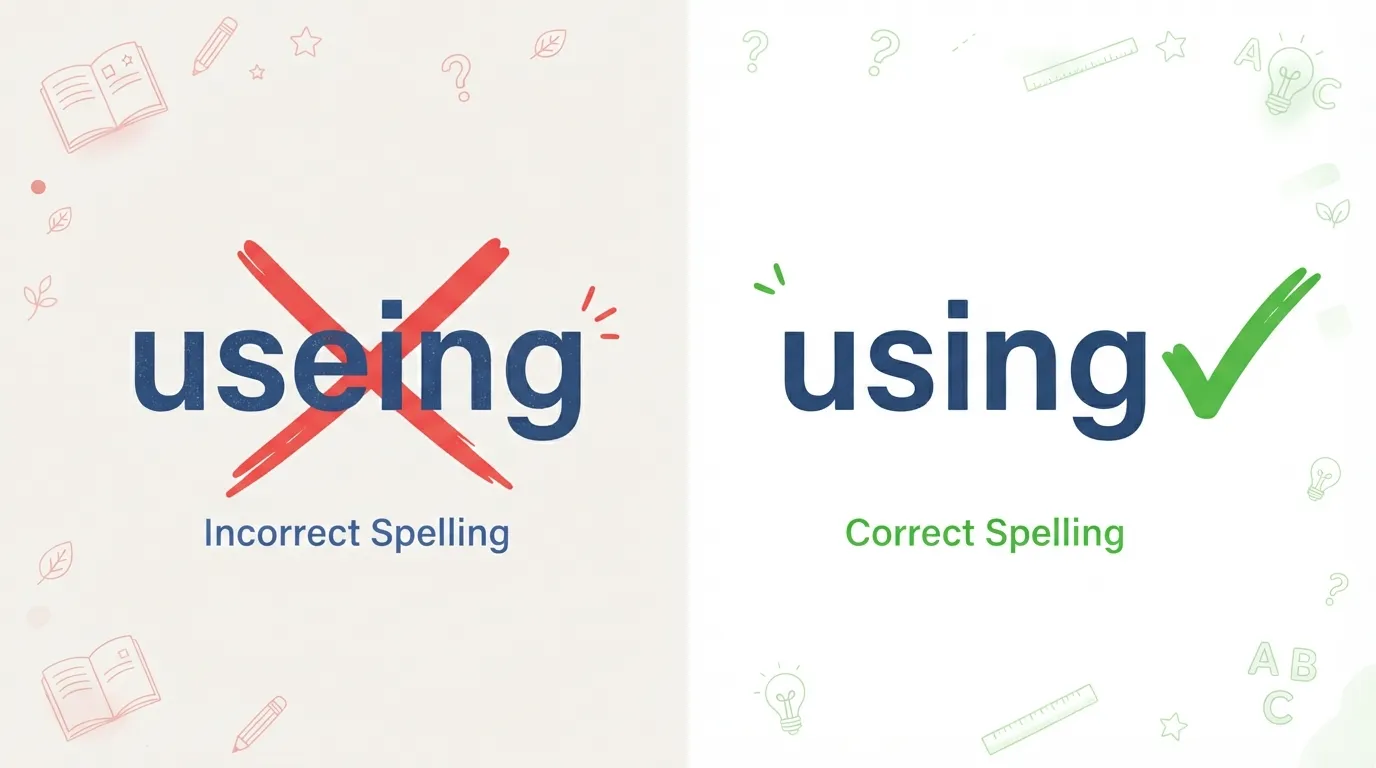
“Using” is the only correct spelling, while “useing” is a common spelling mistake. When adding “-ing” to a word ending in a silent “e” like “use,” you must drop the “e” to form “using.”
Have you ever hesitated while typing a message, wondering whether to write using or useing? You are not alone. Because the base word is “use,” keeping the letter “e” when adding “-ing” can feel natural. However, adding suffixes to words ending in silent letters follows specific spelling patterns. Choosing the right spelling keeps your writing clear, professional, and easy to read. In this guide, you will learn why “using” is the only correct spelling, how the silent “e” rule works, and simple tricks to avoid this common mistake every time you write.
Why “Using” Is the Only Correct Spelling
The word using comes from the base verb use. In English grammar, use ends with a silent “e.” When you convert a verb that ends in a silent “e” into its present participle form (the “-ing” form), standard spelling rules require you to drop the “e” before adding “-ing.”
Because of this rule:
- use + ing = using
The form useing is always considered a spelling mistake in all standard varieties of English, including American, British, Canadian, and Australian English.
The Drop-the-E Rule Explained
To understand why we spell it using, looking at the general rule for adding “-ing” to action words (verbs) helps.
When a verb ends with a silent letter “e,” dropping that “e” prevents two vowel sounds or silent vowels from clashing together. Here are a few other words that follow the exact same pattern:
- make becomes making (not makeing)
- take becomes taking (not takeing)
- write becomes writing (not writeing)
- drive becomes driving (not driveing)
- use becomes using (not useing)
By dropping the silent “e,” the word stays easy to read and follows standard English spelling guidelines.
What About Prefixes? (Reusing, Misusing, Disusing)
The same drop-the-e rule applies when you add prefixes to the verb use. A prefix is a letter group added to the beginning of a word to change its meaning, such as re-, mis-, or dis-.
Notice how the ending always stays -using:
- reuse + ing = reusing
- misuse + ing = misusing
- disuse + ing = disusing
No matter how long the word gets, you never keep the “e” before “-ing.”
When Do You Keep the Letter “E”?
You might wonder if there are times when you should keep the letter “e” when adding endings to use. You keep the “e” when the suffix starts with a consonant rather than a vowel.
For example:
- use + ful = useful (The suffix “-ful” starts with a consonant, so keep the “e.”)
- use + less = useless (The suffix “-less” starts with a consonant, so keep the “e.”)
When the suffix starts with a vowel, like “-ing” or “-able,” you drop the “e”:
- use + ing = using
- use + able = usable
Are There Exceptions to the Silent “E” Rule?
While using always drops the “e,” a few other English words keep the letter “e” before “-ing” to avoid confusion or preserve pronunciation. Knowing these exceptions can help you understand English spelling better:
- To preserve a soft consonant sound: Words ending in -ge or -ce sometimes keep the “e” so the consonant stays soft. For example, singe becomes singeing (to distinguish it from singing).
- To avoid confusing two different words: Dye (coloring cloth) becomes dyeing so it does not get confused with dying (ceasing to live).
- Words ending in double “e”: Words ending in -ee keep both letters. For example, see becomes seeing, and agree becomes agreeing.
Because use ends in a single silent “e” and does not conflict with another word, it always drops the “e” to become using.
Comparison Table
| Word / Form | Correct Spelling? | Meaning / Function | Correct Usage Example |
|---|---|---|---|
| using | Yes | Present participle of “use” (employing or handling something) | She is using a pen to write. |
| useing | No | Incorrect spelling error | None (avoid in all writing) |
| useful | Yes | Adjective meaning helpful or practical | This guide provides useful tips. |
| useless | Yes | Adjective meaning not serving any purpose | Broken tools are useless. |
Practical Examples
Here are standard examples of how to use using correctly in daily conversation and formal writing:
- I am using a new computer software program today.
- Are you using this chair, or may I borrow it?
- The teacher explained the problem by using simple diagrams.
- By using clear communication, the team finished the project early.
- She enjoys using fresh ingredients when cooking dinner.
- They were using solar power to reduce energy costs.
Common Mistakes
| Incorrect | Correct | Why |
|---|---|---|
| I am useing a new dictionary. | I am using a new dictionary. | Drop the silent “e” from “use” before adding “-ing.” |
| He was reuseing old boxes. | He was reusing old boxes. | Prefixes do not change the drop-the-e rule for “-ing.” |
| Are you useing this computer? | Are you using this computer? | “Useing” is not accepted in any region or style guide. |
| She is misuseing the tool. | She is misusing the tool. | Always drop the silent “e” when adding “-ing” to “misuse.” |
Clear Usage Recommendation
Always write using in all situations.
Whether you are writing an essay for school, sending a work email, or posting on social media, using is the only correct form. “Useing” is never correct in American, British, Canadian, Australian, or international English.
A quick memory tip: Drop the “e” before adding “-ing.”
FAQ Section
Is “useing” ever correct in British English?
No, “useing” is not correct in British English or any other dialect of English. Standard British English follows the same spelling rule as American English: drop the silent “e” before adding “-ing.” Therefore, using is the only correct form worldwide.
Why do we drop the letter “e” in “using”?
We drop the letter “e” because “use” ends in a silent “e,” and “-ing” begins with a vowel. In English spelling, when a suffix starting with a vowel is added to a word ending in a silent “e,” the silent “e” is removed to keep the word neat and easy to pronounce.
How do you spell the past tense of “use”?
The past tense of “use” is used. When adding “-ed” to a word ending in “e,” you simply add a “d.” For example: “Yesterday, I used my laptop for three hours.”
What is the difference between “using” and “usable”?
Both words come from “use.” Using is a verb form showing an ongoing action (e.g., “I am using the car”). Usable is an adjective describing something that can be used (e.g., “This old desk is still usable“).
Do you drop the “e” when adding “-ful” or “-less” to “use”?
No, you keep the “e” when adding “-ful” or “-less.” That is because those suffixes start with consonants (“f” and “l”). Therefore, you spell them useful and useless. You only drop the “e” when the suffix starts with a vowel, like “-ing.”
Is “reusing” spelled with an “e”?
No, “reusing” is spelled without an “e” before “-ing.” Adding the prefix “re-” to “use” creates “reuse.” When you add “-ing” to “reuse,” you still drop the silent “e” to form reusing.
Summary and Final Advice
Choosing between using and useing comes down to one simple spelling rule: drop the silent “e” before adding “-ing.” Because “use” ends with a silent “e,” removing it gives us the proper spelling, using. The form “useing” is always an error, regardless of where you live or what style guide you follow. Keeping this rule in mind will make your writing cleaner and more confident. If you want to master more English spelling rules and vocabulary pairs, check out our other word comparison guides today!

Muhammad Afzal is a language content writer specializing in English grammar, word usage, and vocabulary distinctions. With a strong command of linguistic nuance, Muhammad Afzal focuses on simplifying commonly confused word pairs to help readers communicate with clarity and confidence.