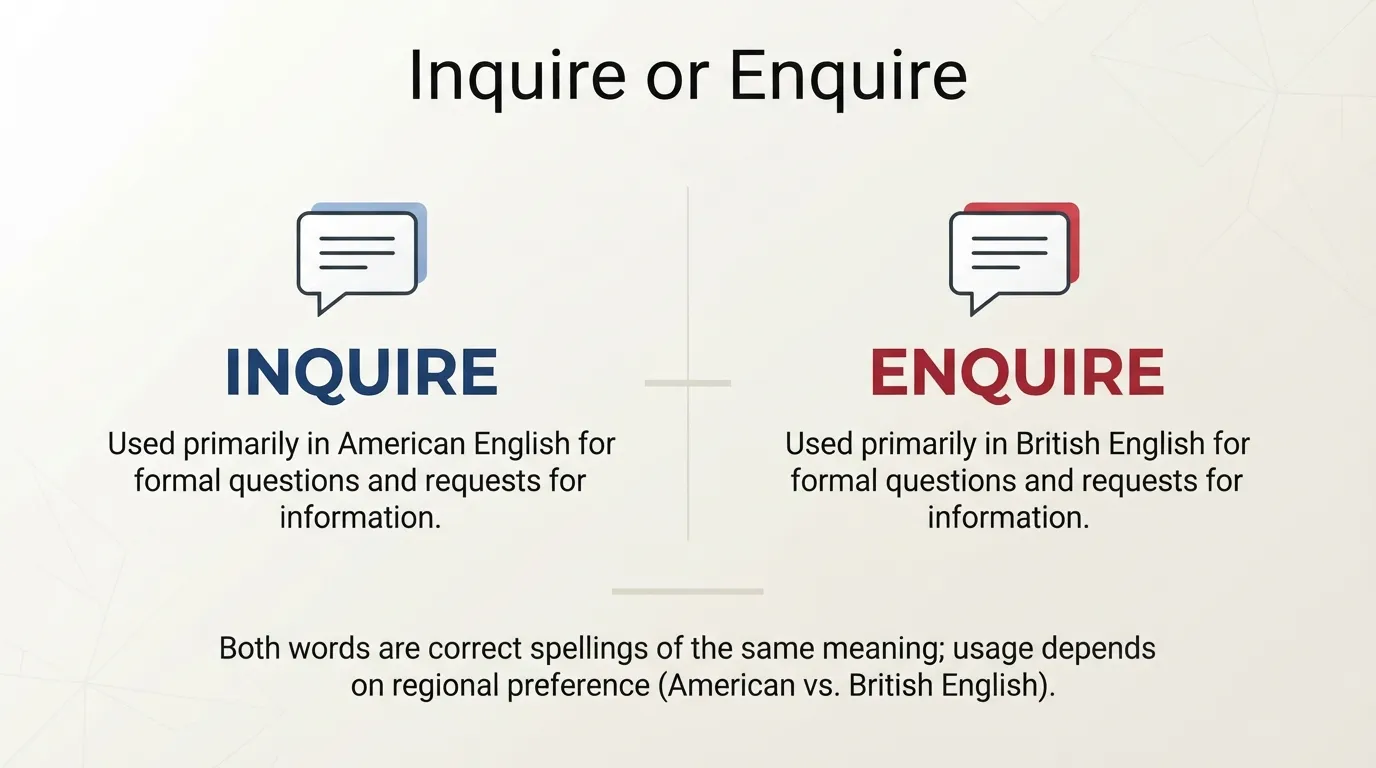
Both inquire and enquire are correct. “Inquire” is preferred in American English, while “enquire” is more common in British English for general questions. In formal British usage, “inquire” may also refer to an official investigation.
Writers often pause when choosing between inquire and enquire. The words look slightly different, but they usually mean the same thing: to ask for information.
The main difference is regional preference. American English strongly prefers inquire, while British English uses both forms. Some British writers also make a small distinction between asking a normal question and carrying out a formal investigation. This guide explains the meanings, spellings, pronunciation, related nouns, and the best form to use for your audience.
What Is the Difference Between Inquire and Enquire?
Inquire and enquire both mean to ask for information, check something, or seek an answer.
The choice usually depends on the variety of English you are using:
- Inquire is standard in American English.
- Enquire is common in British English for ordinary questions.
- Inquire may be preferred in British English for formal investigations.
- Both spellings are understood internationally.
| Word | Main Meaning | Preferred Region or Context | Example |
|---|---|---|---|
| Inquire | To ask for information | American English | I called to inquire about the price. |
| Enquire | To ask for information | British English | I called to enquire about the price. |
| Inquire | To investigate formally | Formal British usage | The committee will inquire into the complaint. |
The difference is usually about spelling style rather than grammar.
What Does Inquire Mean?
Inquire is a verb meaning to ask for information or investigate something.
It is the standard spelling in American English and is suitable for both casual and formal situations.
Examples:
- I am writing to inquire about the job opening.
- She called to inquire about her order.
- The customer inquired whether the item was available.
- We should inquire before making a decision.
- The committee will inquire into the matter.
Inquire can be used when asking a simple question:
- He inquired about the train schedule.
It can also describe a careful or official investigation:
- Officials are inquiring into the cause of the accident.
Forms of Inquire
The main verb forms are:
- Base form: inquire
- Third-person singular: inquires
- Past tense: inquired
- Past participle: inquired
- Present participle: inquiring
Examples:
- She inquires about every detail.
- They inquired about the application process.
- The manager is inquiring into the complaint.
What Does Enquire Mean?
Enquire also means to ask for information. It is most commonly used in British English.
Examples:
- I would like to enquire about your opening hours.
- She enquired whether the room was available.
- Please enquire at the front desk.
- He called to enquire about the course.
- We are enquiring about delivery options.
In everyday British writing, enquire often sounds natural when someone is simply asking a question.
Forms of Enquire
The main verb forms are:
- Base form: enquire
- Third-person singular: enquires
- Past tense: enquired
- Past participle: enquired
- Present participle: enquiring
Examples:
- He enquires about the price every week.
- I enquired about the refund policy.
- They are enquiring about available rooms.
Inquire or Enquire in British English
British English accepts both spellings, but some writers use them in slightly different ways.
Enquire for General Questions
Enquire is often used for an ordinary request for information.
- I called to enquire about the opening time.
- She enquired whether breakfast was included.
- Please enquire at reception.
Inquire for Formal Investigations
Inquire may be used when an organization, committee, or authority investigates something carefully.
- The board will inquire into the allegations.
- Officials are inquiring into the incident.
- A panel was formed to inquire into the failure.
This distinction is useful, but it is not followed by every British writer. Many dictionaries and publications treat inquire and enquire as spelling variants with the same basic meaning.
For consistent British writing, you may use enquire for everyday questions and inquire for official investigations.
Inquire or Enquire in American English
American English normally uses inquire in all situations.
Use it for ordinary questions:
- I am calling to inquire about my booking.
- She inquired about the cost.
- Please inquire at the service desk.
Use it for formal investigations:
- The agency will inquire into the complaint.
- The committee is inquiring into the issue.
The spelling enquire is understandable to American readers, but it is uncommon and may look British. For writing aimed at a US audience, inquire is the safest choice.
How Are Inquire and Enquire Pronounced?
Inquire and enquire are usually pronounced in the same way.
A simple pronunciation guide is:
in-KWYR
The spelling difference does not normally change the pronunciation.
Examples:
- I need to inquire about the application.
- I need to enquire about the application.
Both sentences sound the same when spoken.
Inquiry or Enquiry?
The noun forms follow a similar regional pattern.
Inquiry
Inquiry can mean a question, request for information, or formal investigation.
It is the standard American spelling.
Examples:
- We received an inquiry about the product.
- Please send your inquiry by email.
- The government opened an official inquiry.
Enquiry
Enquiry is commonly used in British English for a general question or request for information.
Examples:
- We received an enquiry about the room.
- Please direct all enquiries to reception.
- The website has an online enquiry form.
Some British writers prefer inquiry for an official investigation:
- A public inquiry was opened after the incident.
| Noun | Common Use | Region or Context |
|---|---|---|
| Inquiry | A question or investigation | American English |
| Enquiry | A general question | British English |
| Inquiry | A formal investigation | Often preferred in formal British English |
Is It Enquiry Form or Inquiry Form?
Both expressions are correct.
Use enquiry form for a British audience:
- Complete our online enquiry form.
- Submit a general enquiry form.
Use inquiry form for an American audience:
- Complete our online inquiry form.
- Submit a customer inquiry form.
For an international website, choose the spelling that matches the rest of your content. Do not switch between British and American forms without a reason.
Is It Inquire About or Inquire Into?
The preposition changes the meaning slightly.
Inquire About
Use inquire about or enquire about when asking for information about a subject.
- I called to inquire about the price.
- She enquired about the available rooms.
- They want to inquire about the course requirements.
Inquire Into
Use inquire into when investigating a problem, event, complaint, or situation.
- The police will inquire into the incident.
- A committee was appointed to inquire into the allegations.
- Officials are inquiring into the cause of the failure.
Inquire Whether or If
Use inquire whether or inquire if when asking a yes-or-no question.
- She inquired whether the office was open.
- He enquired if payment was required.
- I called to inquire whether my application had arrived.
Practical Examples
American English Examples
- I am writing to inquire about the position.
- She inquired about the return policy.
- Please inquire at the information desk.
- We received several customer inquiries.
- The authorities opened an official inquiry.
British English Examples
- I am writing to enquire about the position.
- She enquired about the return policy.
- Please enquire at reception.
- We received several customer enquiries.
- The authorities opened an official inquiry.
Formal Writing Examples
- I would like to inquire about the status of my application.
- Please contact us with any further inquiries.
- The committee will inquire into the reported problem.
- The customer enquired whether delivery was included.
- All general enquiries should be sent to the support team.
Common Mistakes
| Incorrect or Inconsistent | Better Version | Why |
|---|---|---|
| I want to inquiry about the course. | I want to inquire about the course. | “Inquire” is the verb; “inquiry” is a noun. |
| She made an inquire about the price. | She made an inquiry about the price. | A request for information is an inquiry. |
| We received an enquire yesterday. | We received an enquiry yesterday. | Use the noun form after “an.” |
| Please enquire about the service. We welcome all inquiries. | Use either British or American forms consistently. | Mixed spelling can look careless. |
| The committee will inquire about the allegations. | The committee will inquire into the allegations. | “Inquire into” is clearer for a formal investigation. |
Mistake 1: Confusing the Verb and Noun
Incorrect:
- I sent an inquire yesterday.
Correct:
- I sent an inquiry yesterday.
Use inquire as a verb and inquiry as a noun.
Mistake 2: Mixing Regional Spellings
Inconsistent:
- Please enquire using our online inquiry form.
Consistent British version:
- Please enquire using our online enquiry form.
Consistent American version:
- Please inquire using our online inquiry form.
Mixing forms is not always grammatically wrong, especially when making the British distinction between a question and an investigation. However, accidental mixing may make your writing look inconsistent.
Mistake 3: Assuming Enquire Is Incorrect
Enquire is not a spelling mistake. It is an accepted British English form.
However, it is less common in American English. American writers should normally use inquire.
A Simple Memory Tip
Remember:
- Enquire is often used in England.
- Inquire is used in the United States and for formal investigations.
This is only a memory aid, not a strict grammar rule. British English may use both spellings, while American English usually uses inquire.
Which Spelling Should You Use?
Use inquire when:
- You are writing in American English.
- Your audience is mainly in the United States.
- You are describing a formal investigation.
- You want one spelling that is widely accepted internationally.
Use enquire when:
- You are writing in British English.
- You are asking an ordinary question.
- Your organization uses “enquiry” in its house style.
- The rest of your content follows British spelling.
For formal, academic, or professional work, follow the required dictionary or style guide. Most importantly, keep your chosen spelling consistent.
Frequently Asked Questions
Is inquire or enquire correct?
Both are correct. Inquire is preferred in American English, while enquire is common in British English for general questions.
Do inquire and enquire have the same meaning?
Yes, they usually mean to ask for information. In some British usage, inquire is more closely connected with a formal investigation.
Is enquire incorrect in American English?
It is not technically incorrect, but it is uncommon. American writers normally use inquire and inquiry.
Should I write customer inquiry or customer enquiry?
Use customer inquiry in American English and customer enquiry in British English. Both refer to a question or request from a customer.
Is it inquiries or enquiries?
Both plural forms are correct. Use inquiries in American English and enquiries in British English.
Can I use inquire in British English?
Yes. Inquire is accepted in British English and is often preferred for formal investigations. Some British writers also use it for all types of questions.
What is the difference between inquire and ask?
Ask is the more common everyday word. Inquire and enquire can sound more formal or polite, especially in professional communication.
Conclusion
Inquire and enquire are both correct verbs meaning to ask for information. Inquire is the normal American spelling, while enquire is common in British English for ordinary questions. British writers may use inquire for a formal investigation.
Use inquiry in American English and enquiry in British English for the related noun. Choose the spelling that matches your audience, follow any required style guide, and stay consistent throughout your writing. Save this guide and practise by writing one general question and one formal investigation example.

Hassan Afzal has a background in English language instruction and writes to help non-native speakers and students master tricky grammar rules and word choices. Hassan Afzal’s writing style blends practical examples with clear explanations for everyday English learners.