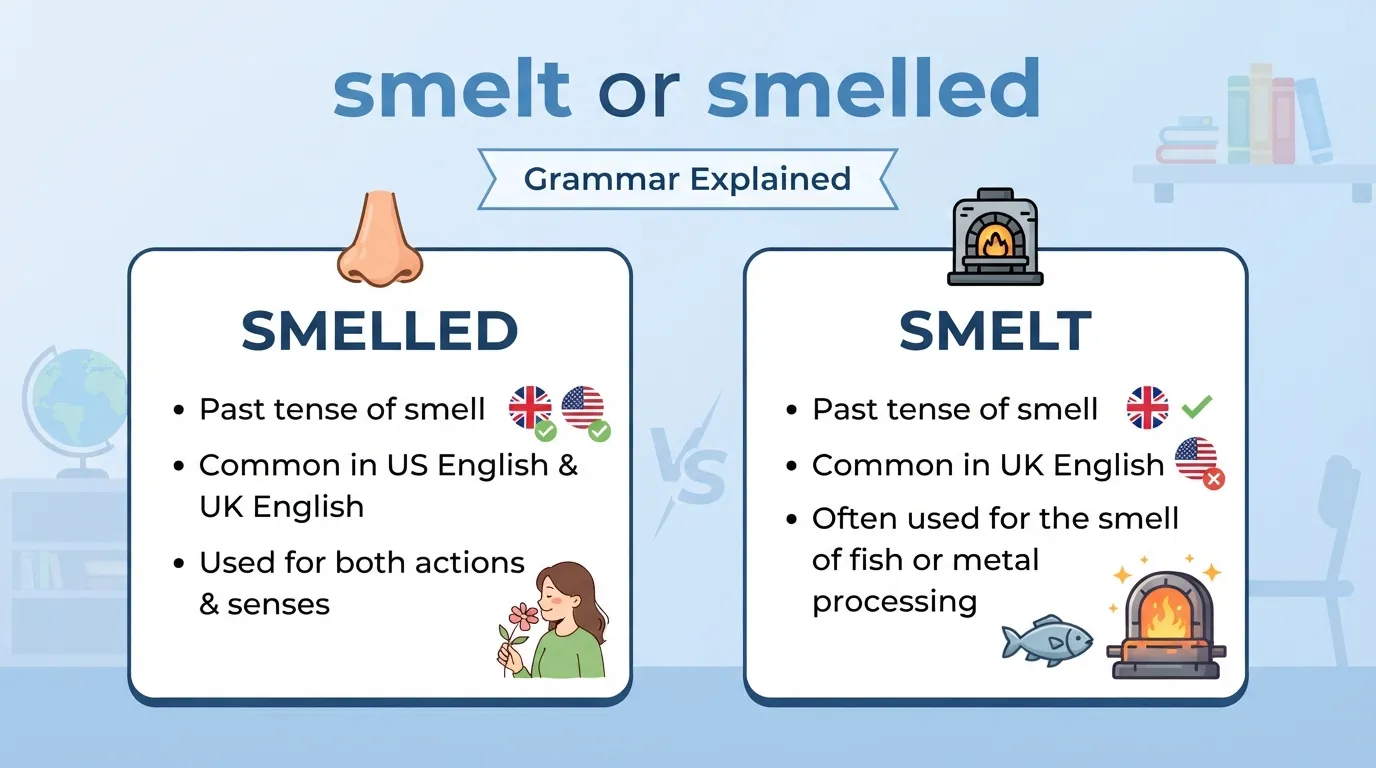
Smelt or smelled means you are choosing between two past tense forms of “smell.” “Smelled” is correct in both American and British English, while “smelt” is also correct mainly in British English.
Have you ever written “it smelt bad” and wondered if it should be “it smelled bad”?
I’ve seen this question many times in student essays, story drafts, captions, and English-learning work. The confusion makes sense. English has many verbs with more than one past tense form. We say learned or learnt, dreamed or dreamt, and burned or burnt. So it feels natural to ask whether smelt and smelled work the same way.
The short answer is yes, but with one important point. Smelled is the safer choice everywhere. Smelt is common in British English, but it can look unusual in American English.
There is also another twist. Smelt can mean a small fish or the act of melting metal from ore. That extra meaning can make the word more confusing.
This guide explains smelt or smelled in simple English, with examples, mistakes, tables, and clear usage advice.
Smelt or Smelled: Quick Answer
Use “smelled” if you want the safest past tense of “smell.” It works in American and British English. Use “smelt” if you are writing in British English or using a more traditional style. Cambridge lists “smelled” as the past tense and past participle, with “smelt” also used in UK English.
Simple examples:
- American English: The soup smelled delicious.
- British English: The soup smelt delicious.
- Also British English: The soup smelled delicious.
- Safer global choice: The soup smelled delicious.
Easy rule:
- Smelled = safe everywhere
- Smelt = mainly British past tense of smell
- Smelt = also a fish or metalworking verb
If your readers are global, choose smelled.
The Origin / Background of Smelt or Smelled
The confusion exists because English has regular and irregular past tense forms. “Smelled” follows the regular “-ed” pattern. “Smelt” follows an older irregular-style pattern, like “dreamt,” “learnt,” or “burnt,” which is more common in British English.
The verb smell means to notice an odor with your nose or to have a certain odor. Cambridge defines smell as having a quality that people notice with their noses, and gives examples such as something smelling delicious or horrible.
The past tense can be:
- smelled
- smelt
Merriam-Webster lists the verb form as smelled or smelt, which confirms that both forms exist.
But the forms do not feel the same in every country. Smelled is normal in American English. Smelt is much more familiar in British English. Oxford Learner’s Dictionaries also lists smelled as the past simple and past participle, with smelt marked as British English also.
That is the key difference. The meaning can be the same, but the regional feel changes.
Smelt or Smelled Explained: Key Differences or Variations
The main difference is region and clarity. “Smelled” is the standard safe form in modern English. “Smelt” is accepted, especially in British English, but it also has other meanings. That means “smelled” is usually clearer for international readers.
| Term | Meaning | When to Use | Region/Context |
|---|---|---|---|
| Smelled | Past tense of smell | Most writing situations | American, British, and global English |
| Smelt | Past tense of smell | British English or traditional style | Mainly British English |
| Smelt | To extract metal by heating ore | Science, industry, metalworking | Technical English |
| Smelt | A small fish | Food, fishing, biology | General noun use |
| Smelled of | Had the odor of something | Everyday writing | Common phrase |
| Smelt of | Had the odor of something | British-style writing | More common in UK English |
Cambridge defines smelt as the past simple and past participle of smell, but it also defines smelt as a verb meaning to get metal from rock by heating it.
Cambridge also lists smelt as a noun for a small fish found in oceans, rivers, and lakes.
Examples:
- The kitchen smelled like garlic.
- The kitchen smelt like garlic.
- The factory smelted iron ore.
- They caught several smelt near the river.
The first two are about odor. The last two are not.
Which Version Should You Use?
Use “smelled” when you want clear, standard English for any audience. Use “smelt” if your audience is British or if you want a British tone. Avoid “smelt” in American business, school, or web writing unless you have a reason to use it.
Here is the best practical advice:
- For students → use smelled unless your teacher prefers British English.
- For American English → use smelled.
- For British English → smelled and smelt can both work.
- For business writing → use smelled for clarity.
- For creative writing → use smelt if it fits the character or setting.
- For global readers → use smelled.
- For metalworking → use smelt as a different verb, not as the past tense of smell.
Examples:
- The flowers smelled fresh.
- The room smelled damp.
- The bread smelled warm and sweet.
- British style: The room smelt damp.
- Technical use: The company smelts copper.
If you are not sure which one to choose, write smelled. It is accepted everywhere and avoids confusion with fish or metal.
Common Mistakes With Smelt or Smelled
Most mistakes happen when writers use “smelt” for American readers or forget that “smelt” has other meanings. Another common mistake is using “smelted” as the past tense of smelling. “Smelted” belongs to metalworking, not ordinary odor.
| Mistake | Correction | Why It Happens |
|---|---|---|
| The cake smelted good. | The cake smelled good. | Writer mixes smell with metalworking |
| The air smelt fresh in a US report. | The air smelled fresh. | British form used in American context |
| They smelled iron from ore. | They smelted iron from ore. | Metalworking meaning needs smelted |
| I caught a smelled in the lake. | I caught a smelt in the lake. | Fish noun confused with verb |
| Switching between smelt and smelled in one article | Pick one style | Inconsistent regional tone |
Mistake 1: Writing “smelted” for odor
Wrong:
The soup smelted amazing.
Correct:
The soup smelled amazing.
Also correct in British English:
The soup smelt amazing.
Use smelted only when talking about melting metal from ore.
Mistake 2: Using “smelt” without thinking about audience
In American English, smelt may sound odd or old-fashioned when used as the past tense of smell. The reader may still understand it, but smelled is smoother.
Mistake 3: Confusing the noun “smelt”
Wrong:
The fisherman caught three smelled.
Correct:
The fisherman caught three smelt.
Here, smelt is a type of fish, not a smell word.
Smelt or Smelled in Real-World Examples
You can use “smelled” in almost any situation. “Smelt” works best when the writing has a British style or voice. In technical and food contexts, be careful because “smelt” may also refer to metal processing or a small fish.
Professional email example
Hi team,
The storage room smelled damp this morning. Please check the area for leaks before we move the boxes.
This is clear and professional.
British-style sentence example
The old cottage smelt of wood smoke and rain.
This sounds natural in British-style prose.
Social media post example
The bakery smelled so good today that I had to buy something.
This is casual and easy to understand.
Formal document example
Inspectors noted that the hallway smelled strongly of chemicals.
This is the safest choice for formal writing.
Technical example
The company smelted copper from ore at high temperature.
This is not about smelling. It is about metal.
Food or fishing example
The restaurant served fried smelt with lemon.
Here, smelt is a fish.
Smelt or Smelled: Data, Trends & Usage
The search intent behind “smelt or smelled” is informational. Most readers want to know which past tense is correct, whether the answer changes in American or British English, and why “smelt” can also mean something unrelated to odor.
People often search this phrase while writing:
- essays
- stories
- captions
- emails
- grammar worksheets
- English-learning notes
- food writing
- travel descriptions
The topic matters because the wrong choice can change the tone. Smelled sounds neutral and global. Smelt may sound British or literary. Smelted sounds technical and industrial.
The safest answer is:
Use smelled for most writing.
Oxford Learner’s Dictionaries lists smelled as the past simple and past participle, and also gives smelt as a British English form.
That means smelt is not wrong. It is just less universal. For SEO content, school writing, and business writing, smelled is usually the better choice.
Smelt or Smelled Comparison Table
A quick comparison makes the choice simple. “Smelled” is the safest past tense of smell. “Smelt” is mainly British as a smell verb, but it can also mean a fish or metal processing. Context decides the right meaning.
| Term/Variant | Meaning | Region/Context | Best Used When |
|---|---|---|---|
| Smelled | Past tense of smell | Global English | Writing for most readers |
| Smelt | Past tense of smell | Mainly British English | Writing with British style |
| Smelted | Extracted metal by heating | Technical or industrial English | Talking about metal or ore |
| Smelt | Small fish | Fishing, food, biology | Talking about fish |
| Smelled of | Had an odor of something | Standard English | Describing a smell |
| Smelt of | Had an odor of something | British English | Describing a smell in UK style |
FAQs About Smelt or Smelled
Q: What does smelt or smelled mean?
A: Smelt or smelled is a grammar choice for the past tense of smell. Smelled is the safer form, while smelt is also correct mainly in British English.
Q: Is smelled correct?
A: Yes. Smelled is correct in both American and British English. It is the best default choice for global writing.
Q: Is smelt correct?
A: Yes, smelt can be correct as the past tense of smell, especially in British English. Cambridge marks smelt as a UK form in its learner entry for smell.
Q: Smelt vs smelled: what’s the difference?
A: The meaning can be the same when both are past tense forms of smell. The difference is usage. Smelled is standard everywhere. Smelt is more common in British English.
Q: Should I write “it smelled good” or “it smelt good”?
A: Write it smelled good for the safest global form. In British English, it smelt good is also acceptable.
Q: Is smelted the past tense of smell?
A: No. Smelted is used for the verb smelt, meaning to extract metal from ore by heating. Do not write “the food smelted good.”
Q: Can smelt mean a fish?
A: Yes. Smelt can also be a noun for a small fish found in oceans, rivers, and lakes.
Conclusion
Now you know the difference between smelt or smelled.
The best default choice is smelled. It works in American English, British English, school writing, business emails, reports, captions, and global content.
Smelt is also correct when it means the past tense of smell, but it is mainly British English. It can also mean a small fish or a metalworking verb, so it may cause confusion for some readers.
Remember this simple rule:
- Smelled = safest past tense of smell
- Smelt = British past tense of smell
- Smelted = metalworking past tense
- Smelt = also a small fish
If your goal is clear modern writing, choose smelled.
Now you know exactly how to use smelt or smelled. Check your next essay, story, email, or caption before you send it.
Meta Description
Feature Image Prompt

Muhammad Afzal is a language content writer specializing in English grammar, word usage, and vocabulary distinctions. With a strong command of linguistic nuance, Muhammad Afzal focuses on simplifying commonly confused word pairs to help readers communicate with clarity and confidence.