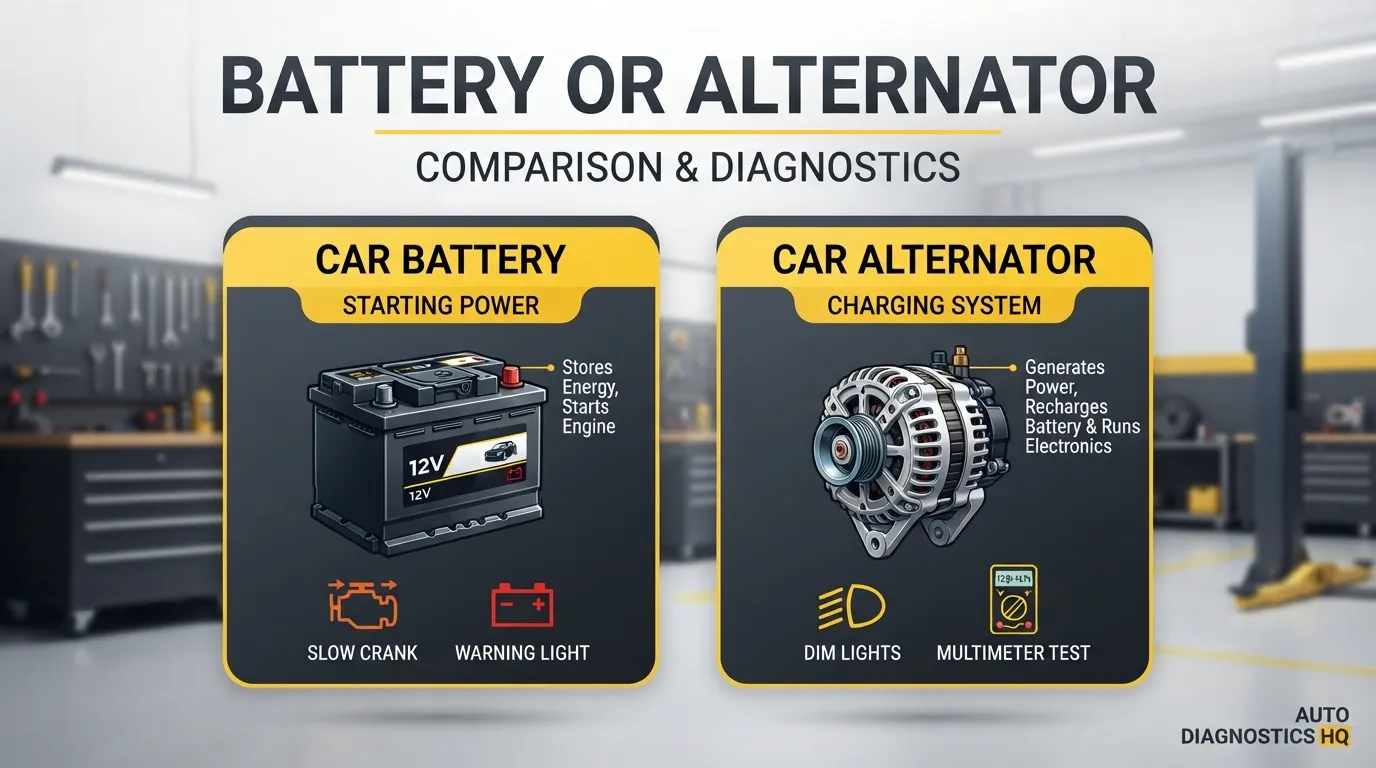
Battery or alternator problems can feel similar, but they are not the same. A weak battery usually causes starting trouble, while a bad alternator often causes dim lights, warning lights, stalling, or repeated dead batteries.
Have you ever turned the key and thought, “Is it the battery or alternator?”
This is one of the most common car questions. The car may click. The lights may come on but the engine may not start. Maybe the car starts after a jump, then dies again later. At that point, many drivers guess and buy a new battery.
Sometimes that works. Sometimes it does not.
The battery gives the car power to start. The alternator keeps the battery charged while the engine runs. If the battery is weak, the car may not start. If the alternator is weak, the battery may keep dying because it is not being charged well.
The problem is that both parts work together, so the symptoms can overlap.
This guide explains battery or alternator in simple English. You’ll learn the main signs, simple tests, common mistakes, real examples, and when to get a charging system test before replacing parts.
Battery or Alternator: Quick Answer
Check the battery first if the car has trouble starting, clicks, or has dim lights before the engine starts. Suspect the alternator if the car starts but dies while running, lights flicker while driving, the battery warning light comes on, or the battery keeps dying after being charged.
NAPA says to check the battery first because batteries usually have a shorter life expectancy, about three to five years, and fail more often than alternators. AAA lists bad alternator signs such as dim lights, accessory problems, stalling, squealing, and needing jump-starts again and again.
Simple rule:
- Bad battery = trouble starting
- Bad alternator = trouble staying charged
- Bad starter = lights may work, but the engine may not crank
- Loose or corroded cables = can look like battery failure
Do not replace parts by guessing. Test the battery, charging system, and cables first.
The Background of Battery or Alternator
The battery and alternator are part of the same electrical system. The battery stores power for starting the car. The alternator produces power while the engine runs and helps recharge the battery. If either part fails, the car may not start or may not keep running.
A car battery has one big starting job. It sends power to the starter motor so the engine can crank. It also powers lights, locks, radio memory, and other electrical parts when the engine is off.
The alternator takes over after the engine starts. It helps power the electrical system and keeps the battery charged. AutoZone says a healthy charging system usually shows about 14.0 to 14.5 volts when the engine is running.
That means a car can have a new battery and still die if the alternator is not charging it.
Think of it like this:
- The battery is the stored power.
- The alternator is the charger.
- The starter is the part that cranks the engine.
- The cables are the path for electricity.
If the charger is bad, the stored power runs out. If the stored power is bad, the car may not start even if the alternator is fine.
Battery or Alternator Explained: Key Differences or Variations
The main difference is timing. Battery problems usually show up before or during starting. Alternator problems often show up while the engine is running or after the battery dies repeatedly.
| Term | Meaning | Region/Context | Best Used When |
|---|---|---|---|
| Battery | Stores electrical power | Starting system | Car struggles to start |
| Alternator | Charges battery while engine runs | Charging system | Battery keeps dying |
| Starter | Cranks the engine | Starting system | Clicking or no crank with good battery |
| Battery terminals | Cable connection points | Electrical system | Corrosion or loose cables appear |
| Charging system test | Test of battery and alternator output | Auto repair | Symptoms overlap |
| Load test | Battery test under demand | Battery diagnosis | Battery voltage looks okay but car still struggles |
AutoZone says a good battery often reads about 12.6 volts, and if it is below that, you may need to have the battery tested or replaced. NAPA says a running vehicle should often show about 13.7 to 14.7 volts at the battery, which reflects charging from the alternator.
These numbers are useful, but they are not the whole story. A battery can show decent voltage and still fail under load. AutoZone notes that a multimeter check is a first step, but a real load test is better for confirming a bad battery.
Which One Should You Check First?
Check the battery first in most no-start cases. Then check the alternator if the battery tests good, if the car dies while running, or if the same battery keeps going dead. Also check cables and terminals before buying any part.
Here is the best practical order:
- Check the battery ageIf the battery is older than three to five years, it may be near the end of its life. NAPA gives three to five years as a typical life expectancy range.
- Check the terminalsLoose, dirty, or corroded terminals can stop power from moving correctly. This can make a good battery act dead.
- Test battery voltageAround 12.6 volts usually points to a charged battery. A lower reading means the battery may be weak, discharged, or not holding charge.
- Start the car and test charging voltageWith the engine running, the reading should usually rise. AutoZone says a healthy charging system typically shows 14.0 to 14.5 volts.
- Watch what happens after a jump-startIf the car starts and keeps running, the battery may be weak or discharged. If it starts but soon dies, the alternator or charging system may be the issue.
- Get a professional testMany auto parts stores and repair shops can test the battery and charging system. This is better than guessing.
Common Mistakes With Battery or Alternator
The biggest mistake is replacing the battery without testing the alternator. Another mistake is replacing the alternator when the real issue is a weak battery, loose cable, corroded terminal, or bad starter.
| Mistake | Better Choice | Why It Matters |
|---|---|---|
| Buying a battery without testing | Test battery and charging system | Alternator may be the real problem |
| Ignoring corroded terminals | Clean and tighten connections | Bad connections can mimic failure |
| Assuming jump-start means battery only | Watch if the car keeps running | Alternator may not be charging |
| Using voltage only as final proof | Ask for a load test | Weak batteries can pass simple voltage checks |
| Driving with warning lights | Stop safely and get checked | The car may stall |
Mistake 1: Thinking a jump-start proves the battery is bad
A jump-start only proves the car needed outside power. It does not prove why. The battery may be weak, or the alternator may not be charging it.
Mistake 2: Ignoring lights while driving
If headlights or interior lights dim while the engine is running, that can point to an alternator problem. AAA lists dim lights and electrical accessory issues as possible bad alternator symptoms.
Mistake 3: Forgetting the starter
If the battery tests good and the alternator charges well, the starter may be the issue. AutoZone lists starter warning signs such as dash lights coming on but the engine not cranking, clicking, slow cranking, smoke, and oil-soaked starter problems.
Battery or Alternator in Real-World Examples
You can often narrow the problem by watching when the failure happens. Starting trouble points more toward the battery. Running trouble points more toward the alternator. But testing is still the safest way to know.
Example 1: Car clicks but will not start
You turn the key. The car clicks. The engine does not turn over.
This often points to a weak battery, poor battery connection, or starter issue. Check the terminals and test the battery first.
Example 2: Car starts after a jump, then works all day
The car was dead in the morning, but after a jump it drove normally.
This may be a weak battery, lights left on, cold weather, or a small electrical drain. Test the battery and check for parasitic drain if it keeps happening.
Example 3: Car starts after a jump, then dies again while driving
The engine starts, but the dashboard lights fade and the car stalls.
This may point more toward the alternator or charging system. AAA lists vehicle stalling as a possible alternator symptom because the engine may not get enough power to keep running.
Example 4: New battery dies in a few days
You replaced the battery, but the car is dead again.
Do not buy another battery right away. Test the alternator and check for an electrical drain.
Example 5: Headlights brighten when you rev the engine
The headlights look dim at idle but get brighter when you press the gas.
This can point to a weak charging system, loose belt, or alternator issue. Get the charging system checked.
Battery or Alternator: Data, Trends & Usage
The search intent behind “battery or alternator” is troubleshooting-focused. Most readers want to know why their car will not start, why the battery keeps dying, or which part they should replace first.
People often search this phrase when they notice:
- clicking sound when starting
- slow crank
- dead battery
- dim headlights
- battery warning light
- car stalls while driving
- repeated jump-starts
- new battery dying quickly
- dashboard electronics acting strange
This topic matters because replacing the wrong part wastes money. A battery is usually cheaper than an alternator, but a bad alternator can ruin or drain a good battery if it is not charging properly.
AAA says a car that cranks, clicks, or stutters before finally starting may have a battery that is losing charge, but cold weather can also make starting harder. That is why symptoms alone are helpful but not perfect.
The best answer is:
Test the battery first, then test the alternator, and do not ignore cables, terminals, starter issues, or electrical drains.
Battery or Alternator Comparison Table
A quick comparison makes the choice easier. A battery problem usually shows up when the car starts. An alternator problem often shows up after the engine is running or when the battery keeps dying again and again.
| Term/Variant | Meaning | Region/Context | Best Used When |
|---|---|---|---|
| Battery problem | Weak or dead stored power | No-start diagnosis | Car clicks or cranks slowly |
| Alternator problem | Charging system issue | Running or charging diagnosis | Car dies while running |
| Bad battery sign | Slow start, clicking, low voltage | Starting system | Car struggles before engine starts |
| Bad alternator sign | Dim lights, stalls, warning light | Charging system | Electrical issues happen while driving |
| Starter problem | Engine does not crank correctly | Starting system | Battery tests good but engine does not turn |
| Cable problem | Poor electrical connection | Battery terminals | Corrosion, looseness, or intermittent power |
| Electrical drain | Power draw while car is off | Parasitic drain | Battery dies after sitting |
FAQs About Battery or Alternator
Q: What does battery or alternator mean?
A: Battery or alternator means you are trying to find out whether your no-start or dead-battery problem comes from the battery or the charging system.
Q: How do I know if it is the battery?
A: A weak battery often causes slow cranking, clicking, dim lights before starting, or a car that needs a jump. A good battery often reads about 12.6 volts, but a load test is better for confirmation.
Q: How do I know if it is the alternator?
A: A bad alternator may cause dim or flickering lights, electrical accessory problems, stalling, squealing, repeated jump-starts, or a battery warning light.
Q: Can a bad alternator drain a new battery?
A: Yes. If the alternator is not charging correctly, even a new battery can go dead after driving or after repeated starts.
Q: What voltage should I see when the car is running?
A: Many healthy charging systems show around 14.0 to 14.5 volts with the engine running, though exact readings can vary by vehicle.
Q: Should I replace the battery first?
A: Test it first. NAPA says batteries fail more often and usually last about three to five years, so checking the battery first makes sense. But do not skip the alternator test if the battery keeps dying.
Q: Can it be neither battery nor alternator?
A: Yes. The problem could be a starter, loose cable, corroded terminal, bad ground, blown fuse, belt issue, or parasitic electrical drain.
Conclusion
Now you know how to think about battery or alternator problems.
A bad battery usually shows up when the car struggles to start. You may hear clicking, slow cranking, or see dim lights before the engine turns over. A bad alternator often shows up after the engine starts. You may see dim or flickering lights, battery warning lights, stalling, or repeated dead batteries.
Remember this simple rule:
- Battery = starts the car
- Alternator = charges the battery
- Starter = cranks the engine
- Cables = carry the power
Do not replace parts based only on one symptom. Check battery age, clean the terminals, test battery voltage, test running voltage, and get a charging system test if the problem is not clear.
If the car stalls, warning lights appear, or electrical power fades while driving, stop safely and get help.
Now you know exactly how to compare battery or alternator symptoms before spending money on the wrong part.

Hassan Afzal has a background in English language instruction and writes to help non-native speakers and students master tricky grammar rules and word choices. Hassan Afzal’s writing style blends practical examples with clear explanations for everyday English learners.