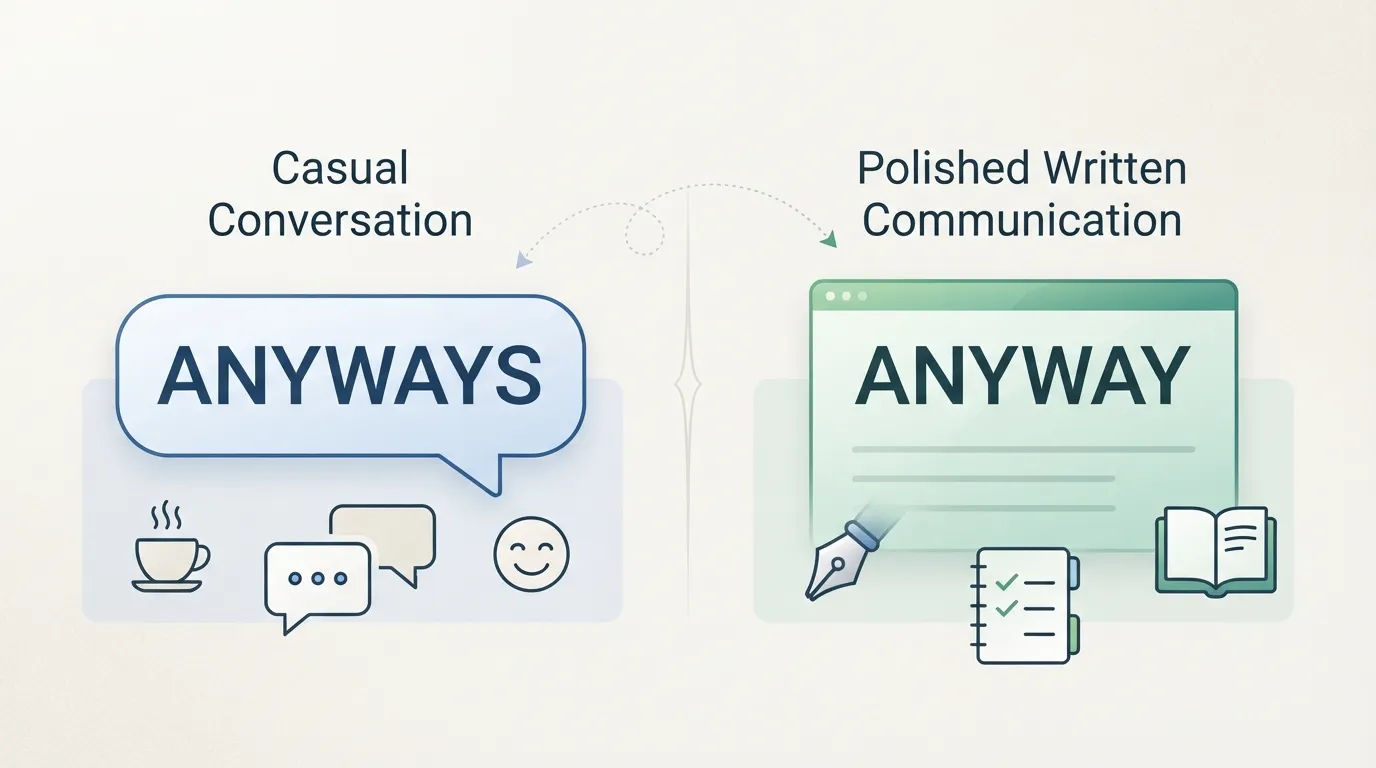
Both “anyway” and “anyways” are used in English, but “anyway” is the standard form and is the best choice for formal and general writing. “Anyways” has the same basic meaning, but it is mainly informal or dialectal and is especially associated with North American speech.
You may hear someone say, “Anyways, I have to go,” and wonder whether the extra s is a mistake. The answer is more interesting than simply saying one word is real and the other is not.
Anyway is the standard form used across formal and informal English. Anyways also appears in dictionaries, but it carries informal, dialectal, or nonstandard labels.
For school, work, professional writing, and most other situations, anyway is the safest choice.
Anyways or Anyway: What Is the Difference?
Anyway and anyways usually mean the same thing. Both can express ideas such as in any case, regardless, or despite what has already been mentioned.
The main difference is usage and formality, not basic meaning.
| Word | Meaning | Usage | Best Choice |
|---|---|---|---|
| Anyway | In any case; regardless; anyhow | Standard English | Formal and informal writing |
| Anyways | Same basic meaning as anyway | Informal, dialectal, or nonstandard | Casual speech or intentional dialogue |
| Any way | In any manner or by any method | Standard two-word phrase | When “way” is a noun |
Cambridge calls anyways an informal form of anyway, while Collins describes it as nonstandard and particularly associated with US and Canadian usage.
What Does Anyway Mean?
Anyway is an adverb.
It can have several closely related uses. Merriam-Webster includes meanings such as in any case, without regard to other considerations, and introducing an additional thought. Cambridge also notes that anyway can work as a conversational marker when changing or returning to a subject.
1. Meaning “Despite That”
Use anyway when something happens despite a reason it might not happen.
- It was raining, but we went outside anyway.
- She was tired, but she finished the work anyway.
- I knew the answer might be no, but I asked anyway.
Here, anyway is close to nevertheless or regardless.
2. Meaning “In Any Case”
Anyway can also mean that something is true regardless of another fact.
- We don’t need to hurry. We’re early anyway.
- I don’t need a ride because I’m walking anyway.
- You don’t have to bring food. We have plenty anyway.
3. Changing or Returning to a Topic
In conversation, anyway can help move the discussion forward or return to an earlier subject.
- Anyway, what were you saying?
- Anyway, we should get back to work.
- Anyway, that’s what happened.
Cambridge describes this use as a discourse marker, especially in spoken English.
Is Anyways a Real Word?
Yes, “anyways” is a real recorded English word.
Merriam-Webster has a dictionary entry for anyways, and Cambridge also includes it. Therefore, saying that anyways “isn’t a word” is too strong.
However, dictionary recognition does not mean that every word is suitable for every context.
Cambridge labels anyways as an informal form of anyway. Merriam-Webster describes related usage as chiefly dialectal, while Collins calls it a nonstandard form used especially in US speech.
So a more accurate rule is:
Anyways is a real word, but anyway is the standard choice.
Is Anyways Grammatically Incorrect?
Not necessarily.
In casual conversation or dialogue, anyways may be completely natural for a speaker whose dialect uses it. Dictionaries record that usage rather than treating the form as nonexistent.
However, anyways is usually avoided in formal edited English.
For example:
Formal or standard:
- Anyway, we need to finish the report today.
Very casual:
- Anyways, I’ll call you later.
The second sentence is understandable and occurs naturally in speech, but the first form is preferable in professional writing.
When Should You Use Anyway?
Use anyway in almost every situation where you are unsure.
It works in:
- essays
- academic assignments
- business emails
- reports
- articles
- professional communication
- everyday conversation
- fiction
- social media
For example:
- The results were disappointing, but we continued anyway.
- Anyway, please send me the document when you’re ready.
- I wasn’t hungry, but I ate something anyway.
- We should leave now anyway.
Because anyway is standard and widely accepted, you do not need to replace it with anyways in casual writing.
When Can You Use Anyways?
Anyways fits best when you deliberately want an informal or conversational tone.
You may see or hear:
- Anyways, what are you doing tonight?
- I didn’t really care anyways.
- Anyways, I’ll talk to you tomorrow.
It can also be useful when writing dialogue if you want to reflect how a particular character naturally speaks.
For example:
- “Anyways, I’m heading home,” Jake said.
In that situation, using anyways can be a stylistic choice rather than an editing mistake.
But if you are writing an essay, formal email, application, report, or professional article, use anyway instead.
Anyways in American and British English
Anyways is particularly associated with North American informal usage.
Cambridge marks the word as US and informal. Collins describes it as a nonstandard US and Canadian form of anyway.
Anyway, by contrast, is standard in both British and American English. Cambridge gives both UK and US pronunciation and usage information for the standard word.
So for international readers, anyway is the clearer choice.
A simple recommendation is:
American English: Prefer anyway in standard writing.
British English: Use anyway.
Global English: Use anyway.
Anyway vs. Any Way
There is another distinction worth knowing: anyway and any way are not always interchangeable.
Anyway: One Word
Anyway is normally an adverb meaning regardless, in any case, or something similar.
- I didn’t feel well, but I went anyway.
- Anyway, let’s continue.
Any Way: Two Words
Any way means any manner, any method, or any possible way.
For example:
- Is there any way to fix this?
- Can I help you in any way?
- Choose any way you like.
A useful test is to see whether you can replace any way with any method.
- Is there any method to fix this?
The wording is slightly different, but the meaning remains clear. That tells you the two-word form is appropriate.
Anyway vs. Anyhow
Anyway and anyhow can often have similar meanings.
Merriam-Webster lists anyhow with meanings such as in any event and at any rate, while Cambridge states that anyhow can have the same meanings as anyway.
Compare:
- I’ll go anyway.
- I’ll go anyhow.
Both can mean that you will go regardless of what happens.
However, anyway is usually the simpler choice for learners because it is very common and works naturally in many contexts.
Practical Examples of Anyway and Anyways
Standard Examples With Anyway
- I didn’t understand everything, but I enjoyed the lecture anyway.
- We were already late, so rushing wouldn’t help anyway.
- Anyway, what are your plans for tomorrow?
- She knew it would be difficult, but she tried anyway.
- We don’t need another chair anyway.
- I wasn’t invited, but I didn’t want to go anyway.
Informal Examples With Anyways
- Anyways, I’ll see you tomorrow.
- I wasn’t interested anyways.
- Anyways, that’s enough about work.
These uses of anyways can occur in casual North American speech, but changing them to anyway makes them suitable for a wider range of contexts.
Common Mistakes With Anyways and Anyway
| Less Suitable or Incorrect | Better Form | Why |
|---|---|---|
| Anyways, please review the attached report. | Anyway, please review the attached report. | “Anyway” is better for professional writing. |
| I’ll do it anyways. | I’ll do it anyway. | Standard English prefers “anyway.” |
| Is there anyway I can help? | Is there any way I can help? | Here “way” means method or manner. |
| “Anyways” is not a real word. | “Anyways” is informal/dialectal. | Dictionaries record the word. |
| British English requires “anyways.” | British English uses anyway. | “Anyways” is mainly associated with informal North American use. |
The most important mistake to avoid is assuming that anyways and any way are the same thing. They serve different grammatical purposes.
How to Remember Anyway vs. Anyways
The easiest rule is:
When in doubt, use anyway.
You can also remember:
Anyway = standard
Anyways = informal
Any way = any method
For example:
- I’ll go anyway.
- Anyways, I’ll see you later. — informal
- Is there any way to get there faster?
These three examples cover most situations learners are likely to meet.
Which Should You Use: Anyways or Anyway?
Use “anyway” as your default choice.
It is standard in both American and British English and works in formal writing, casual writing, and conversation.
Use anyways only when an informal or dialectal tone is appropriate, particularly in casual North American speech or realistic dialogue.
If you are writing for school, work, publication, or an international audience, anyway is the safer and more widely accepted form.
Frequently Asked Questions
Which Is Correct, Anyways or Anyway?
Anyway is the standard form and the best choice in most writing. Anyways is also recorded in dictionaries, but it is generally labelled informal, dialectal, or nonstandard.
Is Anyways a Real Word?
Yes. Merriam-Webster and Cambridge both have entries for anyways. However, its usage labels show that it is not normally preferred in formal standard English.
Is Anyways American English?
It is especially associated with informal North American English. Cambridge labels it US and informal, while Collins describes it as a US and Canadian nonstandard form.
Can I Use Anyways in an Essay?
It is better to use anyway in an essay unless you are quoting someone or deliberately reproducing informal speech. Anyway is the standard form and fits academic writing more naturally.
Is Anyway One Word or Two Words?
Anyway is one word when it means regardless or in any case. Use any way as two words when you mean any method, manner, or possibility.
Is It “Anyway, Moving On” or “Anyways, Moving On”?
Anyway, moving on is the standard form. Anyways, moving on is possible in very casual speech, especially in some North American dialects, but it is less suitable in edited writing.
What Can I Use Instead of Anyway?
Depending on the sentence, alternatives include anyhow, regardless, in any case, at any rate, and nevertheless. The best replacement depends on the exact meaning and tone.
Conclusion
When choosing between anyways or anyway, use anyway in most situations. It is the standard form in both American and British English and works well in conversation, academic work, professional communication, and general writing.
Anyways is not imaginary or meaningless. Dictionaries recognize it, but it is mainly informal, dialectal, or nonstandard and is especially associated with North American speech.
Remember the simple rule: anyway is always the safer choice. And when you mean “any method or manner,” use the separate phrase any way.

Muhammad Afzal is a language content writer specializing in English grammar, word usage, and vocabulary distinctions. With a strong command of linguistic nuance, Muhammad Afzal focuses on simplifying commonly confused word pairs to help readers communicate with clarity and confidence.