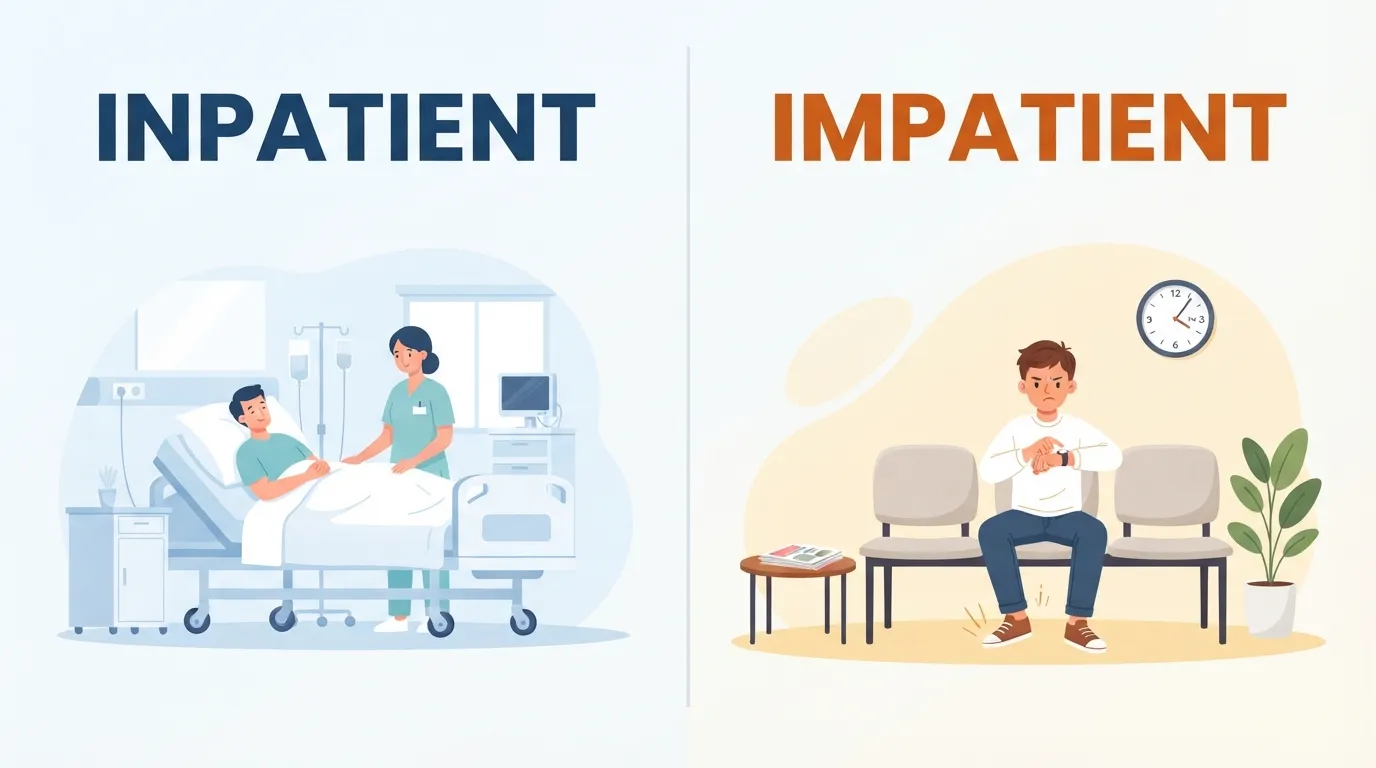
Use inpatient when talking about a patient who stays in a hospital for treatment. Use impatient when describing someone who is restless, annoyed by waiting, or eager for something to happen.
It is easy to mix up inpatient or impatient. The words look almost identical, and both contain the word patient, but their meanings are completely different.
Inpatient is mainly a medical term. It refers to a person receiving treatment while staying in a hospital or similar medical facility. Impatient is an adjective describing a person who finds it difficult to wait calmly or who wants something to happen quickly.
The easiest memory trick is simple: inpatient = in the hospital; impatient = unable to wait patiently.
Inpatient or Impatient: What Is the Main Difference?
The difference comes down to context.
| Word | Part of Speech | Meaning | Example |
|---|---|---|---|
| Inpatient | Noun or adjective | A patient staying in a hospital, or care provided to such a patient | She received inpatient treatment. |
| Impatient | Adjective | Restless, annoyed by waiting, or eager | He became impatient while waiting. |
Merriam-Webster defines an inpatient as a hospital patient who receives lodging and treatment. Collins also uses in-patient as both a noun and an adjective. Impatient, meanwhile, means not patient, particularly when someone becomes restless or short-tempered because of delay or irritation.
What Does Inpatient Mean?
Inpatient is a medical term.
As a noun, it refers to someone who has been admitted to a hospital or medical facility and stays there while receiving treatment.
For example:
- She was admitted as an inpatient after surgery.
- The hospital currently has several inpatients receiving specialist treatment.
- He remained an inpatient while doctors monitored his condition.
Inpatient can also describe medical services or facilities intended for patients who have been admitted.
For example:
- He needs inpatient care.
- The hospital has a separate inpatient unit.
- She entered an inpatient treatment program.
In each case, the word relates to receiving care while admitted to a healthcare facility. Collins records this adjectival use as well as the noun form.
What Does Impatient Mean?
Impatient is an adjective describing a lack of patience.
A person may become impatient because they have been waiting too long, because progress is slow, or because another person’s mistakes are frustrating them. Cambridge describes an impatient person as someone who becomes easily annoyed because of waiting or another person’s mistakes.
For example:
- She became impatient while waiting for the bus.
- Don’t be impatient. Your food will be ready soon.
- He sounded impatient on the phone.
- The children grew impatient during the long journey.
- I’m impatient to hear the results.
Merriam-Webster also notes that impatient can describe someone who is eagerly desirous of something.
So the word does not always mean angry. Sometimes it simply suggests strong eagerness.
Why Are Inpatient and Impatient So Easy to Confuse?
Only one letter separates the key prefixes:
- inpatient begins with in-
- impatient begins with im-
The words also share patient, which itself can have two different common meanings.
A patient can be a person receiving medical care. The adjective patient can also describe someone who can wait calmly without becoming annoyed. Merriam-Webster records this adjective as showing calmness or restraint under difficulty or delay.
This explains the two related words:
in + patient → inpatient
A medical patient staying in a healthcare facility.
im + patient → impatient
Not patient or unable to wait calmly.
The meanings therefore come from different uses of the word patient.
Inpatient vs. Outpatient
When inpatient is used medically, its natural opposite is outpatient, not impatient.
An outpatient receives medical diagnosis or treatment without being hospitalized overnight, according to Merriam-Webster.
Compare:
- She received inpatient treatment after the operation.
- He attended the clinic as an outpatient.
A useful pair to remember is:
Inpatient ↔ Outpatient
By contrast:
Patient ↔ Impatient
Keeping these two pairs separate makes the spelling easier.
Patient vs. Impatient
When describing personality or behavior, the opposite relationship is between patient and impatient.
Patient
A patient person can wait or deal with difficulty without quickly becoming annoyed.
- Please be patient while the page loads.
- She is very patient with young children.
Impatient
An impatient person has difficulty waiting calmly.
- He became impatient after waiting for an hour.
- She gave me an impatient look.
Merriam-Webster defines impatient directly in relation to being “not patient,” especially when dealing with delay or irritation.
Is It Inpatient Care or Impatient Care?
The correct medical expression is inpatient care.
Correct:
- The doctor recommended inpatient care.
- She was transferred to an inpatient unit.
- The facility provides inpatient treatment.
Incorrect for this meaning:
- The doctor recommended impatient care.
Impatient care would literally describe care that is somehow impatient, which is not the intended medical meaning.
When the subject involves hospitals, admission, medical treatment, or hospital units, inpatient is usually the word you need.
Is It Inpatient or Impatient With Someone?
Use impatient with when describing frustration with a person.
For example:
- She was impatient with the slow cashier.
- Try not to become impatient with beginners.
- He gets impatient with people who arrive late.
Cambridge specifically gives impatient with as a normal construction for describing annoyance with someone’s actions or mistakes.
Do not use inpatient with for this meaning.
Practical Examples
Examples With Inpatient
- The doctor recommended inpatient treatment.
- She became an inpatient after the procedure.
- The hospital opened a new inpatient ward.
- He requires several days of inpatient care.
- The program offers both inpatient and outpatient services.
All of these examples relate to healthcare.
Examples With Impatient
- I am getting impatient with the delay.
- The customer became impatient while waiting.
- She was impatient to open her birthday present.
- Don’t be impatient with yourself while learning.
- He tapped his foot impatiently.
All of these examples describe emotions, behavior, or eagerness rather than hospital care.
Common Mistakes With Inpatient and Impatient
| Incorrect | Correct | Why |
|---|---|---|
| She received impatient care. | She received inpatient care. | The sentence refers to hospital treatment. |
| He was admitted as an impatient. | He was admitted as an inpatient. | “Inpatient” is the medical noun. |
| I became inpatient waiting for the train. | I became impatient waiting for the train. | “Impatient” means unable to wait calmly. |
| She is inpatient with slow learners. | She is impatient with slow learners. | The sentence describes frustration. |
| An inpatient is the opposite of an impatient. | An inpatient contrasts with an outpatient. | They belong to different meaning groups. |
The most useful correction is to remember that inpatient and impatient are not opposites.
How to Remember Inpatient vs. Impatient
Try this simple memory trick:
INpatient = IN the hospital
The first two letters, in, remind you that the person is admitted for medical care.
For impatient, connect it with patience:
IMpatient = not patient
If someone is tired of waiting, becoming annoyed, or eager for something to happen, use impatient.
You can also remember these two pairs:
- inpatient / outpatient → medical care
- patient / impatient → patience and behavior
Which Word Should You Use?
Use inpatient when the sentence concerns:
- hospital admission
- hospital treatment
- an admitted patient
- an inpatient ward or unit
- inpatient medical care
Use impatient when the sentence concerns:
- waiting
- frustration
- restlessness
- irritation
- eagerness for something to happen
The quickest rule is:
Hospital = inpatient
Can’t wait = impatient
Frequently Asked Questions
What Is the Difference Between Inpatient and Impatient?
Inpatient is a medical term for a patient who stays in a hospital for treatment, and it can also describe that type of care. Impatient describes someone who has difficulty waiting calmly or is eager for something to happen.
Is It Inpatient or Impatient Care?
Use inpatient care when referring to treatment provided to someone admitted to a hospital or medical facility. Impatient care does not have this medical meaning.
Is Inpatient One Word?
Yes. Inpatient is commonly written as one word in modern American English. Merriam-Webster uses inpatient as its headword. Collins also records the hyphenated form in-patient, reflecting variation in presentation.
Is an Inpatient the Opposite of an Outpatient?
Yes, in the medical sense. An inpatient stays in a hospital while receiving treatment, while an outpatient visits for treatment without being hospitalized overnight.
What Is the Opposite of Impatient?
Patient is the usual opposite of impatient when discussing behavior. A patient person can remain calm while waiting or facing difficulty.
Can Impatient Mean Excited?
It can express strong eagerness rather than simple annoyance. For example, “I’m impatient to see the results” means you are very eager for the results to arrive. Merriam-Webster includes this sense of being eagerly desirous.
Can a Person Be Both Inpatient and Impatient?
Yes. The meanings are independent. A person could be an inpatient in a hospital and also feel impatient because they want to go home. The first word describes their medical status, while the second describes their emotional state.
Conclusion
When choosing between inpatient or impatient, look at the context.
Use inpatient for someone staying in a hospital for treatment or for medical care provided in that setting. Use impatient for someone who becomes restless or annoyed while waiting, or who is very eager for something to happen.
The easiest memory trick is “inpatient = in the hospital.” For behavior, remember that an impatient person lacks patience.
Keep the two natural pairs in mind: inpatient/outpatient for healthcare and patient/impatient for behavior.

Zain Ali is an English content specialist with editorial experience in creating clear, accurate, and reader-friendly grammar guides. Zain is passionate about breaking down confusing English word pairs into simple, actionable explanations.