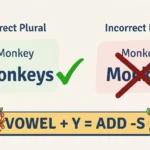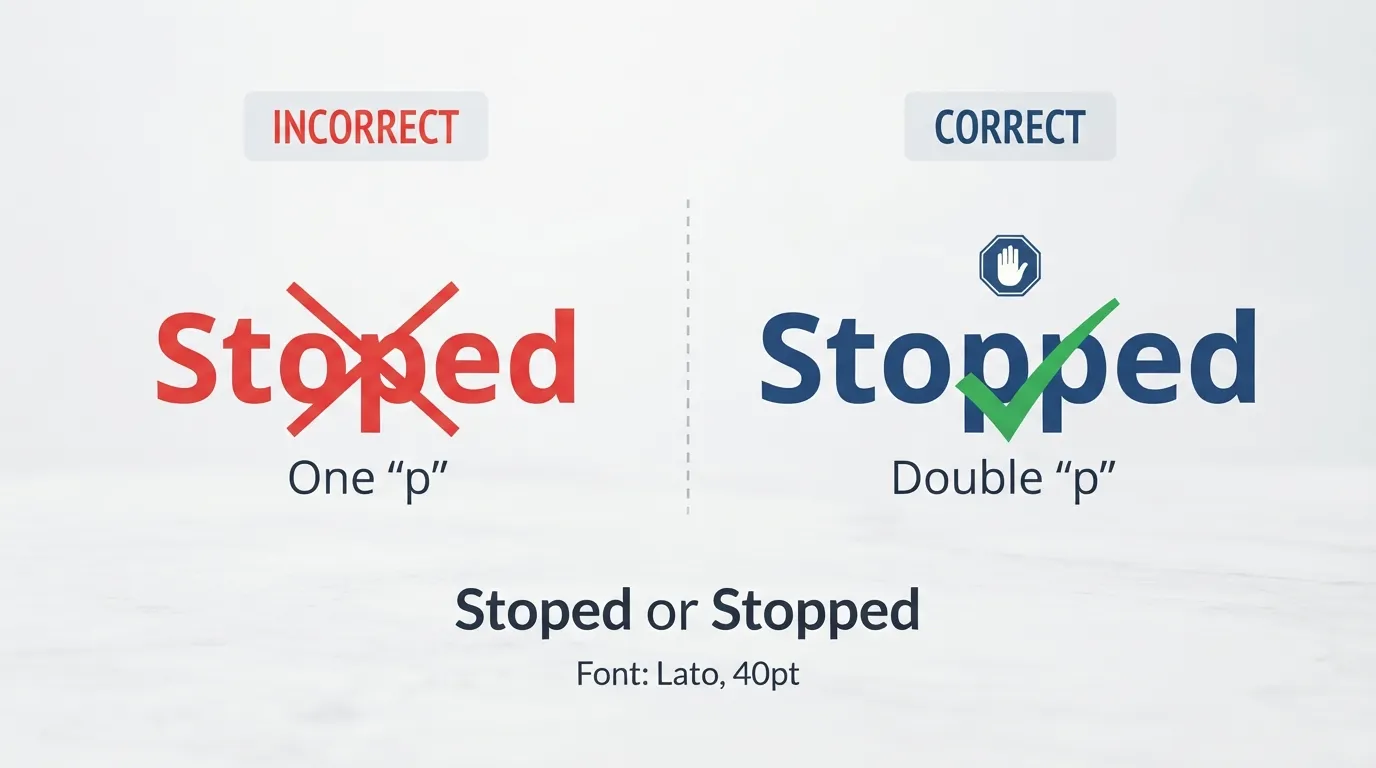
Stopped is the correct spelling. “Stoped” is incorrect in standard English. The verb stop doubles its final p before adding -ed, giving us stopped.
It is easy to hesitate between stoped or stopped. After all, many English verbs simply add -ed to form the past tense. However, stop follows a spelling rule that requires the final consonant to be doubled.
That is why we write stopped, not stoped.
The same rule also gives us stopping rather than stoping. Once you understand why the p doubles, other verbs such as plan, drop, and rob become easier to spell too.
Stoped or Stopped: What Is the Difference?
Only stopped is the standard spelling of the past tense and past participle of stop.
| Form | Correct? | Meaning | Example |
|---|---|---|---|
| Stopped | Yes | Past tense or past participle of “stop” | The car stopped suddenly. |
| Stoped | No | Misspelling of “stopped” | Incorrect in standard English |
| Stopping | Yes | -ing form of “stop” | The bus is stopping here. |
| Stops | Yes | Third-person present form | The train stops at noon. |
The simple answer is:
stop + ed = stopped
Why Is Stopped Spelled With Two P’s?
The verb stop is a short, one-syllable word ending in this pattern:
consonant + vowel + consonant
In stop:
- s and t come before the final pattern
- o is the final vowel
- p is the final consonant
When many short verbs end with one vowel followed by one consonant, the final consonant is doubled before adding -ed or -ing.
So:
- stop + ed → stopped
- stop + ing → stopping
The final p is doubled.
Other Words That Follow the Same Rule
The spelling becomes easier when you compare stop with similar verbs.
| Base Verb | Past Tense | -ing Form |
|---|---|---|
| stop | stopped | stopping |
| plan | planned | planning |
| drop | dropped | dropping |
| rob | robbed | robbing |
| slip | slipped | slipping |
| beg | begged | begging |
Each word ends in a short vowel followed by one consonant, so that final consonant is doubled before certain endings.
This pattern is sometimes called the final-consonant doubling rule.
What Does Stopped Mean?
Stopped is the past tense and past participle of stop.
The verb stop can have several related meanings.
1. To Stop Moving
- The car stopped at the red light.
- The train stopped at the station.
- She suddenly stopped walking.
Here, stopped means that movement ended.
2. To Stop Doing Something
- He stopped talking.
- I stopped watching television.
- They stopped arguing.
In these examples, an activity ended.
3. To Prevent Something
- The police stopped the traffic.
- A fence stopped the ball.
- She stopped him from leaving.
Here, stopped means prevented or caused something to end.
Is Stoped Ever Correct?
No, not as the normal past tense of the verb “stop.”
If you mean that something came to an end, did not continue, or was prevented, the correct spelling is stopped.
Correct:
- The rain stopped.
- He stopped the car.
- We stopped talking.
Incorrect:
- The rain stoped.
- He stoped the car.
- We stoped talking.
Spell-checkers will normally mark stoped as an error because the required second p is missing.
Is It Stopped or Stoped in British English?
The spelling is stopped in both British and American English.
There is no regional difference here.
British English:
- The bus stopped outside the school.
American English:
- The bus stopped outside the school.
Unlike spelling pairs such as colour/color or travelling/traveling, stopped remains the same in the major varieties of English.
Stopped vs. Stopping
Both words double the final p, but they perform different grammatical jobs.
Stopped
Stopped is the past tense or past participle.
- She stopped running.
- The machine has stopped working.
Stopping
Stopping is the present participle or gerund form.
- The bus is stopping.
- Stopping now would be a mistake.
A useful spelling pair is:
stopped → two p’s
stopping → two p’s
Why Isn’t It Stoped?
If we simply added -ed without doubling the consonant, we would get stoped. But standard English spelling requires the final p to double in this word.
Compare:
- hope → hoped
- stop → stopped
Why are they different?
The verb hope already ends in a silent e, so we simply add d:
hope + d = hoped
But stop ends in a short vowel followed by a consonant, so the consonant doubles:
stop + p + ed = stopped
This comparison can help you see why stoped does not follow the standard spelling pattern.
Practical Examples With Stopped
Here are some natural sentences using stopped correctly.
Everyday Life
- We stopped at a café for lunch.
- The clock stopped working yesterday.
- She stopped when she heard her name.
- He stopped the car near the entrance.
- The rain finally stopped.
School and Work
- The teacher stopped speaking for a moment.
- I stopped working at six o’clock.
- The computer suddenly stopped responding.
- They stopped the meeting because of a technical problem.
Activities and Habits
- She stopped drinking coffee at night.
- He stopped playing football after the injury.
- We stopped using the old software.
- They stopped talking when the manager entered.
Common Mistakes With Stoped and Stopped
| Incorrect | Correct | Why |
|---|---|---|
| The car stoped. | The car stopped. | Double the final “p.” |
| She stoped talking. | She stopped talking. | “Stopped” is the past tense of “stop.” |
| He is stoping the car. | He is stopping the car. | The “p” also doubles before “-ing.” |
| We have stoped using it. | We have stopped using it. | The past participle is “stopped.” |
| The rain stoped yesterday. | The rain stopped yesterday. | “Stoped” is not the standard spelling. |
The most common mistake is simply forgetting the second p.
How to Remember Stopped
A simple memory trick is:
STOP needs another P before -ED.
Think of the spelling in three parts:
stop + p + ed = stopped
You can use the same idea for stopping:
stop + p + ing = stopping
Another useful pair is:
- stop → stopped
- drop → dropped
If you remember that dropped needs two p’s, it may help you remember stopped too.
Which Should You Use: Stoped or Stopped?
Always use stopped when you need the past tense or past participle of stop.
Use:
- I stopped.
- She stopped.
- They have stopped.
- The machine was stopped.
Do not use:
- stoped
The quickest rule is:
One p in stop, two p’s in stopped.
Frequently Asked Questions
Which Is Correct, Stoped or Stopped?
Stopped is correct. Stoped is a misspelling in standard English because the final p in stop must be doubled before -ed is added.
Why Does Stopped Have Two P’s?
Stop ends with a short vowel followed by a single consonant. In this type of short verb, the final consonant is commonly doubled before adding -ed or -ing.
Is Stoped a Word?
Not as the standard past-tense form of stop. If you mean the past tense of stop, write stopped.
Is It Stopped or Stoppped?
The correct spelling is stopped, with two p’s, not three. The original p is doubled once before -ed is added.
Is It Stoping or Stopping?
The correct spelling is stopping. Just as stop becomes stopped, it becomes stopping when -ing is added.
Is Stopped British or American English?
Stopped is standard in both British and American English. There is no major regional spelling difference for this word.
What Is the Past Tense of Stop?
The simple past tense of stop is stopped. For example: “The bus stopped at the station.”
Conclusion
When choosing between stoped or stopped, the answer is simple: stopped is correct.
The verb stop doubles its final p before -ed, giving us stopped. The same spelling rule produces stopping with two p’s.
Remember the pattern stop → stopped → stopping. You can also compare it with words such as drop → dropped and plan → planned.
If you are unsure in future writing, remember this quick rule: one p in stop, but two p’s in stopped.

Zain Ali is an English content specialist with editorial experience in creating clear, accurate, and reader-friendly grammar guides. Zain is passionate about breaking down confusing English word pairs into simple, actionable explanations.