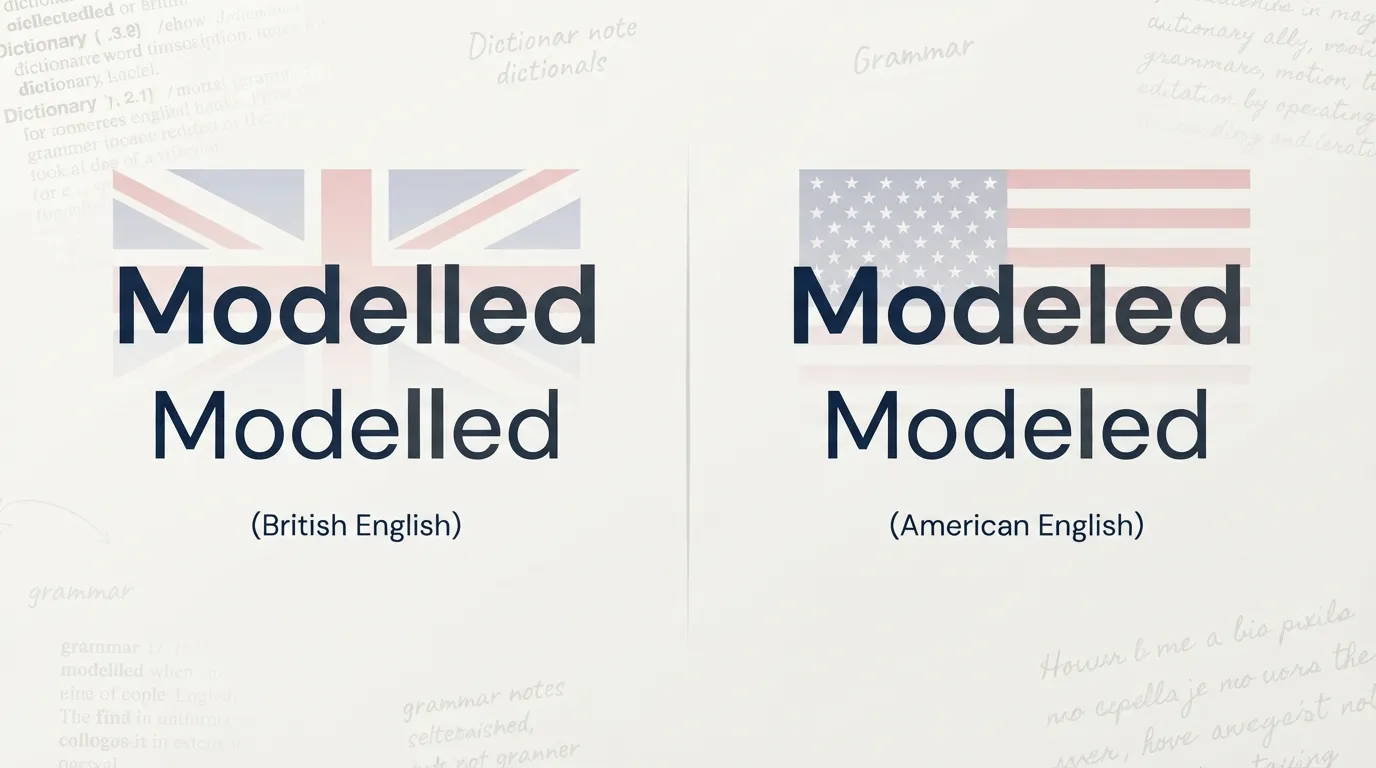
Both modelled and modeled are correct. Use modeled in American English and modelled in British English. They are different regional spellings of the past tense and past participle of model.
Have you ever written “The system was modeled on an earlier design” and wondered whether modelled needs two l’s? Both spellings appear in English, so the difference can easily cause confusion.
The answer depends mainly on your regional English. Modeled is the standard American spelling, while modelled is the standard British spelling. The same difference appears in modeling/modelling.
Neither spelling is universally wrong. The important thing is to choose the form that matches your audience and use it consistently.
Modelled or Modeled: What Is the Difference?
Modelled and modeled have the same meaning. The difference is spelling.
Both are forms of the verb model, which can mean to create a representation of something, demonstrate something, or base one thing on another. Merriam-Webster records model as a verb as well as a noun.
| Form | Region | Status | Example |
|---|---|---|---|
| Modeled | American English | Standard US spelling | The building was modeled on an older design. |
| Modelled | British English | Standard UK spelling | The building was modelled on an older design. |
| Modeling | American English | Standard US -ing form | She is modeling the results. |
| Modelling | British English | Standard UK -ing form | She is modelling the results. |
Cambridge specifically lists modelled for mainly UK usage and modeled for US usage.
The simplest rule is:
American English → modeled
British English → modelled
What Does Modeled Mean?
Modeled is the standard American English past tense and past participle of model.
For example:
- The researchers modeled several possible outcomes.
- The statue was modeled from clay.
- The new program was modeled on an earlier system.
- She modeled the dress for the photographer.
- His teaching style was modeled after his mentor’s approach.
Merriam-Webster’s current examples use modeled and modeling, reflecting the standard American forms.
If you are writing for an American audience, modeled is normally the safest choice.
What Does Modelled Mean?
Modelled is the standard British English form of the same verb.
It has exactly the same basic meanings as modeled.
For example:
- The researchers modelled several possible outcomes.
- The sculpture was modelled in clay.
- The building was modelled on an earlier design.
- She modelled the new clothing collection.
- The system was modelled using computer software.
Cambridge uses modelled as the British past-tense and past-participle form and gives examples such as something being “modelled on” another design.
Why Does British English Double the L?
The difference comes from regional spelling conventions for words ending in -l.
British English often doubles a final l before endings such as -ed and -ing, even when the final syllable is not stressed.
That gives us:
- model → modelled
- model → modelling
American English generally does not double the final l in this situation:
- model → modeled
- model → modeling
Cambridge directly reflects this distinction in its entries, listing modelling/modelled for mainly UK English and modeling/modeled for US English.
Modeled in American English
For American English, normally use:
- model
- modeled
- modeling
- modeler
For example:
- Scientists modeled the changes.
- The team is modeling different scenarios.
- The structure was modeled after an earlier building.
Merriam-Webster uses modeled and modeling as its standard American forms, while also recognizing the double-l variants.
Modelled in British English
For British English, normally use:
- model
- modelled
- modelling
- modeller
For example:
- Scientists modelled the changes.
- The team is modelling different scenarios.
- The structure was modelled on an earlier building.
Cambridge uses modelling as the UK form and modeling as the US equivalent.
The spelling difference therefore continues across related forms rather than affecting only the past tense.
Is It Modelled On or Modeled On?
Both can be correct.
Use modelled on in British English:
- The new school was modelled on a successful program.
- The building was modelled on a historic castle.
Use modeled on in American English:
- The new school was modeled on a successful program.
- The building was modeled on an older structure.
Cambridge’s entry for be modelled on something shows the UK-US distinction directly.
American English also commonly uses model something after another person or thing. Merriam-Webster identifies “model oneself after” as chiefly US usage.
Is It Modeling or Modelling?
The same regional rule applies.
American English: modeling
British English: modelling
Cambridge defines modeling as the US spelling of modelling, while its modelling entry identifies the double-l spelling as the UK form.
Compare:
American:
The researchers are modeling future demand.
British:
The researchers are modelling future demand.
Both sentences are correct.
Computer Modeling or Computer Modelling?
Again, the choice depends on regional English.
Use:
- computer modeling in American English
- computer modelling in British English
Cambridge specifically lists computer modelling as the UK form and computer modeling as the US form.
The same principle applies to expressions such as:
- financial modeling/modelling
- climate modeling/modelling
- statistical modeling/modelling
- data modeling/modelling
- mathematical modeling/modelling
Choose the version that matches the English variety used in the rest of your document.
Modelled or Modeled in Academic Writing
For academic writing, follow the language convention required by your institution, journal, professor, or style guide.
If the document follows American English, write:
- The researchers modeled the data.
- Several scenarios were modeled.
- The team used statistical modeling.
If the document follows British English, write:
- The researchers modelled the data.
- Several scenarios were modelled.
- The team used statistical modelling.
Because both variants are established English forms, consistency is more important than treating one spelling as universally correct and the other as an error. Collins, for example, records both modeled/modelled and modeling/modelling as inflected forms of model.
Practical Examples of Modelled and Modeled
American English Examples
- The software modeled several possible outcomes.
- The house was modeled on a traditional design.
- Researchers modeled the effects of the change.
- She modeled the new clothing collection.
- His leadership style was modeled after his former manager’s.
- The engineers are modeling the system now.
British English Examples
- The software modelled several possible outcomes.
- The house was modelled on a traditional design.
- Researchers modelled the effects of the change.
- She modelled the new clothing collection.
- His approach was modelled on that of his former manager.
- The engineers are modelling the system now.
The meaning remains the same. Only the regional spelling convention changes.
Common Mistakes With Modelled and Modeled
| Mistake | Better Choice | Why |
|---|---|---|
| Saying modelled is always wrong | It is correct in British English | British English normally doubles the l. |
| Saying modeled is always wrong | It is correct in American English | American English normally uses one l. |
| Writing modeled but modelling in one US document | Use modeled/modeling | Keep the regional spelling consistent. |
| Writing modelled but modeling in one UK document | Use modelled/modelling | Follow one spelling system. |
| Assuming they have different meanings | They mean the same thing | The distinction is regional spelling. |
A spelling checker may flag one form simply because the software is set to a particular English region. That does not necessarily mean the other spelling is invalid.
How to Remember Modelled vs. Modeled
A simple memory trick is:
US = one L → modeled
UK = two L’s → modelled
Then use the same pattern with the -ing forms:
US: modeled → modeling
UK: modelled → modelling
This gives you one consistent spelling family for each variety of English.
Which Should You Use: Modelled or Modeled?
Use modeled when writing in American English.
Use modelled when writing in British English.
For professional or academic writing, follow the regional style required by your organization or publication. For an international audience, either spelling is understandable, but choose one English variety and remain consistent throughout the document.
The quickest rule is:
American English: modeled
British English: modelled
Frequently Asked Questions
Which Is Correct, Modelled or Modeled?
Both are correct. Modeled is the standard American spelling, while modelled is the standard British spelling. Cambridge directly lists these regional forms.
Is Modelled British English?
Yes. Modelled, with two l’s, is the standard British past tense and past participle of model. The related UK -ing form is modelling.
Is Modeled American English?
Yes. Modeled, with one l, is the standard American form. Merriam-Webster uses modeled in its American dictionary examples.
Is It Modeling or Modelling?
Use modeling in American English and modelling in British English. Cambridge identifies modeling as the US spelling of modelling.
Is It Modelled On or Modeled On?
Both are possible. Modelled on follows British spelling, while modeled on follows American spelling. The meaning is the same.
Is It Computer Modeling or Computer Modelling?
Use computer modeling in American English and computer modelling in British English. Cambridge explicitly records this regional difference.
Should I Use Modelled or Modeled in an Essay?
Use the spelling required by the English variety of your essay. Choose modeled for American English and modelled for British English, and apply the same convention consistently to related words such as modeling/modelling.
Conclusion
When choosing between modelled or modeled, remember that both spellings are correct. The difference is mainly regional.
Use modeled in American English and modelled in British English. The same pattern gives us American modeling and British modelling.
The words do not have different meanings, so your audience and writing style should guide your choice. For school, academic, professional, or online writing, choose one variety of English and stay consistent.
Remember the easy rule: US = modeled; UK = modelled.

Hassan Afzal has a background in English language instruction and writes to help non-native speakers and students master tricky grammar rules and word choices. Hassan Afzal’s writing style blends practical examples with clear explanations for everyday English learners.