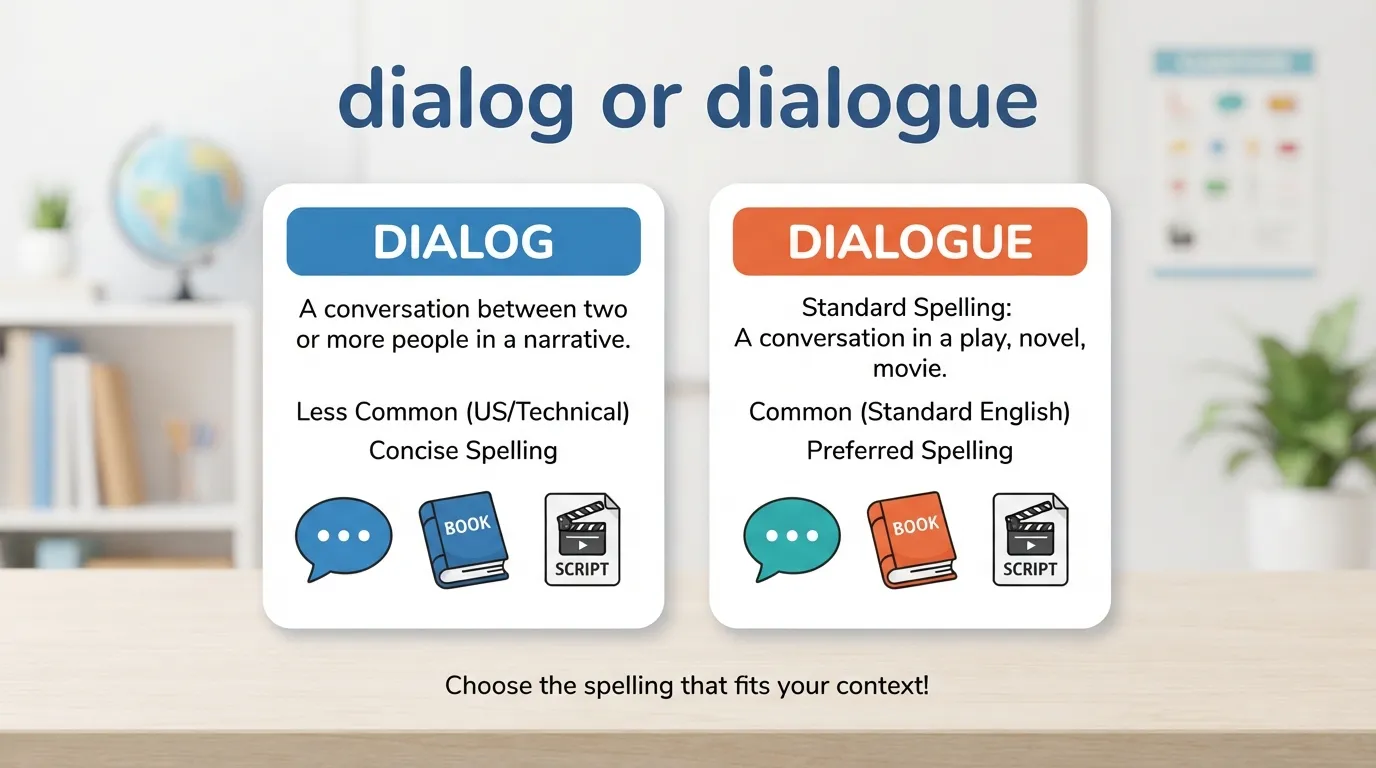
Dialog or dialogue means you are choosing between two accepted spellings. “Dialogue” is the more common standard spelling for conversation in books, plays, films, and formal discussion, while “dialog” is common in American technical and computing use.
Have you ever written “dialog” and then wondered if it should be “dialogue”?
I’ve seen this question many times in student essays, screenwriting notes, blog drafts, software guides, and business writing. The confusion makes sense. Both spellings look correct. Both sound the same. Both can refer to conversation.
But they do not always feel the same.
Dialogue is the spelling most readers expect in normal writing. You use it when talking about conversation in a novel, play, film, interview, classroom, or peace talks. Dialog is shorter and often appears in American English, especially in software terms like dialog box.
So, which one should you use?
This guide explains dialog or dialogue in simple English. You’ll learn the meaning, the spelling difference, common mistakes, real examples, and the best choice for essays, creative writing, business, and tech content.
Dialog or Dialogue: Quick Answer
Use “dialogue” for most writing. Use it when you mean conversation in a book, film, play, or real-life discussion. Use “dialog” mainly in American technical writing, especially for computer terms such as “dialog box.”
Cambridge lists dialogue as the main word and notes dialog as a US form. It defines dialogue as conversation written for a book, play, or film, and also as formal talks between groups.
Simple examples:
- Correct: The novel has strong dialogue.
- Correct: The two leaders opened a dialogue.
- Technical: Click the dialog box to continue.
- Less common in general writing: The novel has strong dialog.
Easy rule:
- Dialogue = best default spelling
- Dialog = shorter US spelling, often technical
- Dialog box = common computer term
The Origin / Background of Dialog or Dialogue
The confusion comes from regional spelling and technical usage. “Dialogue” keeps the older-looking “-ue” ending, while “dialog” is a shorter spelling. American English accepts both, but technical writing often prefers “dialog” for software interfaces.
Merriam-Webster lists dialogue as the main entry and gives dialog as a less common variant. It defines dialogue as the conversational part of a movie, play, or novel, and also as a conversation between two or more people.
Oxford Learner’s Dictionaries also lists dialogue as the main spelling and notes dialog as a US English form. It defines dialogue as conversation in a book, play, film, or language-learning material.
The word is useful in many areas:
- fiction writing
- film scripts
- plays
- language learning
- politics
- conflict resolution
- business meetings
- software interfaces
- user experience design
The spelling dialogue feels more natural for human conversation. The spelling dialog often feels more technical, especially in computing.
That is why you may see:
- character dialogue
- peace dialogue
- classroom dialogue
- login dialog box
- settings dialog
- confirmation dialog
Both spellings exist, but audience and context decide the better one.
Dialog or Dialogue Explained: Key Differences or Variations
The main difference is style and context. “Dialogue” is the standard spelling for most writing. “Dialog” is accepted, especially in American English, but it is most common in computing and technical writing. The meaning is often the same, but the tone changes.
| Term | Meaning | When to Use | Region/Context |
|---|---|---|---|
| Dialogue | Conversation between people | Essays, stories, scripts, formal talks | Standard English |
| Dialog | Shorter spelling of dialogue | Technical writing, software, US style | American and computing use |
| Dialog box | A small computer window asking for input | Software guides and UX writing | Technical English |
| Dialogue tags | Words like “said” or “asked” in fiction | Creative writing | Fiction and script writing |
| Open dialogue | Honest discussion | Workplace, politics, relationships | Formal and general English |
Cambridge’s American dictionary also lists dialogue with dialog as an alternate form for talking in a book, play, or movie.
Examples:
- The movie’s dialogue felt natural.
- The teacher asked students to practise the dialogue.
- The app shows a dialog box before deleting the file.
- The company wants open dialogue with customers.
For most non-technical writing, dialogue is the better spelling.
Which Version Should You Use?
Use “dialogue” if you are writing essays, stories, scripts, articles, reports, or formal discussions. Use “dialog” if you are writing software documentation, user interface text, or American technical content. If you are unsure, choose “dialogue.”
Here is the best practical advice:
- For students → use dialogue in essays and assignments.
- For fiction writers → use dialogue when describing character speech.
- For screenwriters → use dialogue for spoken lines.
- For business writers → use dialogue for discussion or communication.
- For software writers → use dialog in terms like dialog box.
- For US technical content → dialog is common.
- For global readers → dialogue is safer outside computing.
Examples:
- The story uses realistic dialogue.
- We need more dialogue between managers and staff.
- The error message appears in a dialog box.
- Select “OK” in the confirmation dialog.
A good rule is this:
People usually have dialogue. Computers often show a dialog.
Common Mistakes With Dialog or Dialogue
Most mistakes happen when writers use “dialog” in formal or creative writing where “dialogue” looks more natural. Another common issue is mixing both spellings in one article. Choose one spelling style based on context and stay consistent.
| Mistake | Correction | Why It Happens |
|---|---|---|
| The novel has great dialog. | The novel has great dialogue. | Creative writing usually uses dialogue |
| Click the dialogue box. | Click the dialog box. | Software writing often uses dialog |
| Mixing dialog and dialogue randomly | Choose one style | Writer sees both forms online |
| Writing dialouge | Write dialogue | Common letter-order mistake |
| Using dialogue when you mean monologue | Use monologue if one person speaks alone | Related writing terms are confused |
Mistake 1: Using “dialog” in literary writing
Less polished:
The book has sharp dialog.
Better:
The book has sharp dialogue.
In fiction, film, and theatre writing, dialogue is the more expected spelling.
Mistake 2: Using “dialogue box” in tech writing
Less common:
Click the dialogue box to continue.
Better:
Click the dialog box to continue.
In computing, dialog box is the common term.
Mistake 3: Mixing both spellings
Weak:
The app opens a dialog for user input. The next dialogue shows account settings.
Better:
The app opens a dialog for user input. The next dialog shows account settings.
For software writing, stay with dialog.
Dialog or Dialogue in Real-World Examples
You will see “dialogue” in books, plays, films, education, politics, and communication writing. You will see “dialog” more often in software, app design, and technical instructions. The right spelling depends on the setting.
Professional email example
Hi team,
We need open dialogue with customers before finalizing the new support policy.
This sounds clear and professional.
Fiction writing example
The first chapter has too much description and not enough dialogue.
This is the standard creative-writing spelling.
Software guide example
When the confirmation dialog appears, click Save.
This is common in technical writing.
Social media post example
Real change starts with honest dialogue, not shouting.
This uses the word in a public communication sense.
Formal document example
The committee encouraged continued dialogue between both departments.
This is formal and correct.
UI writing example
The settings dialog box lets users change their password and notification options.
This is the most natural technical use.
Dialog or Dialogue: Data, Trends & Usage
The search intent behind “dialog or dialogue” is informational. Most readers want to know which spelling is correct, whether the difference is American or British, and which version fits writing, school, scripts, or software.
People often search this phrase while writing:
- essays
- novels
- screenplays
- film reviews
- grammar worksheets
- business emails
- software guides
- UX copy
- app documentation
- classroom materials
The important point is that this is not always a simple right-or-wrong choice.
Dialogue is the stronger default for general English. Dialog is accepted, especially in US English, but it is more common in technical contexts.
A 2024 paper about spelling choice in NLP and AI research found mixed usage in computing research, with dialogue appearing more often than dialog in titles or abstracts among the studied papers, but both forms were common enough to create a visible split.
That supports the practical rule:
In general writing, choose dialogue. In software UI, choose dialog if your style guide uses it.
Dialog or Dialogue Comparison Table
A quick comparison makes the choice easier. Dialogue is the best spelling for human conversation, literature, and formal discussion. Dialog is common in American technical writing, especially when talking about computer windows or user interface prompts.
| Term/Variant | Meaning | Region/Context | Best Used When |
|---|---|---|---|
| Dialogue | Conversation or formal discussion | Standard general English | Writing essays, stories, scripts, reports, and articles |
| Dialog | Shorter spelling of dialogue | US English and technical writing | Writing software, UX, or computer documentation |
| Dialog box | Computer window that asks for input | Software and UI writing | Explaining app or computer steps |
| Dialogue tag | “Said,” “asked,” or similar speech label | Fiction writing | Teaching or editing story dialogue |
| Open dialogue | Honest exchange of ideas | Business, politics, relationships | Writing about communication |
| Monologue | Long speech by one person | Drama and writing | Comparing one-speaker speech with dialogue |
FAQs About Dialog or Dialogue
Q: What does dialog or dialogue mean?
A: Dialog or dialogue is a spelling choice. Both can refer to conversation, but dialogue is the better default for most writing.
Q: Is dialogue correct?
A: Yes. Dialogue is correct and widely used for conversation in books, plays, films, and formal discussion. Cambridge and Oxford list it as the main form.
Q: Is dialog correct?
A: Yes. Dialog is accepted, especially as a US form or in technical writing. Merriam-Webster lists dialog as a less common variant of dialogue.
Q: Dialog vs dialogue: what’s the difference?
A: The meaning is often the same, but the style differs. Dialogue is standard for general writing. Dialog is shorter and common in software terms like dialog box.
Q: Should I write dialog box or dialogue box?
A: Write dialog box in most software and computer writing. It is the common technical term.
Q: Which spelling should I use in a novel?
A: Use dialogue. Fiction writers usually use dialogue when talking about character speech.
Q: Can I use dialog and dialogue in the same article?
A: Avoid mixing them unless you have a clear reason. Use dialogue for general conversation and dialog for technical UI terms.
Conclusion
Now you know the difference between dialog or dialogue.
The safest spelling for most writing is dialogue. Use it for stories, scripts, films, essays, conversations, formal discussions, and business communication. It looks polished and widely accepted.
Dialog is also a real spelling, but it is less common in general writing. It is especially useful in American technical writing and computer terms like dialog box or settings dialog.
Remember this simple rule:
- Dialogue = standard general spelling
- Dialog = shorter US or technical spelling
- Dialog box = common computer term
- Dialogue = best for books, plays, films, and formal talks
If you are unsure, choose dialogue. It is the better default for most readers.
Now you know exactly how to use dialog or dialogue. Check your next essay, story, software guide, or article before you publish it.

Hassan Afzal has a background in English language instruction and writes to help non-native speakers and students master tricky grammar rules and word choices. Hassan Afzal’s writing style blends practical examples with clear explanations for everyday English learners.