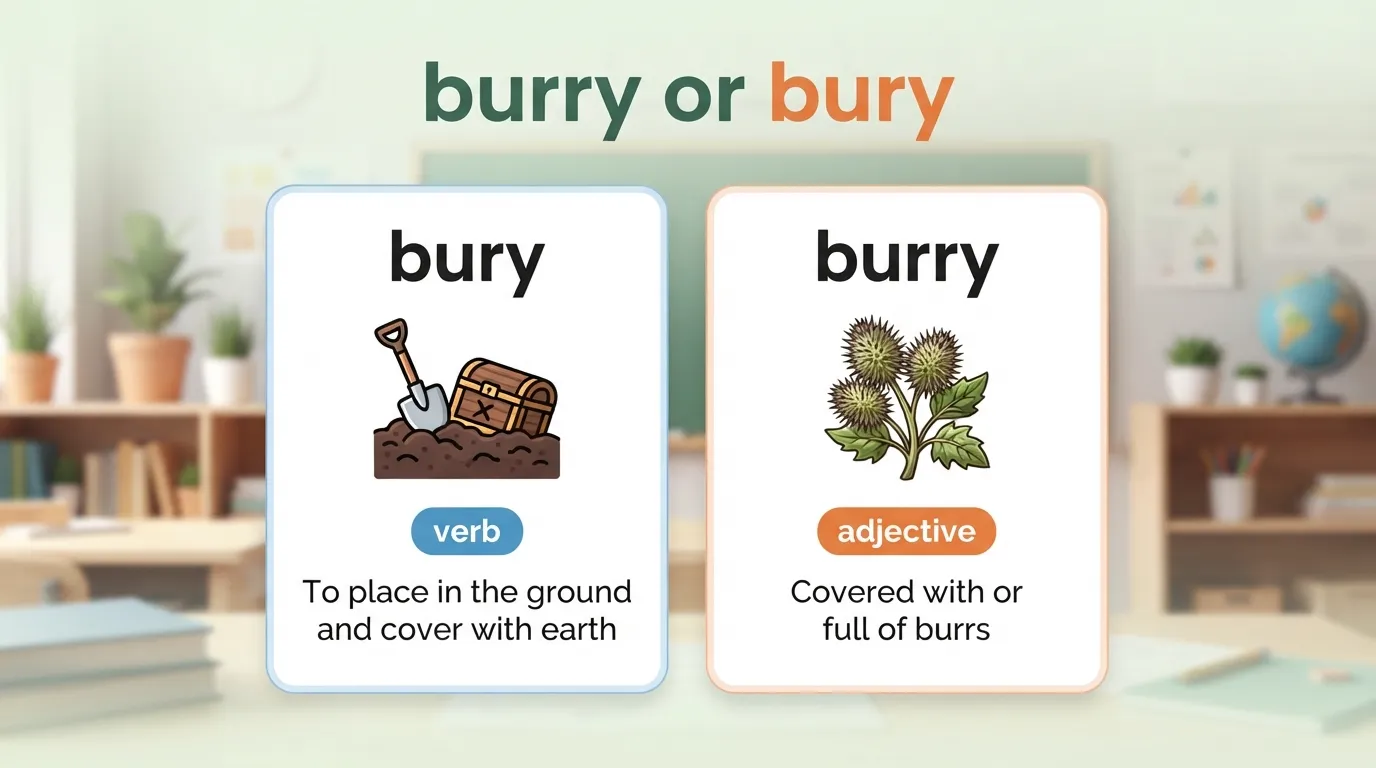
Burry or bury means you are choosing between two different words. “Bury” is the correct verb when you mean to cover, hide, or place something in the ground. “Burry” is a rare adjective meaning full of burrs or prickly.
Have you ever written “burry the treasure” and wondered if it should be “bury the treasure”?
This is a common spelling mistake. The word bury looks like it should have two r letters because it sounds like berry in many accents. But the correct spelling for the verb is bury, with one r.
Use bury when you mean to put something under the ground, cover something, hide something, or place a dead body in a grave. For example, “They will bury the box in the garden.”
Burry is not the normal spelling for this verb. It is a different word. It means covered with burrs, prickly, or marked by a burr-like sound in speech. It is much less common.
This guide explains burry or bury in simple English. You’ll learn the correct spelling, meanings, examples, common mistakes, and quick tests to choose the right word.
Burry or Bury: Quick Answer
Use “bury” when you mean to put something in the ground, cover something, hide something, or place a dead person or animal in a grave. Do not write “burry” for this verb. “Burry” is a rare adjective, not the normal action word.
Cambridge defines bury as putting a dead body into the ground, and also as hiding something in the ground or under something. Merriam-Webster defines burry as an adjective meaning containing burs, prickly, or marked by a burr in speech.
Simple examples:
- Correct: We need to bury the cable.
- Correct: The dog tried to bury the bone.
- Correct: They will bury the treasure.
- Rare adjective: The plant had a burry stem.
- Wrong: The dog tried to burry the bone.
Easy rule:
- Bury = verb, to cover or hide
- Burry = adjective, full of burrs or prickly
- Buried = past tense of bury
- Burying = present participle of bury
The Origin / Background of Burry or Bury
The confusion comes from sound. In many English accents, “bury” is pronounced like “berry.” That sound can make writers think the word needs two “r” letters. But the correct spelling of the verb is still “bury.”
Cambridge gives the US pronunciation of bury as /ˈber.i/, which helps explain why many people spell it incorrectly by sound.
The word bury is a common verb. It can mean several related things:
- to place a dead body in the ground
- to cover something with earth
- to hide something
- to cover something from view
- to hide feelings or facts
- to put something deep inside something else
Examples:
- They will bury him in the village cemetery.
- The child tried to bury a toy in the sand.
- She buried her face in her hands.
- The report was buried in the middle of the file.
Cambridge also defines bury as putting something where it is difficult or impossible to find or see.
Burry is different. It comes from burr, which can mean a rough, prickly seed case or a rough sound. That is why burry means prickly, full of burrs, or burr-like in speech.
Burry or Bury Explained: Key Differences or Variations
The main difference is grammar. “Bury” is a verb. It shows an action. “Burry” is an adjective. It describes something as prickly, full of burrs, or rough-sounding. They are not spelling variants for the same common verb.
| Term | Meaning | When to Use | Region/Context |
|---|---|---|---|
| Bury | To put under the ground or cover | Most everyday writing | Standard English |
| Buried | Past tense of bury | Talking about something already covered or hidden | General English |
| Burying | Present participle of bury | Talking about the action happening now | General English |
| Buries | Present tense with he, she, or it | Talking about a repeated or present action | General English |
| Burry | Full of burrs or prickly | Rare descriptive use | Botanical or descriptive writing |
| Burry speech | Speech with a burr-like sound | Describing accent or voice | Rare formal use |
Examples:
- The farmer will bury the pipe.
- The treasure was buried under the tree.
- He is burying the old wires.
- The dog buries bones in the yard.
- The weeds were burry and rough.
Merriam-Webster lists burry only as an adjective, not as the normal verb meaning “to place in the ground.”
Which Version Should You Use?
Use “bury” in almost every normal sentence. Use “burry” only if you are describing something that contains burrs, feels prickly, or has a burr-like speech sound. If the sentence shows an action, the correct word is probably “bury.”
Here is the best practical advice:
- For putting something underground → use bury.
- For hiding something → use bury.
- For funeral or grave context → use bury.
- For covering something with sand, snow, or soil → use bury.
- For past tense → use buried.
- For a prickly plant or burr-covered fabric → use burry.
- For normal school or blog writing → use bury, not burry.
Correct examples:
- Please bury the old cable safely.
- The snow will bury the road.
- She tried to bury the truth.
- He buried the box in the garden.
- The trail was full of burry weeds.
A quick test helps:
If the word means cover or hide, use bury.
If the word means prickly or full of burrs, use burry.
Common Mistakes With Burry or Bury
Most mistakes happen because writers spell “bury” the way it sounds. Another common mistake is adding an extra “r” to the past tense. The correct forms are “bury,” “buried,” and “burying,” not “burry,” “burried,” or “burrying.”
| Mistake | Correction | Why It Happens |
|---|---|---|
| Please burry the box. | Please bury the box. | Writer spells by sound |
| The treasure was burried. | The treasure was buried. | Extra “r” added |
| He is burrying the bone. | He is burying the bone. | Wrong base spelling |
| They will burry him tomorrow. | They will bury him tomorrow. | Verb should be bury |
| A bury plant scratched my pants. | A burry plant scratched my pants. | Adjective needed |
Mistake 1: Writing “burry” as the verb
Wrong:
The dog tried to burry the bone.
Correct:
The dog tried to bury the bone.
The action word is bury.
Mistake 2: Writing “burried”
Wrong:
The treasure was burried under the tree.
Correct:
The treasure was buried under the tree.
The past tense of bury is buried, not burried.
Mistake 3: Forgetting that burry is a real word
Burry is real, but it is not the common verb. It is an adjective. Use it only when you mean prickly, burr-covered, or burr-like.
Example:
The dog came home with burry fur after running through the weeds.
Burry or Bury in Real-World Examples
You can use bury or burry correctly by checking the meaning. “Bury” shows an action. “Burry” describes a rough or prickly quality. In most everyday writing, the word you need is “bury.”
Professional email example
Hi team,
Please bury the outdoor cable below the marked line and cover the area after inspection.
This is correct because the sentence means to place something underground.
Story example
The pirate decided to bury the treasure on a quiet island.
This is the normal verb.
Emotional sentence example
She tried to bury her sadness, but everyone could see she was hurt.
Here, bury means to hide feelings.
Weather example
Heavy snow may bury the road by morning.
Here, bury means to cover.
Nature description example
The field was full of burry plants that stuck to our socks.
Here, burry describes the plants.
Past tense example
The old box was buried under the floorboards.
This is the correct past form of bury.
Burry or Bury: Data, Trends & Usage
The search intent behind “burry or bury” is spelling-focused. Most readers want to know which spelling is correct, why “bury” sounds like “berry,” and whether “burry” is ever a real word.
People often search this phrase while writing:
- school essays
- stories
- captions
- emails
- grammar worksheets
- funeral-related sentences
- construction notes
- garden descriptions
- spelling practice
The best answer is simple:
Bury is the verb. Burry is a rare adjective.
This topic matters because burry can make a normal sentence look wrong. A sentence like “We will burry the pipe” should be “We will bury the pipe.”
It also matters because burry is not completely fake. Merriam-Webster defines burry as containing burs, prickly, or characterized by a burr in speech.
So the safest rule is not “burry is never a word.” The better rule is:
Do not use burry when you mean bury.
Burry or Bury Comparison Table
A quick comparison makes the choice easy. Bury is the correct verb for covering, hiding, or placing something in the ground. Burry is a rare adjective for something prickly, burr-covered, or burr-like.
| Term/Variant | Meaning | Region/Context | Best Used When |
|---|---|---|---|
| Bury | To put in the ground, cover, or hide | Standard English | Writing an action sentence |
| Buried | Covered, hidden, or placed in the ground | Standard English | Talking about the past |
| Burying | The act of covering or hiding | Standard English | Talking about an ongoing action |
| Buries | Covers or hides | Standard English | Present tense with he, she, or it |
| Burry | Full of burrs or prickly | Rare descriptive English | Describing plants, fur, or rough texture |
| Burry speech | Speech with a burr-like sound | Rare formal use | Describing voice or accent |
FAQs About Burry or Bury
Q: What does burry or bury mean?
A: Burry or bury is a spelling choice. Bury is the correct verb for covering, hiding, or placing something in the ground. Burry is a rare adjective.
Q: Is bury correct?
A: Yes. Bury is correct when you mean to put something in the ground, cover something, hide something, or place a dead body in a grave. Cambridge defines bury with these meanings.
Q: Is burry correct?
A: Burry can be correct, but only as an adjective. It means containing burrs, prickly, or marked by a burr-like sound.
Q: Burry vs bury: what’s the difference?
A: Bury is a verb. Burry is an adjective. Use bury for actions and burry for prickly or burr-covered things.
Q: Is it “bury the body” or “burry the body”?
A: The correct phrase is bury the body. The verb is spelled bury.
Q: Is it “buried” or “burried”?
A: The correct spelling is buried. Do not double the r.
Q: Why is bury pronounced like berry?
A: In many accents, bury is pronounced like berry. Cambridge lists the US pronunciation as /ˈber.i/.
Conclusion
Now you know the difference between burry or bury.
The correct verb is bury. Use it when you mean to place something in the ground, cover something, hide something, or put a dead person or animal in a grave.
Burry is a different word. It is a rare adjective that means full of burrs, prickly, or burr-like. It is not the normal spelling for the action word.
Remember this simple rule:
- Bury = cover, hide, or place in the ground
- Buried = past tense
- Burying = action happening now
- Burry = prickly or full of burrs
If you are unsure, ask one question: does the sentence show an action? If yes, use bury.
Now you know exactly how to use burry or bury. Check your next sentence, story, email, or school answer before you send it.

Luqman Aleem holds a strong academic foundation in English language and linguistics. Luqman Aleem researches and writes in-depth comparisons of frequently misused words, drawing on formal grammar rules and real-world usage patterns to guide readers toward correct English.