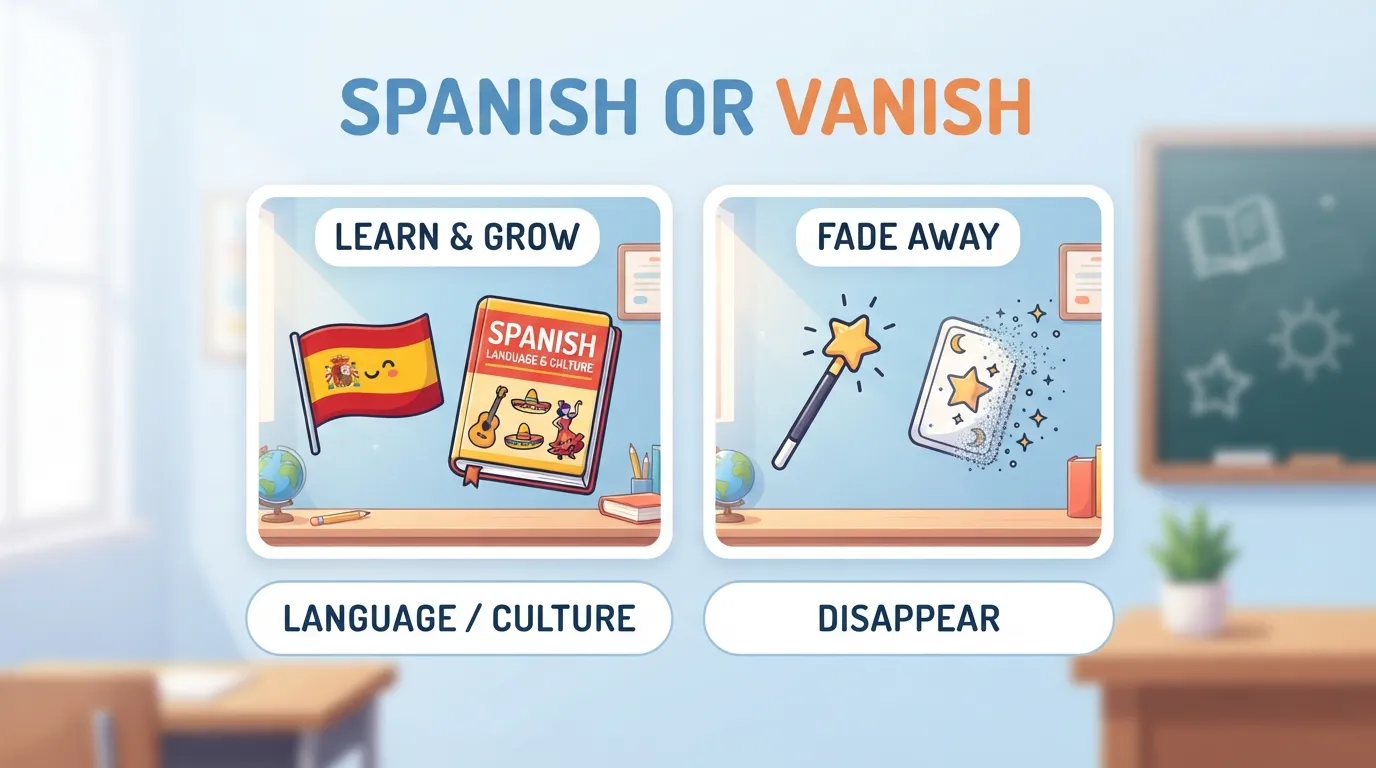
Spanish or vanish means you are choosing between two very different words. “Spanish” relates to Spain, its people, or its language, while “vanish” means to disappear or stop being seen.
Have you ever typed “Spanish” when you meant “vanish,” or saw both words together and wondered if they were connected?
This mistake can happen because the words look a little similar at the end. Both include the “-nish” sound. But their meanings are not close at all.
Spanish is a proper word linked to a language, country, people, food, culture, and nationality. It should usually start with a capital S because it is a proper adjective or proper noun.
Vanish is a verb. It means something disappears, goes out of sight, or stops being present.
So the choice is simple once you check the sentence. If you are talking about Spain, Spanish-speaking people, or the Spanish language, use Spanish. If you are talking about something disappearing, use vanish.
This guide explains Spanish or vanish in simple English. You’ll learn the meanings, differences, common mistakes, examples, and quick tests to choose the right word.
Spanish or Vanish: Quick Answer
Use “Spanish” when you mean the language, people, or things related to Spain. Use “vanish” when you mean disappear. “Spanish” is usually capitalized. “Vanish” is usually lowercase unless it starts a sentence.
Cambridge defines Spanish as belonging to or relating to Spain, its people, or its language. Merriam-Webster defines vanish as to pass quickly from sight, disappear, or pass completely from existence.
Simple examples:
- Correct: I am learning Spanish.
- Correct: She likes Spanish food.
- Correct: The rabbit seemed to vanish.
- Correct: My keys always vanish when I need them.
- Wrong: I am learning vanish.
- Wrong: The rabbit seemed to Spanish.
Easy rule:
- Spanish = language, country, people, culture
- Vanish = disappear
The Origin / Background of Spanish or Vanish
The confusion comes from spelling, not meaning. “Spanish” and “vanish” both end with a similar sound, but they have different grammar roles. “Spanish” is a noun or adjective. “Vanish” is a verb.
Spanish can work as a noun.
Examples:
- I speak Spanish.
- She teaches Spanish.
- We studied Spanish in school.
Spanish can also work as an adjective.
Examples:
- Spanish music is popular.
- He ordered a Spanish omelet.
- They visited a Spanish city.
Vanish works as a verb.
Examples:
- The smoke began to vanish.
- The magician made the coin vanish.
- Her smile seemed to vanish after the bad news.
Cambridge defines vanish as to disappear or stop being present or existing, especially in a sudden or surprising way.
The best way to remember the difference is this:
Spanish names something. Vanish shows an action.
Spanish or Vanish Explained: Key Differences or Variations
The main difference is meaning and grammar. “Spanish” describes a language, nationality, or culture. “Vanish” describes the action of disappearing. They are not spelling variants of the same word.
| Term | Meaning | When to Use | Region/Context |
|---|---|---|---|
| Spanish | Language of Spain and many other countries | Talking about language | Education, travel, culture |
| Spanish | Related to Spain, its people, or culture | Describing food, music, people, places | Proper adjective |
| Vanish | To disappear | Talking about something going out of sight | Everyday English |
| Vanished | Disappeared | Talking about the past | Stories, news, daily writing |
| Vanishing | Disappearing | Talking about an ongoing action | Descriptions, reports |
| Vanishes | Disappears | Present tense with he, she, it | General writing |
Merriam-Webster defines Spanish as the Romance language of most of Spain and countries colonized by Spaniards. It also lists Spanish as an adjective.
Examples:
- Spanish class starts at 9 a.m.
- The bird seemed to vanish into the trees.
- She loves Spanish art.
- The stain did not vanish after washing.
The words may look close, but the sentence meaning makes the correct choice clear.
Which Version Should You Use?
Use “Spanish” if the sentence is about language, nationality, country, people, food, music, art, culture, or school subjects. Use “vanish” if the sentence is about disappearing, going away, fading, or no longer being seen.
Here is the best practical advice:
- For language learning → use Spanish.
- For Spain-related topics → use Spanish.
- For nationality or culture → use Spanish.
- For magic tricks → use vanish.
- For lost items → use vanish.
- For things fading away → use vanish.
- For formal writing → capitalize Spanish.
Correct examples:
- I want to learn Spanish.
- She bought a Spanish dictionary.
- The plane seemed to vanish behind the clouds.
- The pain did not vanish overnight.
- He enjoys Spanish films.
- The sound slowly began to vanish.
A quick test helps:
If you can replace the word with “disappear,” use vanish.
If you can replace the word with “the language from Spain,” use Spanish.
Common Mistakes With Spanish or Vanish
Most mistakes happen when writers choose the wrong word because the endings look similar. Another common mistake is forgetting to capitalize “Spanish.” Since Spanish is linked to a language and nationality, it usually needs a capital S.
| Mistake | Correction | Why It Happens |
|---|---|---|
| I speak vanish. | I speak Spanish. | Writer needs the language name |
| The cat will Spanish. | The cat will vanish. | Writer needs a verb |
| I like spanish food. | I like Spanish food. | Proper adjective needs capital letter |
| The coin Spanished. | The coin vanished. | Wrong verb form |
| He is taking a vanish class. | He is taking a Spanish class. | School subject is Spanish |
Mistake 1: Using vanish as a language
Wrong:
I am learning vanish.
Correct:
I am learning Spanish.
A language name is needed, so Spanish is correct.
Mistake 2: Using Spanish as a verb
Wrong:
The bird will Spanish from sight.
Correct:
The bird will vanish from sight.
An action word is needed, so vanish is correct.
Mistake 3: Forgetting the capital letter
Wrong:
She speaks spanish.
Correct:
She speaks Spanish.
Language names are capitalized in English.
Spanish or Vanish in Real-World Examples
You can use Spanish or vanish correctly by checking the sentence meaning. Spanish names a language or describes something related to Spain. Vanish tells that something disappears or goes out of sight.
Professional email example
Hi Maria,
Please send the Spanish version of the brochure before Friday.
This is correct because the sentence is about the Spanish language.
Story example
The old house seemed to vanish in the fog.
This is correct because the house became hard to see.
School sentence example
My brother takes Spanish every Monday and Wednesday.
This is correct because Spanish is a school subject.
Magic trick example
The magician made the card vanish from his hand.
This is correct because the card disappeared.
Travel example
We tried Spanish food during our trip.
This is correct because the food is related to Spain.
Everyday example
My phone charger always seems to vanish.
This is correct because the charger disappears or cannot be found.
Spanish or Vanish: Data, Trends & Usage
The search intent behind “Spanish or vanish” is likely spelling and meaning confusion. Most readers want to know whether these words are related, which one is correct, and how to use them in a sentence.
People may search this phrase while writing:
- school sentences
- English homework
- captions
- stories
- language-learning notes
- spelling worksheets
- simple grammar exercises
- vocabulary lists
The most useful answer is:
Spanish is a language or adjective. Vanish is a verb meaning disappear.
This topic matters because the wrong word makes the sentence confusing. For example, “I speak vanish” does not make sense. “I speak Spanish” does.
The two words also differ in capitalization. Spanish normally starts with a capital letter because it is a proper noun or proper adjective. Vanish is lowercase unless it begins a sentence.
That small detail can make writing look cleaner and more correct.
Spanish or Vanish Comparison Table
A quick comparison makes the choice easy. Use Spanish for language, people, culture, or Spain-related meaning. Use vanish for disappear. They are not regional spellings and they are not interchangeable.
| Term/Variant | Meaning | Region/Context | Best Used When |
|---|---|---|---|
| Spanish | Language spoken in Spain and many other countries | Language learning, school, translation | Talking about the language |
| Spanish | Related to Spain, its people, or culture | Food, art, music, history | Describing Spain-related things |
| Vanish | To disappear | Stories, daily speech, descriptions | Something goes out of sight |
| Vanished | Disappeared | Past tense | Something disappeared before now |
| Vanishing | Disappearing | Ongoing action | Something is fading or going away |
| Vanishes | Disappears | Present tense | Something disappears now or often |
FAQs About Spanish or Vanish
Q: What does Spanish or vanish mean?
A: Spanish or vanish is a word-choice question. Spanish relates to Spain, its people, or its language. Vanish means to disappear.
Q: Is Spanish correct?
A: Yes. Spanish is correct when you mean the language, the people, or something related to Spain. Cambridge defines it as relating to Spain, its people, or its language.
Q: Is vanish correct?
A: Yes. Vanish is correct when you mean disappear or stop being seen. Cambridge defines it as to disappear or stop being present or existing.
Q: Spanish vs vanish: what’s the difference?
A: Spanish is a noun or adjective. Vanish is a verb. Spanish names a language or describes something related to Spain. Vanish means disappear.
Q: Should Spanish be capitalized?
A: Yes. In English, Spanish is usually capitalized because it is a language name, nationality word, or proper adjective.
Q: Can vanish be used as a noun?
A: In normal everyday writing, vanish is mainly a verb. Use it for actions like “The smoke began to vanish.”
Q: Is “I speak vanish” correct?
A: No. The correct sentence is “I speak Spanish.” Vanish is not a language.
Conclusion
Now you know the difference between Spanish or vanish.
The words are not the same. They do not have the same meaning. They are not British and American spelling variants. They only look a little similar.
Use Spanish when you talk about the language, people, food, culture, or anything related to Spain. Use vanish when something disappears, fades, or stops being seen.
Remember this simple rule:
- Spanish = language, Spain, people, culture
- Vanish = disappear
- Spanish = usually capitalized
- Vanish = usually lowercase
If you are unsure, test the sentence. If the word means disappear, choose vanish. If it means a language or Spain-related idea, choose Spanish.
Now you know exactly how to use Spanish or vanish. Check the meaning first, then choose the right word.

Zain Ali is an English content specialist with editorial experience in creating clear, accurate, and reader-friendly grammar guides. Zain is passionate about breaking down confusing English word pairs into simple, actionable explanations.