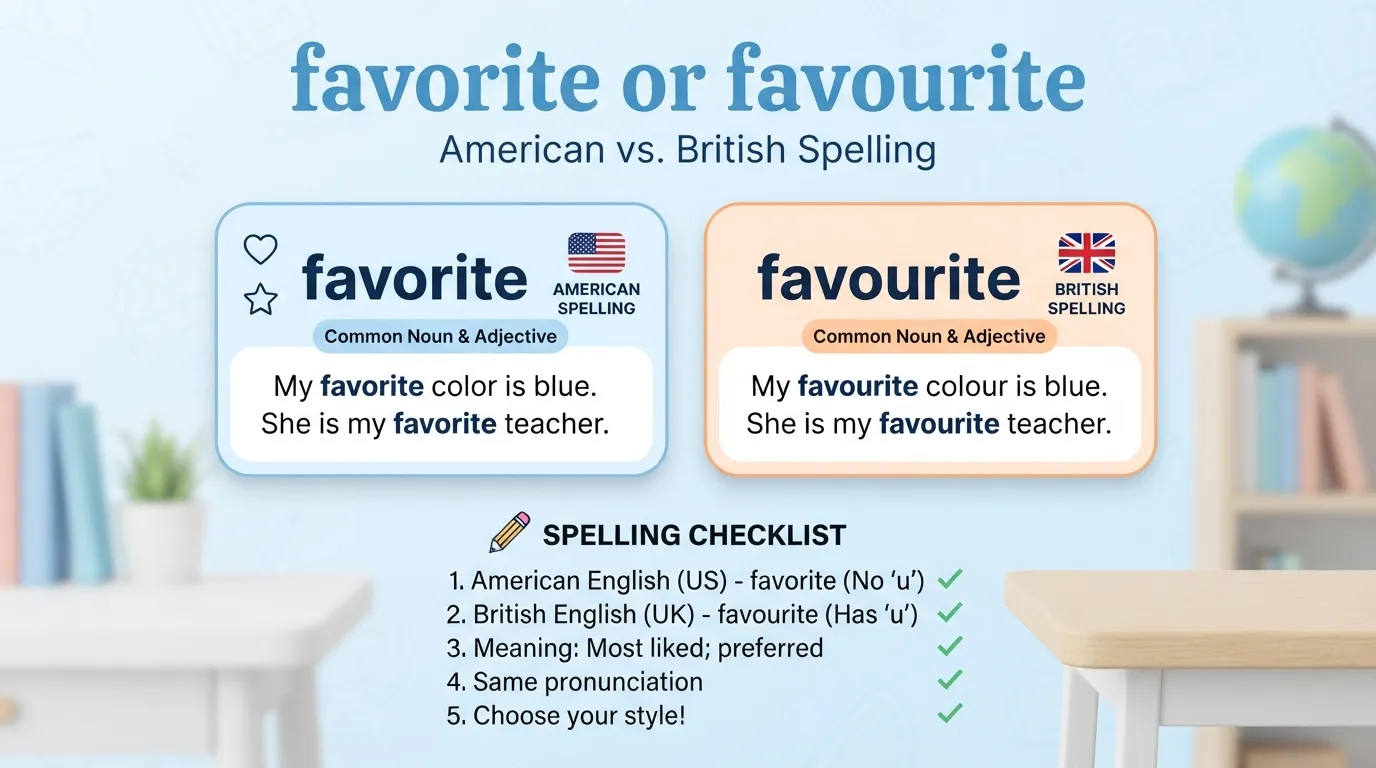
Favorite or favourite means you are choosing between American and British spelling. “Favorite” is the standard spelling in American English, while “favourite” is the standard spelling in British English and many Commonwealth varieties.
Have you ever written “favourite” and then your spell checker changed it to “favorite”?
This happens often in essays, captions, product pages, blog posts, school work, and emails. The word is simple, but the spelling can feel confusing because both versions are correct.
The difference is not meaning. The difference is region.
If you write for American readers, favorite looks natural. If you write for British, Canadian, Australian, or many Commonwealth readers, favourite often looks more natural.
This matters in professional writing too. A US website should usually use favorite. A UK website should usually use favourite. If you mix both spellings in one article, the writing can look careless.
This guide explains favorite or favourite in simple English. You’ll learn the meaning, spelling difference, common mistakes, real examples, and which version to use in school, work, SEO, and daily writing.
Favorite or Favourite: Quick Answer
Use “favorite” in American English. Use “favourite” in British English and many Commonwealth spelling styles. The meaning is the same: the person, thing, place, or choice you like best.
Cambridge lists favorite as the US spelling of favourite and defines it as something best liked or most enjoyed. Merriam-Webster also says favorite and favourite are variant spellings with the same definition, with favorite used in the United States and favourite used in much of the rest of the English-speaking world.
Simple examples:
- American English: Pizza is my favorite food.
- British English: Pizza is my favourite food.
- American English: That is my favorite song.
- British English: That is my favourite song.
Easy rule:
- Favorite = American English
- Favourite = British English
- Meaning = the same
If your audience is in the United States, use favorite. If your audience is in the UK or many Commonwealth countries, use favourite.
The Origin / Background of Favorite or Favourite
The spelling difference comes from regional English. British English often keeps the “u” in words like “favourite,” “colour,” and “honour.” American English usually drops the “u,” giving us “favorite,” “color,” and “honor.”
The word can work as both a noun and an adjective.
As an adjective:
- My favorite color is blue.
- My favourite colour is blue.
As a noun:
- This song is my favorite.
- This song is my favourite.
Merriam-Webster notes that both spellings can function as a noun and as an adjective. It also explains that the u in favourite traces back to French influence on English after the Norman conquest.
This spelling pattern appears in many common word pairs:
- favorite / favourite
- color / colour
- honor / honour
- behavior / behaviour
- neighbor / neighbour
- flavor / flavour
The meaning does not change. The audience changes the spelling.
Favorite or Favourite Explained: Key Differences or Variations
The main difference is region. “Favorite” is American spelling. “Favourite” is British spelling. Both mean the same thing, and both can be used for people, places, foods, songs, books, teams, colors, and choices.
| Term | Meaning | When to Use | Region/Context |
|---|---|---|---|
| Favorite | Best liked or most enjoyed | Writing for US readers | American English |
| Favourite | Best liked or most enjoyed | Writing for UK/Commonwealth readers | British English |
| Favorites | Plural of favorite | Talking about several liked things | American English |
| Favourites | Plural of favourite | Talking about several liked things | British English |
| Least favorite | Liked the least | US-style spelling | American English |
| Least favourite | Liked the least | UK-style spelling | British English |
Cambridge’s American dictionary entry also notes favourite as the Canadian and British form of favorite. Oxford Learner’s Dictionaries lists favourite/favorite as a person or thing someone likes more than others of the same type.
Examples:
- US: This is my favorite restaurant.
- UK: This is my favourite restaurant.
- US: These are my favorites.
- UK: These are my favourites.
- US: Math is my least favorite subject.
- UK: Maths is my least favourite subject.
The spelling changes, but the feeling stays the same.
Which Version Should You Use?
Use “favorite” when writing for American readers, US schools, US businesses, or American-style websites. Use “favourite” when writing for British, Canadian, Australian, New Zealand, or many Commonwealth readers. For global content, choose one spelling style and stay consistent.
Here is the best practical advice:
- For US readers → use favorite.
- For UK readers → use favourite.
- For Canadian readers → favourite is common in standard spelling.
- For Australian readers → use favourite.
- For school work → follow your teacher’s English style.
- For SEO content → match the target country.
- For brand names → copy the official spelling.
Examples:
- US blog title: My Favorite Summer Recipes
- UK blog title: My Favourite Summer Recipes
- US product copy: Save this item to your favorites
- UK product copy: Save this item to your favourites
If your website targets the United States, favorite is usually better. If your website targets the UK, favourite is usually better.
For a global site, pick one style for each page or region. Do not mix both randomly.
Common Mistakes With Favorite or Favourite
Most mistakes happen when writers mix American and British spelling in the same article. Another common mistake is thinking one spelling is wrong. Both are correct, but each one fits a different audience and writing style.
| Mistake | Correction | Why It Happens |
|---|---|---|
| Mixing favorite and favourite in one page | Pick one style | Writer uses mixed sources |
| Writing favourite for a US-only page | Use favorite | Audience is American |
| Writing favorite for a UK-only page | Use favourite | Audience is British |
| Using favorite colour in UK style | Use favourite colour | Spelling styles are mixed |
| Using favourite color in US style | Use favorite color | British and American forms are mixed |
Mistake 1: Mixing spellings
Weak:
My favourite song is on my favorite playlist.
Better for American English:
My favorite song is on my favorite playlist.
Better for British English:
My favourite song is on my favourite playlist.
Mistake 2: Forgetting related words
If you choose favorite, use related American spellings too:
- favorite
- favorites
- favorable
- favor
If you choose favourite, use related British spellings too:
- favourite
- favourites
- favourable
- favour
Oxford lists favourable as the British spelling and notes favorable as the US English form.
Mistake 3: Trusting spell check without checking settings
Spell check depends on your language setting.
If your tool is set to US English, it may mark favourite as wrong. If it is set to UK English, it may mark favorite as wrong.
That does not mean the spelling is wrong. It means your tool is following a different English style.
Favorite or Favourite in Real-World Examples
You can use favorite or favourite correctly by matching the spelling to your reader. American writing uses favorite. British-style writing uses favourite. The meaning stays the same in emails, captions, essays, product pages, and reviews.
Professional email example
US style:
Hi team,
Please choose your favorite design option before Friday.
UK style:
Hi team,
Please choose your favourite design option before Friday.
Product page example
US style:
Add this item to your favorites and buy it later.
UK style:
Add this item to your favourites and buy it later.
Social media caption example
US style:
This is my favorite coffee spot in the city.
UK style:
This is my favourite coffee spot in the city.
School sentence example
US style:
My favorite book is about space.
UK style:
My favourite book is about space.
Review example
US style:
This is one of my favorite restaurants.
UK style:
This is one of my favourite restaurants.
Favorite or Favourite: Data, Trends & Usage
The search intent behind “favorite or favourite” is informational. Most readers want to know which spelling is correct, whether the difference is American or British, and which version they should use in school, SEO, business, or daily writing.
People often search this phrase while writing:
- essays
- blog posts
- product descriptions
- reviews
- social captions
- app buttons
- website menus
- school worksheets
- emails
This topic matters because spelling affects trust. A US reader expects favorite. A UK reader expects favourite. If a page mixes both spellings, it can feel inconsistent.
The simple answer is:
Use favorite for American English. Use favourite for British English.
Spelling style can also affect search and retrieval. A research paper on regional spelling conventions notes that American and British spellings are different surface forms with similar or identical meanings, and that spelling convention can affect retrieval models in some cases.
For SEO, match your target country. A US page should usually use favorite. A UK page should usually use favourite.
Favorite or Favourite Comparison Table
A quick comparison makes the choice easy. Favorite and favourite mean the same thing. Favorite is American spelling. Favourite is British spelling. The best choice depends on your audience, region, and style guide.
| Term/Variant | Meaning | Region/Context | Best Used When |
|---|---|---|---|
| Favorite | Best liked or most enjoyed | American English | Writing for US readers |
| Favourite | Best liked or most enjoyed | British/Commonwealth English | Writing for UK, Australian, or many Commonwealth readers |
| Favorites | Things liked best | American English | US apps, websites, lists, and writing |
| Favourites | Things liked best | British English | UK apps, websites, lists, and writing |
| Least favorite | Liked the least | American English | US-style comparisons |
| Least favourite | Liked the least | British English | UK-style comparisons |
| Favor | Approval or support | American English | US spelling |
| Favour | Approval or support | British English | UK spelling |
FAQs About Favorite or Favourite
Q: What does favorite or favourite mean?
A: Favorite or favourite is a spelling choice. Both words mean the person, place, thing, or choice someone likes best.
Q: Is favorite correct?
A: Yes. Favorite is correct in American English. Cambridge lists favorite as the US spelling of favourite.
Q: Is favourite correct?
A: Yes. Favourite is correct in British English and many Commonwealth spelling styles. Merriam-Webster says favourite is used in much of the English-speaking world outside the United States.
Q: Favorite vs favourite: what’s the difference?
A: The meaning is the same. The difference is spelling by region. Favorite is American English. Favourite is British English.
Q: Which spelling should I use in the USA?
A: Use favorite in the USA. For example, write favorite food, favorite song, and favorite color.
Q: Which spelling should I use in the UK?
A: Use favourite in the UK. For example, write favourite food, favourite song, and favourite colour.
Q: Can I use favorite and favourite in one article?
A: It is better not to mix them. Choose one spelling style and use it consistently, unless you are quoting a title, brand name, or exact text.
Conclusion
Now you know the difference between favorite or favourite.
The meaning is the same. The spelling depends on the English style you use. Favorite is American English. Favourite is British English and is also common in many Commonwealth countries.
Remember this simple rule:
- Favorite = US spelling
- Favourite = UK/Commonwealth spelling
- Meaning = the same
- Best practice = stay consistent
If you write for American readers, use favorite, favorites, and favorable. If you write for British-style readers, use favourite, favourites, and favourable.
Do not let spell check confuse you. Check your language setting first. Then match your spelling to your audience.
Now you know exactly how to use favorite or favourite. Check your next essay, caption, product page, or blog post before you publish it.

Muhammad Afzal is a language content writer specializing in English grammar, word usage, and vocabulary distinctions. With a strong command of linguistic nuance, Muhammad Afzal focuses on simplifying commonly confused word pairs to help readers communicate with clarity and confidence.