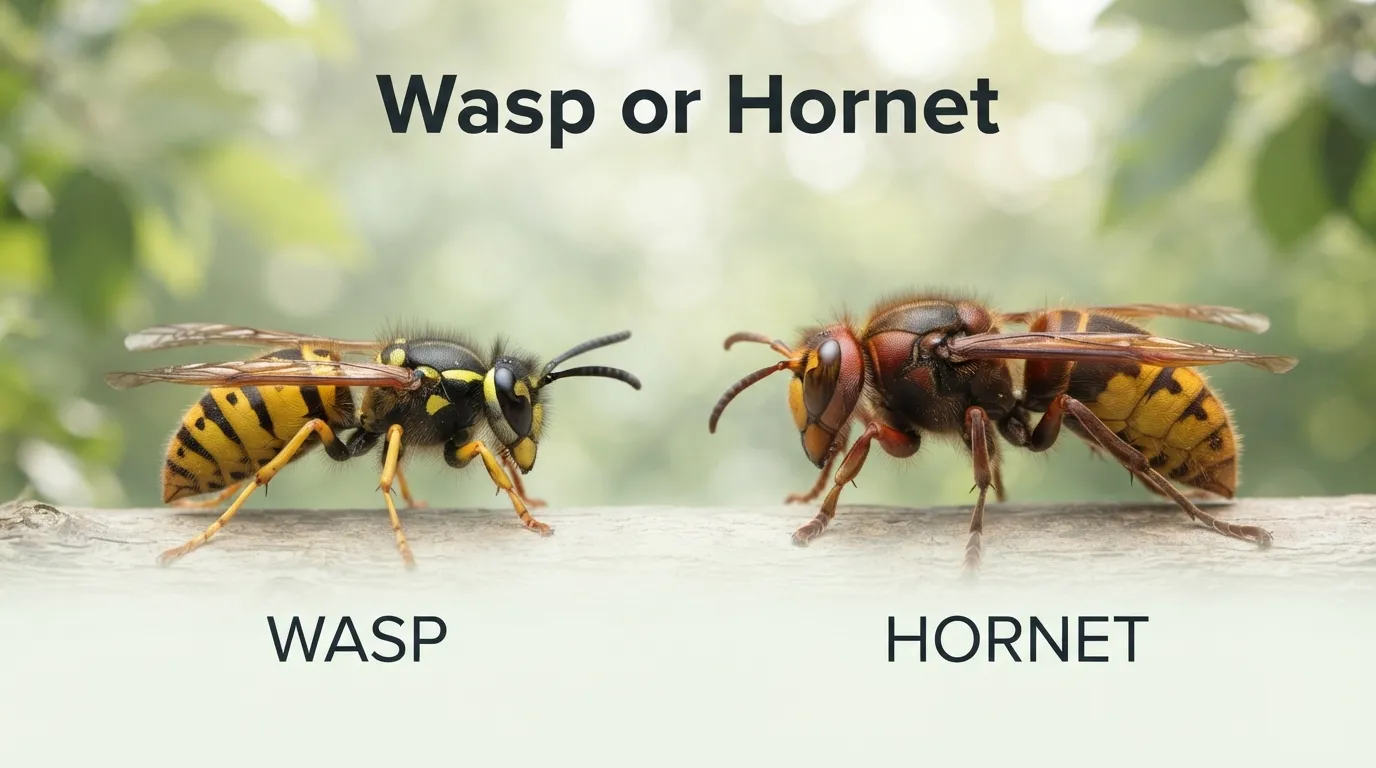
A hornet is a type of wasp, but not every wasp is a hornet. True hornets belong to the genus Vespa and are social wasps; many familiar hornets are larger and more robust than common yellowjackets or paper wasps, but size and color alone are not always enough for identification.
Seeing a large buzzing insect nearby can quickly raise the question: is it a wasp or hornet? The answer is not always obvious. Wasps come in many shapes, sizes, and colors, and some insects commonly called hornets are not true hornets in the scientific sense.
The most useful fact to remember is that hornets belong within the larger group we call wasps. Appearance can provide clues, but species and location matter. Learning about body shape, size, markings, nests, and behavior can help you make a better identification without getting dangerously close.
Wasp or Hornet: What Is the Main Difference?
Wasp is a broad term covering many kinds of insects, including social and solitary species. Hornets are a smaller group of social wasps; true hornets belong to the genus Vespa.
That means the relationship is similar to this:
All true hornets are wasps, but not all wasps are hornets.
| Feature | Wasp | Hornet |
|---|---|---|
| Classification | Broad group of insects | A type of social wasp |
| Typical build | Varies from very slender to robust | Often relatively large and robust |
| Color | Highly variable | Varies by species |
| Nesting | Ground, cavities, buildings, exposed nests, mud nests, and more | Social nests, often made from paper-like material |
| Social behavior | Can be solitary or social | True hornets are social |
| Sting | Females of many species can sting | Female workers and queens can sting |
| Best identification clue | Species-specific features | Species-specific features |
Because wasps are so diverse, there is no single color, size, or nest shape that separates every wasp from every hornet. Even researchers note that hornet identification can be complicated by variation in size and coloration.
What Is a Wasp?
A wasp is a broad name used for many insects in the order Hymenoptera. The group includes familiar insects such as yellowjackets, paper wasps, solitary hunting wasps, and hornets. The Smithsonian specifically includes hornets among the familiar types of wasps.
Wasps can be either social or solitary.
Social species share a nest with other members of their colony. Yellowjackets and paper wasps are common examples. Solitary species generally maintain their own nests and are often much less defensive around people.
Wasps also vary greatly in appearance. For example, paper wasps are often slender and long-legged, while yellowjackets have compact bodies with relatively little hair. Other wasps may be black, metallic, reddish, or otherwise very different from the familiar yellow-and-black pattern.
What Is a Hornet?
A true hornet is a social wasp belonging to the genus Vespa. UC Davis, summarizing research coauthored by entomologists from UC Davis, USDA APHIS, and the American Museum of Natural History, identifies true hornets as members of this genus.
Hornets are predators of other insects and live in colonies. Like other social wasps, they can defend their nests when they perceive a threat.
One familiar example is the European hornet (Vespa crabro). Penn State reports that European hornet workers may reach about 25 mm, or one inch, while queens can grow to roughly 35 mm, or 1.3 inches.
However, those measurements apply to that particular species. You should not assume that every large wasp is a hornet.
How to Tell a Wasp From a Hornet
There is no perfect one-step visual test, but several clues can help.
1. Look at the Overall Build
Many familiar hornets have a large, heavy, robust appearance.
Common paper wasps tend to look more slender. University of Minnesota Extension describes paper wasps as slender insects with long legs that may hang beneath the body during flight.
Yellowjackets have a more compact appearance. Depending on the species, they may measure roughly 3/8 to 5/8 inch long and often have bright yellow-and-black markings.
A large body can point toward some hornet species, but size alone is unreliable because several non-hornet wasps are also large. Cicada killer wasps, for example, can reach roughly two inches long.
2. Check the Colors and Markings
Do not use the rule “yellow and black equals wasp, brown equals hornet.” Color varies too much between species.
Yellowjackets are often bright yellow and black. European hornets have a different overall appearance, while northern giant hornets have been described by USDA as having a large yellow or orange head, a dark thorax, and dark-and-orange or yellow bands on the abdomen.
Other wasps can be black, reddish, orange, metallic green, or blue. Color is therefore useful only when combined with other identification features.
3. Consider the Nest
Nest type can offer another clue, but it does not automatically tell you whether an insect is a hornet.
Many social wasps make nests from a paper-like pulp created from chewed wood fibers. Yellowjackets may nest underground or in cavities, while some related aerial-nesting species build enclosed paper nests in trees or under structures. Paper wasps typically make a single exposed comb rather than a fully enclosed nest.
Because different wasps use different nesting sites, avoid approaching a nest simply to identify it.
4. Notice the Behavior From a Safe Distance
Behavior can help, but it should not be used as your only identification tool.
Many solitary wasps are unlikely to sting people unless physically threatened or handled. Social wasps may be much more defensive when their colony or nest is disturbed.
An insect calmly feeding on flowers away from its nest may behave very differently from the same type of insect near a colony.
Are Hornets More Dangerous Than Wasps?
It is too simple to say that hornets are always more dangerous than wasps.
“Wasp” covers a huge range of species. Some solitary wasps present little sting risk during ordinary encounters, while social yellowjackets and hornets can defend their nests vigorously. The danger depends on the species, whether a nest is being threatened, how many insects are present, and whether the person who is stung has a venom allergy.
Hornets, yellowjackets, and other wasps can also sting more than once. Unlike a honey bee, they do not necessarily leave their stinger behind after one sting.
The safer rule is:
Do not disturb an active wasp or hornet nest, regardless of the species.
Do Wasps and Hornets Sting?
Yes. Female workers of many social wasp species can sting, including hornets and yellowjackets. They may sting repeatedly.
A typical sting causes pain, redness, and swelling around the sting site. More serious allergic reactions can involve hives away from the sting, difficulty breathing, swelling of the tongue or throat, or other systemic symptoms. Such reactions require immediate medical attention.
If you know you have a serious insect-sting allergy, follow the emergency plan provided by your healthcare professional.
What About the Bald-Faced Hornet?
The bald-faced hornet is a useful example of why common names can be confusing.
Despite its name, the bald-faced hornet is not a true hornet of the genus Vespa. It belongs to Dolichovespula and is closely associated with the yellowjackets. Ohio State University Extension identifies it as a yellowjacket rather than a true hornet.
Bald-faced hornets are black with distinctive white or cream markings and commonly make large aerial paper nests.
So the word hornet in an insect’s common name does not always mean it is scientifically a true hornet.
Practical Identification Examples
Example 1: Small Yellow-and-Black Insects Entering the Ground
You see several compact yellow-and-black insects repeatedly flying into a hole in the ground.
That pattern may fit a yellowjacket colony, because many yellowjackets use underground cavities for their nests.
Example 2: A Slender Wasp With Dangling Legs
You notice a slim brown-and-yellow insect flying with long legs hanging below it.
That appearance is typical of many paper wasps.
Example 3: A Very Large Wasp-Like Insect
A large insect does not automatically equal a hornet. Some solitary wasps, including cicada killers, can be unusually large.
The best approach is to photograph the insect from a safe distance and identify the species rather than judging it by size alone.
Example 4: A Large Enclosed Paper Nest in a Tree
An enclosed aerial paper nest may belong to a social wasp such as a bald-faced hornet. Because social wasps can defend nests, avoid approaching or disturbing it just to inspect the insects.
Common Mistakes When Comparing Wasps and Hornets
| Common Mistake | Correct Idea | Why |
|---|---|---|
| “Wasps and hornets are completely separate.” | Hornets are a type of wasp. | True hornets are social wasps in Vespa. |
| “Every large wasp is a hornet.” | Size alone is not enough. | Some non-hornet wasps are very large. |
| “All wasps are yellow and black.” | Wasp colors vary widely. | Species may be black, brown, orange, metallic, and more. |
| “Hornets always attack people.” | Nest defense and circumstances matter. | Social wasps are especially defensive around nests. |
| “A bald-faced hornet is a true hornet.” | It is a type of yellowjacket. | Its common name is misleading. |
| “Wasps can sting only once.” | Many can sting repeatedly. | Their stingers are not used like a honey bee’s barbed stinger. |
These mistakes happen because common names are much simpler than insect taxonomy. Identification is more reliable when you consider several traits together.
Wasp or Hornet: Which One Are You Seeing?
Start with this rule:
If it is a hornet, it is also a wasp. But a wasp is not necessarily a hornet.
Then look at:
- body size and shape
- head and abdomen markings
- leg length
- nest location and shape
- your geographic location
Do not get close to an active nest to collect these clues. University of Minnesota Extension notes that wasps generally cause less trouble away from their nests, while nests close to human activity create a greater sting risk.
For an exact identification, a clear photograph taken from a safe distance is more useful than simply deciding that an insect “looks big enough to be a hornet.”
Frequently Asked Questions
Are Hornets Wasps?
Yes. True hornets are social wasps in the genus Vespa. The word wasp covers a much broader range of insects.
Which Is Bigger, a Wasp or a Hornet?
Many familiar hornets are larger than common yellowjackets and paper wasps, but this is not a universal rule. Some non-hornet wasps, such as cicada killers, can also be very large.
Which Is More Aggressive, a Wasp or a Hornet?
There is no reliable answer based on those two names alone. Many solitary wasps rarely sting people, while social hornets, yellowjackets, and other wasps may strongly defend their nests.
Do Hornets Sting More Than Once?
Yes. Hornets and many other wasps can sting repeatedly rather than losing their stinger after one sting.
Is a Yellowjacket a Hornet?
Yellowjackets and true hornets are related social wasps, but they are not the same group. Yellowjackets are generally placed in genera such as Vespula and Dolichovespula, while true hornets belong to Vespa.
Is a Bald-Faced Hornet Really a Hornet?
Not scientifically. The bald-faced hornet belongs to Dolichovespula and is a type of aerial yellowjacket rather than a true Vespa hornet.
What Should I Do if I Find a Wasp or Hornet Nest?
Keep your distance and avoid disturbing it. Nests in places where people regularly walk, work, or play may require professional assessment or management because social wasps can defend their colonies.
Conclusion
When comparing a wasp or hornet, remember that a hornet is not the opposite of a wasp. Hornets are one type of wasp, specifically social wasps belonging to the genus Vespa.
Hornets are often relatively large and robust, but size and color cannot identify every species. Wasps are extremely diverse, and even common names such as bald-faced hornet can be misleading.
For a safe identification, look at several features together and observe from a distance. If an active nest is close to people, avoid disturbing it and seek appropriate help rather than trying to inspect it closely.

Luqman Aleem holds a strong academic foundation in English language and linguistics. Luqman Aleem researches and writes in-depth comparisons of frequently misused words, drawing on formal grammar rules and real-world usage patterns to guide readers toward correct English.