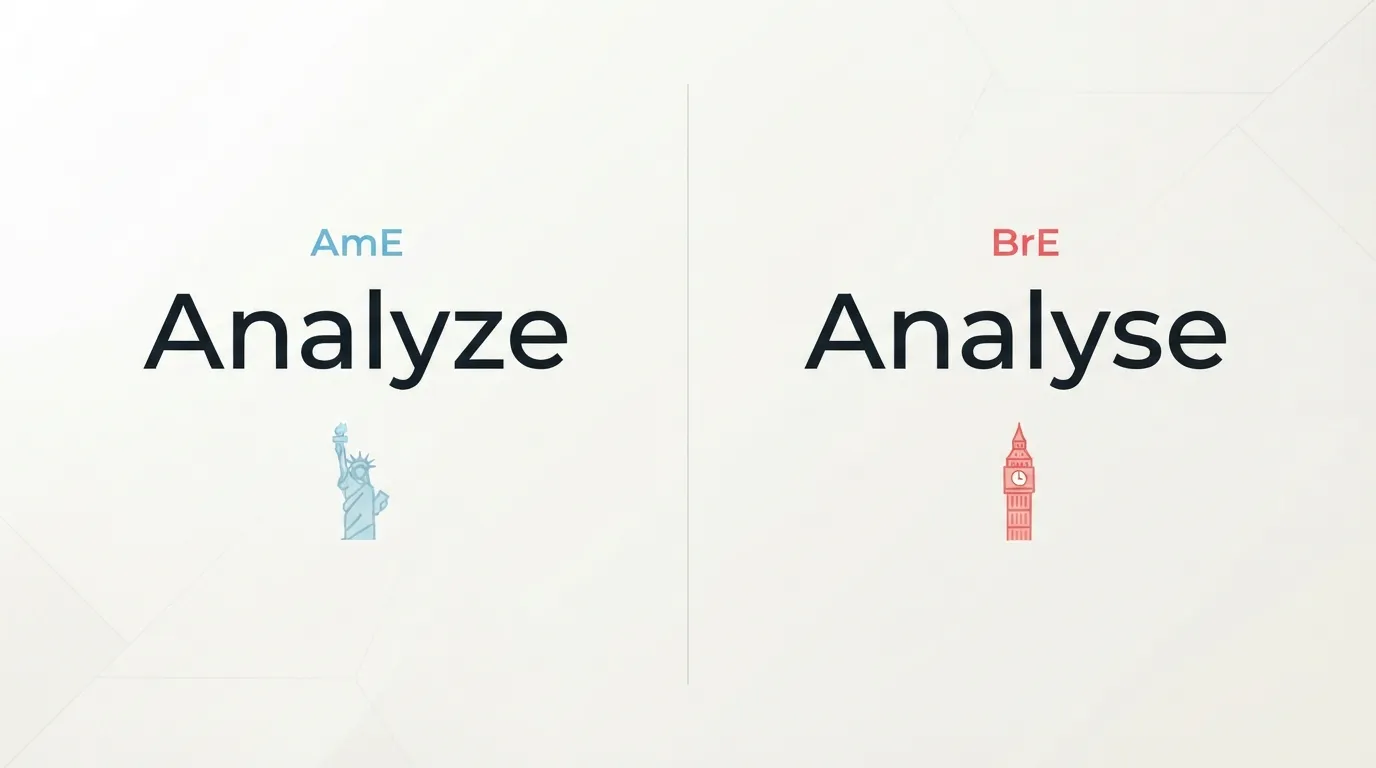
Both analyze and analyse are correct. Use analyze in American English and analyse in British English. They have the same meaning and pronunciation; only the spelling differs.
Have you ever written analyze and then wondered whether it should be analyse? The difference can be confusing because both words mean exactly the same thing.
The choice depends mainly on which variety of English you are using. Analyze is standard in American English, while analyse is standard in British English. Cambridge labels analyze as the US spelling of analyse, and Merriam-Webster describes analyse as chiefly British.
Once you know your audience, choosing the correct form is simple.
Analyze or Analyse: What Is the Difference?
There is no difference in meaning between analyze and analyse.
Both are verbs meaning to examine or study something carefully so that you can understand it better. Merriam-Webster defines analyze in terms of studying the nature and relationships of the parts of something, while Cambridge describes analyse as studying or examining something in detail.
The difference is regional spelling:
| Spelling | Meaning | Main Region | Example |
|---|---|---|---|
| Analyze | Examine something carefully | American English | We need to analyze the results. |
| Analyse | Examine something carefully | British English | We need to analyse the results. |
So the simple rule is:
American English = analyze
British English = analyse
What Does Analyze Mean?
Analyze is the standard American English spelling.
It means to study, examine, or break something down carefully in order to understand its nature, meaning, or parts.
For example:
- The researchers will analyze the data.
- We need to analyze the problem before making a decision.
- The teacher asked us to analyze the poem.
- Scientists analyze samples in the laboratory.
- She likes to analyze every detail before acting.
If you are writing for an American audience, analyze is normally the form to choose.
What Does Analyse Mean?
Analyse is the standard British English spelling of the same verb.
Cambridge marks analyse as the UK form and analyze as its US equivalent. Collins likewise presents analyse as the British spelling and analyze as the American form.
Examples include:
- The researchers will analyse the data.
- We need to analyse the problem carefully.
- Students were asked to analyse the text.
- The laboratory will analyse the samples.
- She tried to analyse his response.
These sentences mean exactly the same as their American English versions.
Analyze in American English
For American English, use:
- analyze
- analyzed
- analyzing
- analyzable
Merriam-Webster lists analyzed and analyzing as the regular American forms.
Examples:
- We will analyze the figures tomorrow.
- The team analyzed the results yesterday.
- She is analyzing the report now.
If your school, company, publication, or audience follows American English, keep the z throughout these forms.
Analyse in British English
For standard British English, use:
- analyse
- analysed
- analysing
- analysable
Cambridge lists analysed as the past form of analyse, while Collins gives analysable as the British-derived form alongside American analyzable.
Examples:
- We will analyse the figures tomorrow.
- The team analysed the results yesterday.
- She is analysing the report now.
For British English, keeping the s form creates consistent spelling.
Is Analyze British or American?
Analyze is primarily the American spelling.
Cambridge explicitly identifies analyze as the US spelling of analyse. Collins also labels analyze under American English.
For example:
American English:
The researchers will analyze the information.
British English:
The researchers will analyse the information.
Neither sentence is grammatically better. They simply follow different regional spelling conventions.
Is Analyse British or American?
Analyse is the standard British spelling.
Cambridge identifies it as the UK form, and Merriam-Webster describes analyse as chiefly British.
You are therefore more likely to see sentences such as:
- Please analyse the results.
- We analysed the information carefully.
- Scientists are analysing the samples.
in writing that follows British English conventions.
Do Analyze and Analyse Have Different Meanings?
No. Analyze and analyse have the same meaning.
The difference is comparable to other regional spelling pairs, where the form changes but the basic meaning does not.
For analyze/analyse, dictionaries on both sides describe essentially the same action: examining something carefully to understand it or its parts.
Therefore:
- analyze the data
- analyse the data
mean the same thing.
Do Analyze and Analyse Sound Different?
No meaningful pronunciation distinction is required simply because of the spelling difference.
Cambridge gives the same pronunciation pattern for the US analyze and UK analyse entries.
The distinction is therefore mainly visible in writing.
You do not need to pronounce analyse with an “s” sound just because it contains an s. Both words end with the sound represented by -ize in words such as realize.
What About Analysis?
An important point is that the noun is analysis in both American and British English.
Correct:
- American English: analysis
- British English: analysis
Cambridge defines analysis as the act of examining something in detail. It is not spelled analyzis in American English.
Compare:
| Form | American English | British English |
|---|---|---|
| Verb | analyze | analyse |
| Past tense | analyzed | analysed |
| -ing form | analyzing | analysing |
| Noun | analysis | analysis |
| Plural noun | analyses | analyses |
The plural of analysis is analyses in both varieties. Cambridge confirms that analyses is the plural of analysis.
Analyze or Analyse in Academic Writing
The best spelling in academic writing depends on the English style your institution, journal, or course requires.
If you are expected to use American English, write:
- analyze
- analyzed
- analyzing
If you are expected to use British English, write:
- analyse
- analysed
- analysing
For example:
American style:
The study analyzed the responses of the participants.
British style:
The study analysed the responses of the participants.
The most important practical rule is consistency. Avoid changing between analyze and analyse without a reason in the same piece of writing.
Analyze or Analyse for a Global Audience
For a global audience, either form can be understood.
Your best choice depends on the language standard used by your website, organization, publication, or target readers.
Use:
- analyze for a mainly American audience
- analyse for a mainly British audience
- the spelling required by your style guide for professional or academic work
If there is no required style, choose one form and use it consistently.
Practical Examples
American English With Analyze
- We need to analyze the customer feedback.
- The software can analyze large amounts of data.
- Students must analyze the argument.
- Doctors may analyze test results.
- The company analyzed its sales figures.
- She is analyzing the report.
British English With Analyse
- We need to analyse the customer feedback.
- The software can analyse large amounts of data.
- Students must analyse the argument.
- Scientists analyse the samples.
- The company analysed its sales figures.
- She is analysing the report.
Notice that the meaning does not change. Only the regional spelling changes.
Common Mistakes With Analyze and Analyse
| Mistake | Better Choice | Why |
|---|---|---|
| Using analyse in an American-English paper | Analyze | Analyze is the standard US form. |
| Using analyze in a British-English document | Analyse | Analyse is the standard UK form. |
| Writing analyzis as the noun | Analysis | The noun is analysis in both varieties. |
| Mixing analyze and analysed | Use one regional style | The forms belong to different spelling systems. |
| Assuming one spelling is universally wrong | Both can be correct | The choice depends on regional English. |
The biggest mistake is treating this as a correct-versus-incorrect spelling question.
It is better to think of it as an American-versus-British spelling choice.
How to Remember Analyze vs Analyse
A simple memory trick is:
Z = USA → analyze
It is not a spelling rule for every English word, but it can help you remember this particular pair.
For British English, remember:
British English → analyse with S
You can also connect the whole family of forms:
US: analyze → analyzed → analyzing
UK: analyse → analysed → analysing
Which Should You Use: Analyze or Analyse?
Use analyze when writing in American English.
Use analyse when writing in British English.
Both forms are correct, so your choice should depend on your audience and required writing style. Cambridge and Merriam-Webster both recognize this US-UK distinction.
The simplest recommendation is:
US English: analyze
UK English: analyse
For professional, academic, or website content, choose one variety of English and remain consistent.
Frequently Asked Questions
Which Is Correct, Analyze or Analyse?
Both are correct. Analyze is the standard American English spelling, while analyse is the standard British English spelling.
Is Analyze American English?
Yes. Cambridge identifies analyze as the US spelling of analyse. Merriam-Webster also uses analyze as its main dictionary entry.
Is Analyse British English?
Yes. Analyse is the standard British form. Merriam-Webster describes it as chiefly British, while Cambridge labels it UK English.
Is It Analyze or Analyse in Canada?
Canadian English can combine British and American spelling conventions, so the preferred form may depend on the publication or style guide being followed. For formal writing, use the spelling required by your institution or editor and remain consistent.
Is It Analyzed or Analysed?
Use analyzed in American English and analysed in British English. The same regional difference continues in the past-tense form.
Is It Analyzing or Analysing?
Use analyzing in American English and analysing in British English. Both mean that someone is examining something carefully.
Is the Noun Analysis or Analysys?
The correct noun is analysis. Its plural is analyses. These forms are used in both American and British English.
Conclusion
When choosing between analyze or analyse, neither spelling is universally wrong. The difference depends mainly on regional English.
Use analyze in American English and analyse in British English. Their meanings are the same, and both refer to examining something carefully to understand it better.
Remember to change the related forms too: analyzed/analyzing in American English and analysed/analysing in British English.
For school, work, academic writing, or online content, follow the required English variety and stay consistent throughout your writing.

Hassan Afzal has a background in English language instruction and writes to help non-native speakers and students master tricky grammar rules and word choices. Hassan Afzal’s writing style blends practical examples with clear explanations for everyday English learners.