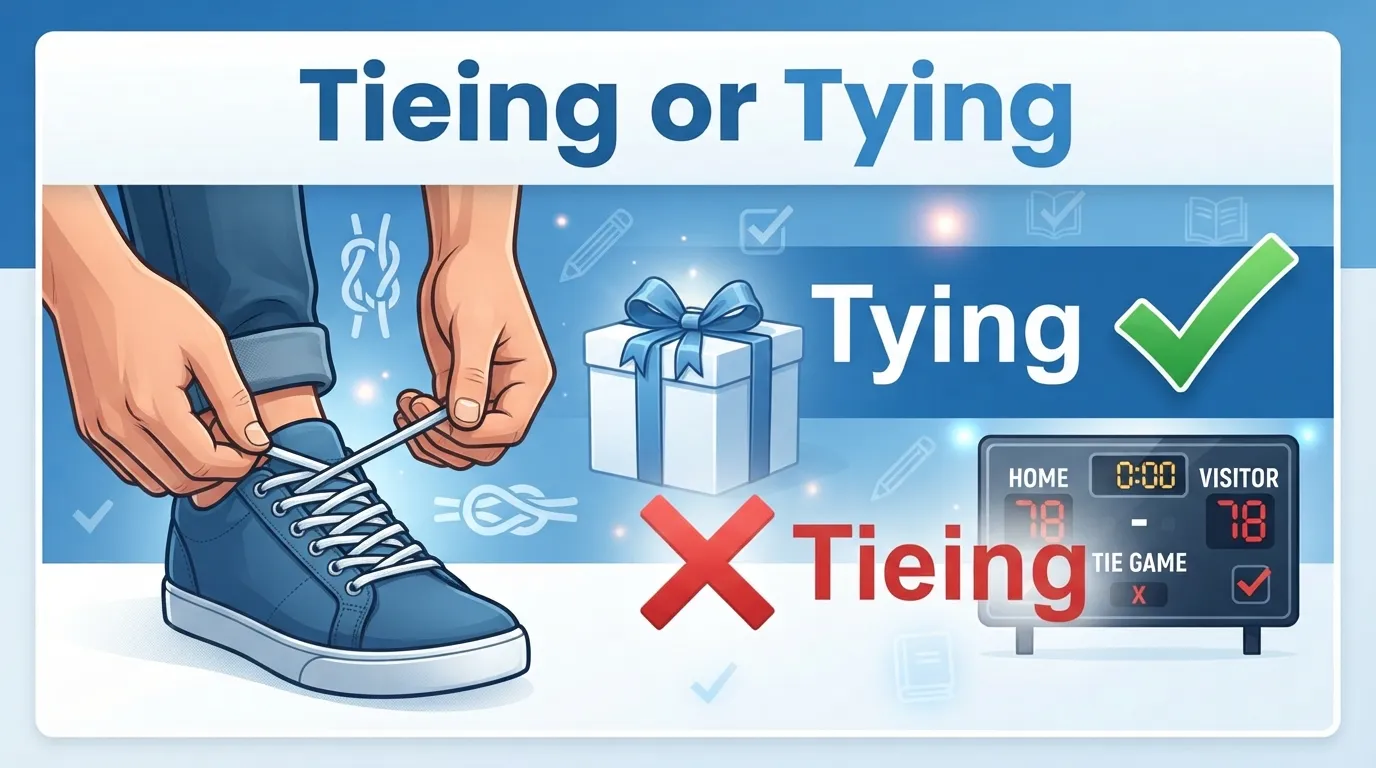
Tying is the correct spelling in modern English. Tieing is considered incorrect in almost all everyday writing. When referring to fastening a knot, securing something, or ending with the same score in a game, always use tying.
Have you ever stopped while writing the word tying and wondered whether it should actually be tieing? If so, you are not alone. This is one of the most common spelling questions among English learners because the word does not follow the spelling pattern many people expect.
Normally, when a verb ends with the letter e, English often drops the e before adding ing. However, some words seem to break familiar patterns, making it difficult to know which spelling is correct. As a result, many writers mistakenly type tieing, believing they are simply following the usual grammar rule.
The confusion becomes even greater because both spellings appear online. You may come across tieing in old documents, informal posts, or spelling mistakes on websites. This leaves many learners wondering whether both forms are acceptable.
The good news is that modern English has a clear answer. Once you understand the spelling rule behind this word, you will know exactly which version to use every time.
In this guide, you will learn the difference between tieing and tying, understand why the confusion exists, see practical examples, and avoid one of the most common English spelling mistakes.
Tieing or Tying: Quick Answer
Tying is the correct spelling. It is the present participle and gerund of the verb tie, meaning to fasten, secure, connect, or finish with the same score.
Tieing is generally considered incorrect in modern English and should not be used in everyday writing.
Examples
✅ She is tying her shoes.
✅ They are tying the ropes together.
✅ The teams are tying the game in the final minute.
❌ She is tieing her shoes.
❌ We are tieing the package.
Easy Rule to Remember
- Present: Tie
- Present Participle: Tying
Never write tieing in standard English.
The Origin and Background of Tieing or Tying
The verb tie comes from Old English and has long been used to describe fastening or securing something with a knot, string, rope, or similar material. Over time, English developed spelling rules to make words easier to read and pronounce.
Most verbs ending in e drop the final e before adding ing.
Examples:
- Make → Making
- Write → Writing
- Drive → Driving
The verb tie follows the same basic rule, but there is one important spelling change.
Instead of becoming tieing, the letters change to form tying. This spelling keeps the word easier to read and prevents the awkward letter combination iei.
This pattern also appears in similar words.
| Base Verb | Present Participle |
| Lie | Lying |
| Die | Dying |
| Tie | Tying |
Notice that none of these verbs simply add ing after keeping the e. Instead, the spelling changes slightly to produce a smoother and more natural word.
Today, tying is the standard spelling used in dictionaries, schools, books, newspapers, business writing, and professional communication.
The spelling tieing occasionally appears online, but it is almost always the result of a spelling mistake rather than an accepted alternative.
Tieing or Tying Explained: Key Differences or Variations
The difference between tying and tieing is simple. Tying is the correct spelling in modern English and is accepted by dictionaries, grammar books, and style guides. Tieing is considered incorrect in standard English and should be avoided in almost every situation.
Many English learners assume tieing is correct because the base verb tie ends with the letter e. However, English changes the spelling to tying instead of simply adding ing.
Comparison Table
| Term | Meaning | When to Use | Region or Context |
| Tying | Present participle and gerund of tie | Standard English writing and speech | Used worldwide |
| Tieing | Common misspelling of tying | Avoid in everyday writing | Rarely seen except as an error |
Examples of Tying
- She is tying her shoelaces before school.
- We are tying balloons to the chairs.
- The sailor is tying the boat to the dock.
- The two teams are tying the match with only a few minutes left.
Each example correctly uses tying to describe an action happening now.
Examples of Incorrect Usage
❌ She is tieing her shoes.
✅ She is tying her shoes.
❌ They are tieing the gift with a ribbon.
✅ They are tying the gift with a ribbon.
Which Version Should You Use?
For every type of everyday writing, choose tying. Whether you are writing an essay, email, report, social media post, or blog article, tying is the only correct spelling.
For students
Always write tying in homework, assignments, and exams.
Examples
- The child is tying his shoes.
- We are tying ribbons around the gift boxes.
Using tieing may result in a spelling correction from your teacher.
For business writing
Professional writing should always use tying.
Examples
- The company is tying customer feedback to future product improvements.
- We are tying the marketing campaign to the holiday season.
Using the correct spelling helps your writing look polished and professional.
For creative writing
Authors and bloggers should also use tying.
Example
- She smiled while tying her long hair into a ponytail.
The sentence reads naturally and follows modern English spelling rules.
For sports
Tying is also used when two competitors have the same score.
Examples
- The teams are tying the game at halftime.
- She is tying for first place after the final round.
This meaning follows the same spelling rule.
Quick Recommendation
- School writing → Tying ✅
- Business writing → Tying ✅
- Emails → Tying ✅
- Books and blogs → Tying ✅
- Sports reporting → Tying ✅
- Everyday English → Tying ✅
There is almost never a reason to use tieing.
Common Mistakes with Tieing or Tying
Most mistakes happen because writers apply the wrong spelling rule to the verb tie. Understanding these common errors will help you remember the correct form.
| Mistake | Correct |
| She is tieing her shoes. | She is tying her shoes. |
| We are tieing the package. | We are tying the package. |
| They were tieing balloons together. | They were tying balloons together. |
| He enjoys tieing fishing knots. | He enjoys tying fishing knots. |
| The teams are tieing for first place. | The teams are tying for first place. |
Why These Mistakes Happen
- People try to keep the final e from the word tie.
- They apply the spelling rule incorrectly.
- They copy the incorrect spelling from social media or informal websites.
- They are unfamiliar with irregular spelling patterns involving ie verbs.
Easy Memory Trick
Think about these similar verbs:
| Base Verb | Correct ing Form |
| Die | Dying |
| Lie | Lying |
| Tie | Tying |
Notice the pattern.
None of these words become:
- ❌ Dieing
- ❌ Lieing
- ❌ Tieing
Instead, they become:
- ✅ Dying
- ✅ Lying
- ✅ Tying
One More Tip
If you’re ever unsure, remember this simple sentence:
If you are fastening, securing, or making a knot, you are always tying, never tieing.
This small trick will help you avoid one of the most common English spelling mistakes.
Tieing or Tying in Real World Examples
The easiest way to remember the correct spelling is to see tying used in everyday situations. Whether you are writing an email, reading the news, posting on social media, or preparing a report, tying is the correct spelling.
Professional Email
Subject: Event Decorations
Hello Team,
We will begin tying the banners and balloons around the entrance at 9:00 a.m. Please arrive early so everything is ready before guests arrive.
Thank you.
Why it works: The sentence describes an action in progress, so tying is the correct form.
News Headline
Volunteers Spend the Morning Tying Relief Packages for Flood Victims
Why it works: Newspapers use tying because it is the standard spelling in modern English.
Social Media Post
We spent the afternoon tying colorful ribbons around all the birthday gifts. Everything looks beautiful!
Why it works: The writer describes an ongoing activity, making tying the correct choice.
Formal Business Report
The project team is tying customer feedback to future product improvements to increase customer satisfaction.
Why it works: In business writing, tying can also mean connecting or linking ideas, strategies, or goals.
Sports Example
The home team is tying the game with only two minutes remaining.
Why it works: Tying is also used when competitors have the same score during a game or competition.
Everyday Conversation
Correct
- She is tying her shoelaces.
- Dad is tying the boat to the dock.
- We are tying balloons to the chairs.
- The two teams are tying the match.
Incorrect
- She is tieing her shoes.
- We are tieing the package.
- They are tieing the rope together.
In standard English, these examples should always use tying.
Tieing or Tying: Data, Trends and Usage
The keyword tieing or tying is searched by thousands of English learners because the correct spelling is not obvious. Many people expect tieing to follow the normal spelling rule, but modern English uses tying instead.
Where Is This Topic Most Popular?
People search for this topic on:
- English learning websites
- Grammar blogs
- Dictionary websites
- Student forums
- Writing communities
- Educational platforms
- Search engines
Who Searches for This Topic?
Common searchers include:
- English learners
- School students
- College students
- Teachers
- Bloggers
- Copywriters
- Editors
- Business professionals
Most users want to confirm which spelling is correct before submitting an assignment, publishing content, or sending an email.
Search Intent
Primary Search Intent: Informational
People usually want answers to questions like:
- Is it tying or tieing?
- Why is tieing incorrect?
- What is the ing form of tie?
- How do you spell tying shoes?
- Can tieing ever be correct?
Why This Matters Today
Correct spelling improves both readability and credibility. Using tying instead of tieing shows that you understand standard English spelling rules. It also helps you avoid mistakes in academic writing, professional communication, and online content.
Learning this spelling pattern will also help you remember similar words like dying and lying.
Tieing or Tying Comparison Table
| Term or Variant | Meaning | Region or Context | Best Used When |
| Tying | Present participle and gerund of tie | Standard English worldwide | Everyday writing, education, business, publishing |
| Tieing | Common misspelling of tying | Avoid in standard English | Rarely seen except as an error |
| Tie | Base form of the verb | Standard English | Present tense |
| Tying | Ongoing action of fastening, securing, or connecting | Standard English | Present continuous and gerund forms |
Quick Summary
| If you mean… | Correct Word |
| Fastening a knot | Tying |
| Connecting ideas | Tying |
| Equaling the score | Tying |
| Standard English spelling | Tying |
| Everyday writing | Tying |
Frequently Asked Questions About Tieing or Tying
Q: Is it tieing or tying?
A: Tying is the correct spelling in modern English. Tieing is considered incorrect and should not be used in everyday writing.
Q: Why is tying spelled without the letter e?
A: When tie changes to its ing form, the spelling changes to tying. This follows the same pattern as die becoming dying and lie becoming lying.
Q: Is tieing a real word?
A: No. In modern standard English, tieing is considered a misspelling. Dictionaries and style guides recommend using tying.
Q: Can tying mean a game with the same score?
A: Yes. Tying can describe two teams or competitors reaching the same score.
Example: The players are tying the match in the final minute.
Q: Is tying acceptable in formal writing?
A: Yes. Tying is the correct spelling for academic papers, business documents, books, emails, and professional communication.
Q: What is the difference between tie and tying?
A: Tie is the base form of the verb, while tying describes an action that is happening now or functions as a gerund.
Examples:
- I tie my shoes every morning.
- I am tying my shoes now.
Q: How can I remember the correct spelling?
A: Remember these three words together:
- Die → Dying
- Lie → Lying
- Tie → Tying
If you remember one, the other two become much easier.
Conclusion
The difference between tieing and tying is simple once you understand the spelling rule. Tying is the correct form in modern English and should be used whenever you are talking about fastening something, making a knot, connecting ideas, or reaching the same score in a game.
Although tieing may seem logical at first, it is not accepted in standard English. This mistake usually happens because people expect every verb ending in e to keep the letter before adding ing. Fortunately, remembering similar words like dying and lying makes the correct spelling much easier to recall.
Whenever you write, choose tying with confidence. It is the spelling recognized by dictionaries, teachers, editors, and professional writers around the world.
Now you know exactly when to use tying and why tieing is incorrect. Bookmark this guide so you never make this spelling mistake again, and share it with anyone learning English.
Read More: Laid or Layed: Learn the Correct Spelling Easily