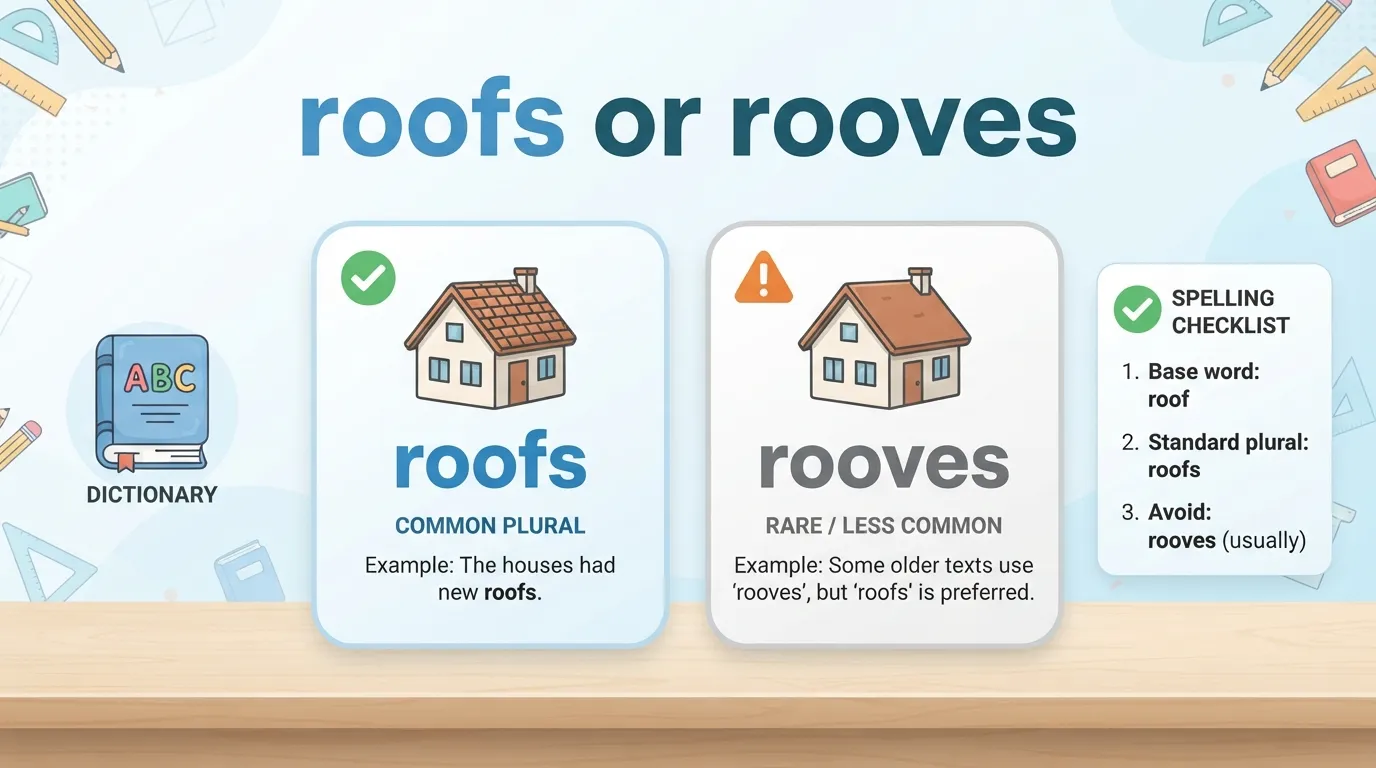
Roofs or rooves means you are choosing between the standard plural and a rare older variant. The correct modern plural is “roofs.” “Rooves” exists, but it is uncommon and should usually be avoided in careful writing.
Have you ever written “rooves” and wondered if it looked old-fashioned?
I’ve seen this spelling question many times in student essays, home improvement blogs, real estate content, and construction writing. The confusion makes sense. Many English nouns ending in f change to ves in the plural. We write knife → knives, leaf → leaves, and shelf → shelves.
So it feels natural to think roof should become rooves.
But English does not always follow one clean pattern. The standard plural of roof is roofs. You can write flat roofs, metal roofs, leaking roofs, and house roofs.
The word rooves is not the best choice for normal modern writing. Some dictionaries recognize it, but it is rare and may look strange to many readers.
This guide explains roofs or rooves in simple English. You’ll learn the correct spelling, why the confusion exists, common mistakes, real examples, and which word to use in formal and casual writing.
Roofs or Rooves: Quick Answer
Use “roofs” when you mean more than one roof. “Rooves” is a rare plural form, but “roofs” is the standard spelling in modern English. Merriam-Webster lists “roofs” as the plural of “roof,” and Oxford Learner’s Dictionaries also gives “roofs” as the plural form. (Merriam-Webster)
Simple examples:
- Correct: The storm damaged several roofs.
- Correct: Many old roofs need repair.
- Rare: The storm damaged several rooves.
Easy rule:
- One = roof
- More than one = roofs
If you are writing for school, work, SEO content, real estate, roofing services, or construction pages, choose roofs.
The Origin / Background of Roofs or Rooves
The confusion happens because many English words ending in “f” or “fe” change to “ves” in the plural. But “roof” does not follow that pattern in standard modern English. The accepted plural is “roofs,” even though “rooves” has appeared as a minority form.
Here are some words that change f to ves:
- leaf → leaves
- knife → knives
- wolf → wolves
- shelf → shelves
- calf → calves
That pattern makes rooves feel possible. But roof is different.
Dictionary.com explains that roof is not normally pluralized by replacing f with ves, even though many other words ending in f do that. It gives roofs as the plural form and notes that rooves dropped out of common use. (Dictionary.com)
Oxford Reference also says the standard plural in British English is roofs, while rooves is an occasional recognized minority form that many people may find distracting. (Oxford Reference)
So the history is simple:
Rooves may exist, but roofs won.
Roofs or Rooves Explained: Key Differences or Variations
The main difference is usage. “Roofs” is the normal plural in modern English. “Rooves” is rare and may look old, regional, or nonstandard to many readers. Both point to more than one roof, but only “roofs” is the safe choice for polished writing.
| Term | Meaning | When to Use | Region/Context |
|---|---|---|---|
| Roof | One top covering of a building | Talking about one building top | Standard English |
| Roofs | More than one roof | Normal plural use | Standard modern English |
| Rooves | Rare plural of roof | Usually avoid in modern writing | Rare or old-fashioned use |
| Roofing | Materials or work used to cover a roof | Construction and home repair | Trade and service writing |
| Rooftops | Top surfaces of roofs | Urban, design, real estate writing | Common modern English |
Cambridge defines roof as the covering that forms the top of a building, vehicle, or other object. It also lists roof-related uses like a roof over your head and go through the roof. (Cambridge Dictionary)
Examples:
- The houses have red roofs.
- Solar panels were added to the roofs.
- The workers repaired three roofs in one week.
- The hotel has gardens on its rooftops.
In all these examples, roofs is the best spelling.
Which Version Should You Use?
Use “roofs” in almost every situation. It is the standard plural for one roof, two roofs, flat roofs, metal roofs, house roofs, and commercial roofs. Use “rooves” only if you are quoting older text or discussing the rare variant itself.
Here is the best practical advice:
- For students → use roofs in essays and assignments.
- For roofing websites → use roofs in service pages and blog posts.
- For real estate writing → use roofs in listings and property descriptions.
- For formal writing → use roofs.
- For creative or historical writing → rooves may appear, but use it carefully.
- For global readers → use roofs, because it is clearer and more accepted.
Examples:
- The neighborhood has many tile roofs.
- Strong winds damaged the roofs of several homes.
- Metal roofs can last for many years.
- The city looked beautiful from the rooftops.
If your goal is clear modern English, do not overthink it. Write roofs.
Common Mistakes With Roofs or Rooves
Most mistakes happen because writers copy the “f to ves” pattern from words like “leaf” and “knife.” But not every word ending in “f” follows that rule. “Roof” usually takes a simple “s,” so the correct plural is “roofs.”
| Mistake | Correction | Why It Happens |
|---|---|---|
| The houses have new rooves. | The houses have new roofs. | Writer follows leaf → leaves pattern |
| Several roofes were damaged. | Several roofs were damaged. | Writer adds “es” incorrectly |
| One roofs needs repair. | One roof needs repair. | Singular and plural are mixed |
| The roof’s need replacing. | The roofs need replacing. | Possessive and plural are confused |
| The company fixes rooves. | The company fixes roofs. | Rare variant used in normal writing |
Mistake 1: Writing “rooves” by analogy
Wrong:
The old rooves were covered in moss.
Better:
The old roofs were covered in moss.
This mistake happens because roof looks like it should behave like hoof or leaf. But standard usage prefers roofs.
Mistake 2: Writing “roofes”
Wrong:
Three roofes were repaired after the storm.
Correct:
Three roofs were repaired after the storm.
You do not add es to make roof plural.
Mistake 3: Mixing plural and possessive forms
Wrong:
The roof’s were leaking.
Correct:
The roofs were leaking.
Use roof’s only when something belongs to one roof.
Example:
The roof’s edge was damaged.
Roofs or Rooves in Real-World Examples
You will see “roofs” in construction writing, home repair pages, weather reports, real estate listings, school writing, and formal documents. “Rooves” may appear sometimes, but it is not the best choice for modern professional writing.
Professional email example
Hi Mark,
The storm damaged three roofs on the property. We will inspect them tomorrow and send a repair estimate.
This is clear and professional.
Roofing website example
We repair shingle roofs, metal roofs, tile roofs, and flat roofs for local homeowners.
This is the best spelling for SEO and service pages.
News headline example
Heavy Rain Damages Roofs Across the City
News writing uses the standard plural because it is clear for all readers.
Social media post example
After last night’s storm, several roofs in our area need quick repairs.
This works for a local roofing business or community update.
Formal document example
The inspection report found damage to the roofs of buildings A, B, and C.
This is suitable for insurance, property, and construction reports.
Roofs or Rooves: Data, Trends & Usage
The search intent behind “roofs or rooves” is informational. Most readers want to know which plural is correct, whether “rooves” is a real word, and why “roof” does not change like “leaf” or “knife.”
People often search this phrase while writing:
- school assignments
- roofing blog posts
- construction reports
- insurance claims
- real estate listings
- grammar worksheets
- home repair content
This spelling matters because rooves can distract readers. Even if someone understands it, they may pause and question the wording.
Merriam-Webster has a separate entry for rooves as a plural of roof, but its main roof entry gives roofs as the plural. This is a useful clue: rooves exists, but roofs is the modern form you should normally use. (Merriam-Webster)
For public content, roofs is also better for trust. If you run a roofing website, real estate page, or home repair blog, readers expect clean, standard spelling.
Roofs or Rooves Comparison Table
A quick comparison makes the answer easy. “Roof” is singular. “Roofs” is the standard plural. “Rooves” is a rare older or minority form. If you want your writing to look modern, clear, and professional, use “roofs.”
| Term/Variant | Meaning | Region/Context | Best Used When |
|---|---|---|---|
| Roof | One top covering of a building | Standard English | Talking about one roof |
| Roofs | More than one roof | Standard modern English | Talking about two or more roofs |
| Rooves | Rare plural of roof | Older, rare, or minority use | Only when discussing the variant |
| Roof’s | Possessive form of one roof | Grammar use | Showing something belongs to one roof |
| Roofs’ | Possessive form of multiple roofs | Grammar use | Showing something belongs to several roofs |
| Rooftops | Top surfaces of roofs | General English | Talking about roof surfaces or views |
FAQs About Roofs or Rooves
Q: What does roofs or rooves mean?
A: Roofs or rooves is a spelling choice for the plural of roof. The standard modern plural is roofs.
Q: Is roofs correct?
A: Yes. Roofs is the correct standard plural of roof. Merriam-Webster and Oxford Learner’s Dictionaries both list roofs as the plural form. (Merriam-Webster)
Q: Is rooves correct?
A: Rooves exists as a rare plural form, but it is not the best choice for normal modern writing. Use roofs unless you are discussing the variant itself. (Merriam-Webster)
Q: Roofs vs rooves: what’s the difference?
A: The meaning is the same, but the usage is different. Roofs is standard and common. Rooves is rare and may look old-fashioned or nonstandard.
Q: Why is it roofs and not rooves?
A: Not all nouns ending in f change to ves. While leaf becomes leaves, roof usually becomes roofs in modern English.
Q: Is rooves acceptable in formal writing?
A: It is better to avoid rooves in formal writing. Use roofs in essays, reports, business writing, construction content, and real estate pages.
Q: Do British English users write roofs or rooves?
A: The standard plural in British English is also roofs. Oxford Reference notes rooves as an occasional minority form, but roofs is the standard. (Oxford Reference)
Conclusion
Now you know the difference between roofs or rooves.
The clear modern answer is roofs. Use it when you mean more than one roof. It is the standard spelling in school writing, business writing, roofing content, real estate listings, construction reports, and everyday English.
Rooves is not the best choice for normal writing. It may appear as a rare or older plural form, but many readers may find it strange. That can distract from your message.
Remember this simple rule:
- One = roof
- More than one = roofs
- Rare variant = rooves
- Possessive singular = roof’s
- Possessive plural = roofs’
If you want your writing to look clean and professional, choose roofs.
Now you know exactly how to use roofs or rooves. Check your next essay, article, listing, or roofing page before you publish it.
Read More: Smoky or Smokey: Easy Correct Spelling Guide

Muhammad Afzal is a language content writer specializing in English grammar, word usage, and vocabulary distinctions. With a strong command of linguistic nuance, Muhammad Afzal focuses on simplifying commonly confused word pairs to help readers communicate with clarity and confidence.