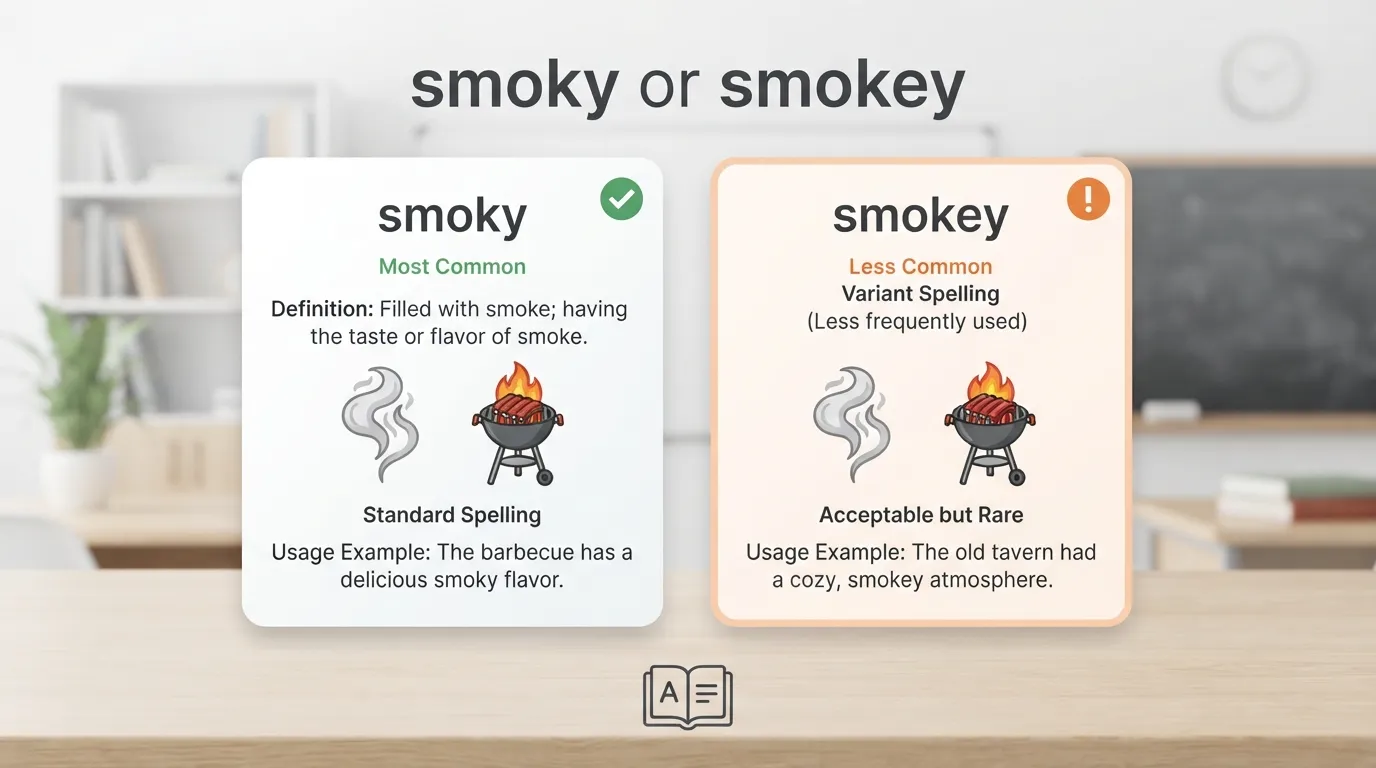
Smoky or smokey means you are choosing between the standard spelling and a less common variant. “Smoky” is the best spelling for most writing, while “smokey” is mostly used in names, brands, or informal style.
Have you ever written “smokey flavor” and wondered if it should be “smoky flavor”?
I’ve seen this spelling question many times in food blogs, restaurant menus, product descriptions, and student writing. The confusion makes sense. The base word is smoke, so adding y feels like it should become smokey.
But English often drops the final e before adding y.
That is why we write smoky, not usually smokey, when we describe a smoky room, smoky barbecue, smoky eyeshadow, or smoky mountain view.
Still, smokey is not completely unknown. Some dictionaries list it as a less common variant. You may also see it in names, brand styles, and casual writing.
This guide explains smoky or smokey in simple English. You’ll learn the correct spelling, the difference between both forms, common mistakes, real examples, and the best choice for formal writing, menus, blogs, and everyday use.
Smoky or Smokey: Quick Answer
Use “smoky” in standard English when you mean filled with smoke, smelling like smoke, tasting like smoke, or looking like smoke. “Smokey” is a less common variant, but “smoky” is the safer choice for polished writing.
Merriam-Webster lists smoky as the main spelling and notes smokey as a less common variant. It defines smoky as emitting smoke, resembling smoke, filled with smoke, or having a smoke-like flavor or smell.
Simple examples:
- Correct: The room was smoky.
- Correct: This sauce has a smoky flavor.
- Less common: This sauce has a smokey flavor.
Easy rule:
- Smoky = standard spelling
- Smokey = less common variant or name style
If you are unsure, choose smoky.
The Origin / Background of Smoky or Smokey
The confusion comes from the word “smoke.” Since smoke ends in “e,” many writers expect the adjective to keep that “e” and become “smokey.” But the standard spelling drops the “e” before adding “y,” giving us “smoky.”
This same spelling pattern appears in other English words:
- smoke → smoky
- shine → shiny
- bone → bony
- ice → icy
The word smoky can describe several things. Cambridge says a smoky place has a lot of smoke, and something can also be smoky if it is similar to smoke, such as a smoky color or smoky flavor.
That is why smoky is common in many topics:
- food
- weather
- fire
- rooms
- colors
- voices
- makeup
- mountain views
For example:
- a smoky fire
- a smoky blue color
- a smoky barbecue sauce
- a smoky voice
- a smoky eye look
The spelling smokey appears sometimes, but it is not the best standard choice. Use smoky when you want your writing to look clean and professional.
Smoky or Smokey Explained: Key Differences or Variations
The main difference is spelling preference. “Smoky” is the standard form. “Smokey” is a less common spelling. Both may be understood, but “smoky” is better for essays, recipes, menus, blogs, reports, and formal writing.
| Term | Meaning | When to Use | Region/Context |
| Smoky | Filled with smoke, like smoke, or tasting of smoke | Standard writing | General English |
| Smokey | Less common variant of smoky | Names, brands, informal style | Casual or stylized use |
| Smokier | More smoky | Comparing two things | Standard English |
| Smokiest | Most smoky | Comparing three or more things | Standard English |
| Smoke | Gas from burning material | Noun or verb | General English |
Oxford Learner’s Dictionaries gives examples such as a smoky room, a smoky fire, a smoky flavour, and smoky blue glass.
Examples:
- The kitchen became smoky after the oil burned.
- The cheese has a deep smoky taste.
- The artist used a smoky gray shade.
- Her voice had a low, smoky sound.
In all these examples, smoky is the better spelling.
Which Version Should You Use?
Use “smoky” for almost every normal writing situation. Use “smokey” only if it is part of a name, brand, title, or chosen style. For school, work, recipes, product descriptions, and SEO content, “smoky” is the safest spelling.
Here is the best practical advice:
- For students → use smoky in essays and assignments.
- For food bloggers → use smoky for flavor, aroma, and barbecue descriptions.
- For restaurant menus → use smoky unless the dish name uses a brand style.
- For beauty content → use smoky eye, not usually smokey eye.
- For formal writing → use smoky.
- For names or branding → keep Smokey if that is the official spelling.
Examples:
- The soup had a smoky taste.
- The cabin smelled smoky after the fire.
- She wore a soft smoky eye look.
- The sky looked smoky after the wildfire.
If the word is a person’s name, character name, product name, or brand name, do not change it. Names often follow their own spelling.
Common Mistakes With Smoky or Smokey
Most mistakes happen because writers keep the “e” from “smoke” and write “smokey.” Another common mistake is using different spellings in the same article. For clean writing, choose “smoky” and use it consistently.
| Mistake | Correction | Why It Happens |
| The room was smokey. | The room was smoky. | Writer keeps the “e” from smoke |
| This has a smokey flavor. | This has a smoky flavor. | Common menu-style spelling |
| She wore smokey eyes. | She wore smoky eyes. | Beauty spelling varies online |
| The air was smoke-y. | The air was smoky. | Writer tries to show the base word |
| Smoky sauce and smokey ribs | Smoky sauce and smoky ribs | Inconsistent spelling |
Mistake 1: Writing “smokey” in formal text
Wrong:
The report described smokey air near the fire site.
Better:
The report described smoky air near the fire site.
Mistake 2: Using “smokey” for flavor
Less standard:
The ribs had a smokey flavor.
Better:
The ribs had a smoky flavor.
Cambridge includes smoky flavor as a normal use of the word smoky.
Mistake 3: Mixing both spellings
Weak:
The sauce is smoky, rich, and slightly smokey.
Better:
The sauce is smoky, rich, and slightly sweet.
Pick one spelling. For standard writing, pick smoky.
Smoky or Smokey in Real-World Examples
You will see “smoky” in food writing, weather reports, beauty content, fiction, and product descriptions. “Smokey” may appear in names or brand-style wording, but “smoky” is the cleaner spelling for normal sentences.
Professional email example
Hi team,
The test batch has a mild smoky flavor. Please reduce the spice level slightly before the next tasting.
This sounds clear and professional.
Food blog example
These roasted potatoes have a smoky paprika flavor with crispy edges and a soft center.
This is a natural food-writing use.
Beauty content example
A soft smoky eye works well for evening makeup without looking too heavy.
This is the standard spelling for polished beauty content.
News headline example
Fire Crews Warn Residents About Smoky Air Near the Hills
This works because the air contains or resembles smoke.
Formal document example
The inspection noted a smoky odor in the kitchen area.
This is clear and suitable for formal writing.
Smoky or Smokey: Data, Trends & Usage
The search intent behind “smoky or smokey” is informational. Most readers want to know which spelling is correct, whether “smokey” is wrong, and which version they should use in food, beauty, weather, or formal writing.
People often search this phrase because both spellings appear online.
You may see smoky in:
- dictionaries
- recipes
- menus
- reports
- news writing
- product descriptions
- makeup guides
You may see smokey in:
- names
- brand names
- casual captions
- informal menu wording
- stylized product titles
Merriam-Webster gives smoky as the main entry and smokey as a less common variant, which makes the practical answer clear: smoky is the better default spelling.
This matters because spelling affects trust. A reader may understand smokey, but smoky looks more polished in school, business, publishing, and SEO content.
Smoky or Smokey Comparison Table
A simple comparison makes the choice easy. “Smoky” is the standard spelling for smoke-filled air, smoke-like color, smoke-like taste, and smoke-like smell. “Smokey” is less common and works best when it is part of a name or chosen style.
| Term/Variant | Meaning | Region/Context | Best Used When |
| Smoky | Filled with smoke or like smoke | Standard English | Writing recipes, reports, articles, and descriptions |
| Smokey | Less common variant of smoky | Informal or stylized use | Writing names, brands, or casual copy |
| Smoky flavor | Taste like smoke | Food writing | Describing barbecue, sauces, cheese, or spices |
| Smoky room | Room filled with smoke | General English | Describing air or indoor spaces |
| Smoky eye | Soft dark eye makeup look | Beauty writing | Writing makeup tutorials or captions |
| Smokiness | Quality of being smoky | Food, smell, air, voice | Describing the level of smoky quality |
FAQs About Smoky or Smokey
Q: What does smoky or smokey mean?
A: Smoky or smokey is a spelling choice. Smoky is the standard spelling for something filled with smoke, like smoke, or tasting like smoke.
Q: Is smoky correct?
A: Yes. Smoky is the standard spelling. It is the best choice for formal writing, food descriptions, reports, essays, and articles.
Q: Is smokey correct?
A: Smokey is listed as a less common variant by some dictionaries. Still, smoky is the better default spelling for polished writing.
Q: Smoky vs smokey: what’s the difference?
A: The meaning is usually the same, but the spelling preference is different. Smoky is standard. Smokey is less common and often used in names or stylized writing.
Q: Should I write smoky flavor or smokey flavor?
A: Write smoky flavor. This is the cleaner and more standard spelling for food writing.
Q: Is it smoky eye or smokey eye?
A: Smoky eye is the more standard spelling. You may see smokey eye online, but smoky eye is better for polished beauty content.
Q: Can I use smokey in a brand name?
A: Yes. If Smokey is part of a name, brand, title, or official style, keep that spelling. Names do not always follow standard spelling rules.
Conclusion
Now you know the difference between smoky or smokey.
The best spelling for normal writing is smoky. Use it when you describe smoke-filled air, a smoky room, smoky mountains, smoky flavor, smoky barbecue, smoky eyeshadow, or a smoky voice.
Smokey is not the best default choice. Some dictionaries list it as a less common variant, and you may see it in names or brand styles. But for school, work, menus, recipes, reports, blog posts, and professional writing, smoky looks cleaner.
Remember this simple rule:
- Smoky = standard spelling
- Smokey = less common variant or name style
If you want your writing to look polished, choose smoky.
Now you know exactly how to use smoky or smokey. Check your next recipe, caption, product description, or article before you publish it.
Read More: Potatos or Potatoes: Easy Correct Spelling Guide

Zain Ali is an English content specialist with editorial experience in creating clear, accurate, and reader-friendly grammar guides. Zain is passionate about breaking down confusing English word pairs into simple, actionable explanations.