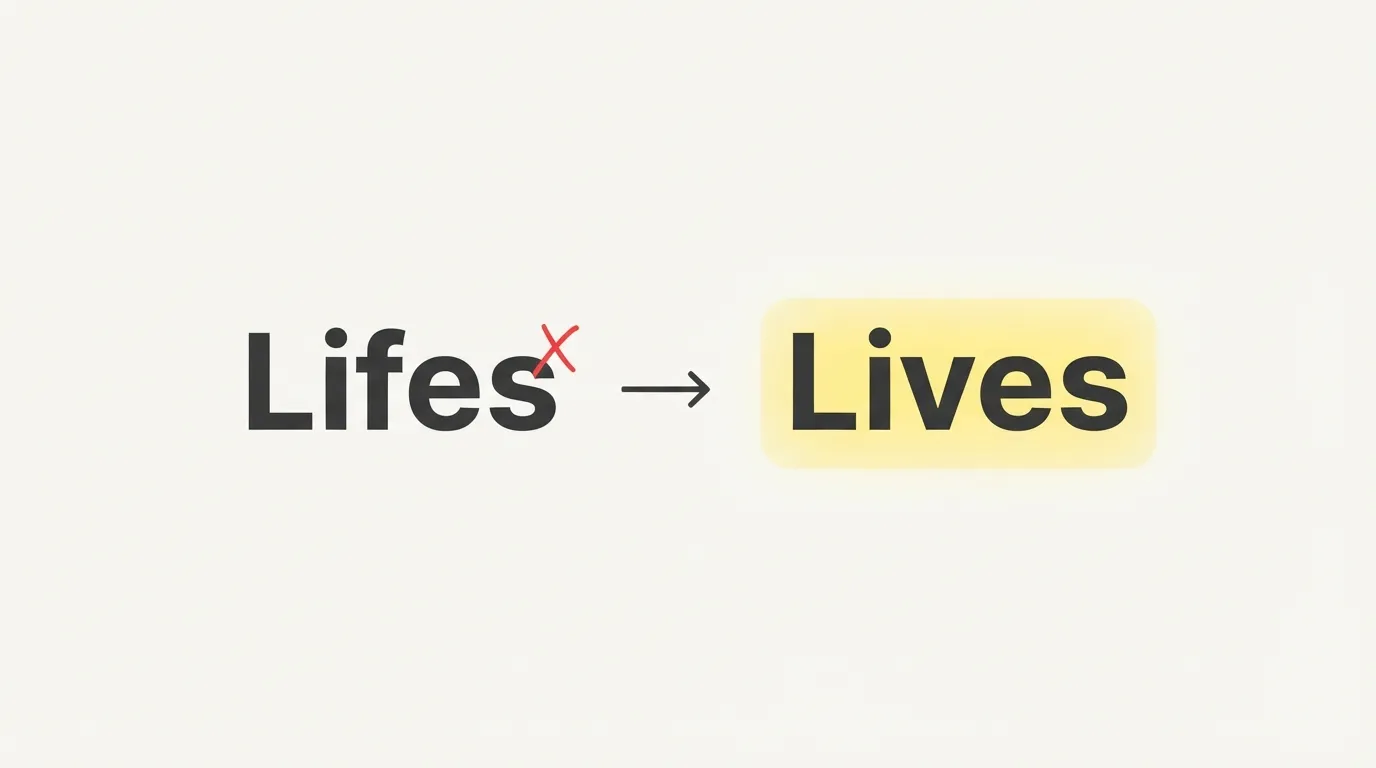
“Lives” is the correct plural form of “life.” “Lifes” is not a standard English word. “Lives” can also be a verb, as in “She lives in London.”
Many learners become confused when changing the word life into its plural form. It may seem natural to add an “s” and write “lifes,” but English spelling does not work that way in this case.
The correct plural is lives. However, the word lives can also be a verb, and its pronunciation changes depending on its meaning. You may also see life’s, which includes an apostrophe and has a different use. This guide explains each form with simple rules and examples.
What Is the Difference Between Lifes and Lives?
Lives is a correct English word. Lifes is usually a spelling mistake.
When lives is the plural of life, it means more than one life.
- One person has one life.
- Many people have many lives.
The word lives can also be the present-tense form of the verb live used with he, she, it, or a singular name.
- She lives in New York.
- Ahmed lives near his school.
| Form | Is It Correct? | Meaning | Example |
|---|---|---|---|
| Life | Yes | One person’s or animal’s existence | He saved a life. |
| Lives | Yes | More than one life | The doctors saved many lives. |
| Lives | Yes | A form of the verb “live” | She lives in Canada. |
| Lifes | No | Incorrect plural spelling | The accident changed their lives. |
| Life’s | Yes | Possessive form or “life is” | Life’s challenges can teach us. |
Why Is the Plural of Life “Lives”?
The plural of life is formed by changing the ending -fe to -ves.
- Life → Lives
This pattern also appears in several other English nouns:
- Wife → Wives
- Knife → Knives
- Leaf → Leaves
- Thief → Thieves
- Wolf → Wolves
You should not simply add an “s” to these words.
However, not every noun ending in “f” or “fe” follows this pattern. For example:
- Roof → Roofs
- Chief → Chiefs
- Safe → Safes
- Belief → Beliefs
Because English has exceptions, it is best to learn the plural form of each word.
What Does “Lives” Mean as a Noun?
As a noun, lives is the plural of life. It refers to the existence, experiences, or activities of two or more people, animals, or living things.
Examples:
- Firefighters risk their lives to protect others.
- The new law may improve people’s lives.
- Cats are often said to have nine lives.
- Their lives changed after moving abroad.
- The medicine has saved thousands of lives.
In these examples, lives means more than one life.
How Is the Noun “Lives” Pronounced?
When lives is the plural of life, it is pronounced like:
LYVZ
It rhymes closely with “drives.”
Example:
- The doctors saved several lives.
What Does “Lives” Mean as a Verb?
Lives can also be a verb. It is the third-person singular form of live in the present simple tense.
Use lives with:
- He
- She
- It
- One person’s name
- One singular subject
Examples:
- He lives with his parents.
- She lives in a small apartment.
- Maria lives near the beach.
- The dog lives in the house.
- My brother lives abroad.
Do not use lives with “I,” “you,” “we,” or “they.”
- I live in Pakistan.
- You live near the office.
- We live together.
- They live in London.
How Is the Verb “Lives” Pronounced?
When lives is a verb, it is pronounced like:
LIVZ
It rhymes closely with “gives.”
Compare:
- She lives in Spain.
Pronunciation: LIVZ - The treatment saved many lives.
Pronunciation: LYVZ
The spelling is the same, but the pronunciation and meaning are different.
What Is the Difference Between Lives and Life’s?
Lives and life’s are different words.
Lives
Lives can be:
- The plural of life.
- A form of the verb live.
Examples:
- The storm affected many lives.
- My aunt lives in Manchester.
Life’s
Life’s contains an apostrophe. It can show possession or be a shortened form of “life is” or “life has.”
Possession:
- Life’s purpose is different for everyone.
- One of life’s greatest lessons is patience.
“Life is”:
- Life’s too short to stay angry.
- Life’s full of surprises.
“Life has”:
- Life’s changed greatly since then.
The apostrophe changes the meaning, so do not use life’s as the plural of life.
Practical Examples
Lives as the Plural of Life
- Seat belts can save lives.
- The war affected millions of lives.
- Teachers can change their students’ lives.
- The rescue workers put their lives at risk.
- Social media is now part of many people’s lives.
Lives as a Verb
- Sarah lives across the street.
- My teacher lives near the school.
- He lives a healthy lifestyle.
- The bird lives in the forest.
- Everyone lives differently.
Life’s With an Apostrophe
- Life’s journey is not always easy.
- Life’s better when you have good friends.
- He accepted life’s challenges.
- Life’s taught her many lessons.
Common Mistakes
| Incorrect | Correct | Why |
|---|---|---|
| The doctors saved many lifes. | The doctors saved many lives. | The plural of life is lives. |
| She live in London. | She lives in London. | Use lives with she, he, or it. |
| Their life’s were changed. | Their lives were changed. | Life’s is not a plural form. |
| Many lives is at risk. | Many lives are at risk. | Lives is plural, so use “are.” |
| He lives with his parents last year. | He lived with his parents last year. | Use the past tense for a finished past time. |
Mistake 1: Adding Only “S”
Incorrect:
- Many lifes were lost.
Correct:
- Many lives were lost.
Remember that the “f” changes to “v” before adding “es.”
Mistake 2: Using an Apostrophe for a Plural
Incorrect:
- The accident affected several life’s.
Correct:
- The accident affected several lives.
Apostrophes do not normally create plural nouns.
Mistake 3: Confusing the Pronunciations
The noun and verb forms are spelled the same but pronounced differently.
- Human lives: LYVZ
- She lives here: LIVZ
Context usually makes the correct meaning clear.
A Simple Memory Tip
Remember this pattern:
One life, two lives.
You can also connect life with wife:
- One life → many lives
- One wife → many wives
Both words change -fe to -ves in the plural.
For the verb, remember:
- I live.
- They live.
- He lives.
- She lives.
Which Form Should You Use?
Use lives when talking about more than one life:
- The program improved many people’s lives.
Use lives as a verb with a singular third-person subject:
- My cousin lives in Australia.
Use life’s when showing possession or shortening “life is” or “life has”:
- Life’s challenges can make us stronger.
Do not use lifes in normal English writing. It is not the correct plural form of life.
Frequently Asked Questions
Is “lifes” a correct English word?
No. Lifes is normally an incorrect spelling. The correct plural form of life is lives.
Is it “our life” or “our lives”?
Use our lives when each person has their own life.
- Technology affects our lives.
You may use our life when talking about one shared way of living, such as a married couple’s shared life.
Is it “people’s life” or “people’s lives”?
Usually, people’s lives is correct because “people” refers to more than one person.
- Education can improve people’s lives.
Use “people’s life” only in unusual contexts where one shared type of life is being discussed.
What is the singular form of lives?
The singular noun form is life.
- Singular: One life
- Plural: Two lives
The basic form of the verb is live.
Why does lives have two pronunciations?
The noun comes from life, while the verb comes from live. English keeps the same spelling for both forms, but their vowel sounds are different.
Is “life’s” plural?
No. Life’s is a possessive form or a contraction. The plural form is lives, without an apostrophe.
Should I write “their life” or “their lives”?
Use their lives when talking about several people and their individual lives.
- The students worked hard to improve their lives.
Use “their life” when “they” refers to one person or when several people share one way of life.
Conclusion
Lives is the correct plural form of life, while lifes is a spelling mistake. Lives can also be a verb used with he, she, it, or another singular subject. Remember that the noun and verb forms have different pronunciations.
Use lives for more than one life, lives for a person’s present action or situation, and life’s for possession or a shortened form of “life is.” Practise these forms in your own sentences to make the difference easier to remember.

Muhammad Afzal is a language content writer specializing in English grammar, word usage, and vocabulary distinctions. With a strong command of linguistic nuance, Muhammad Afzal focuses on simplifying commonly confused word pairs to help readers communicate with clarity and confidence.