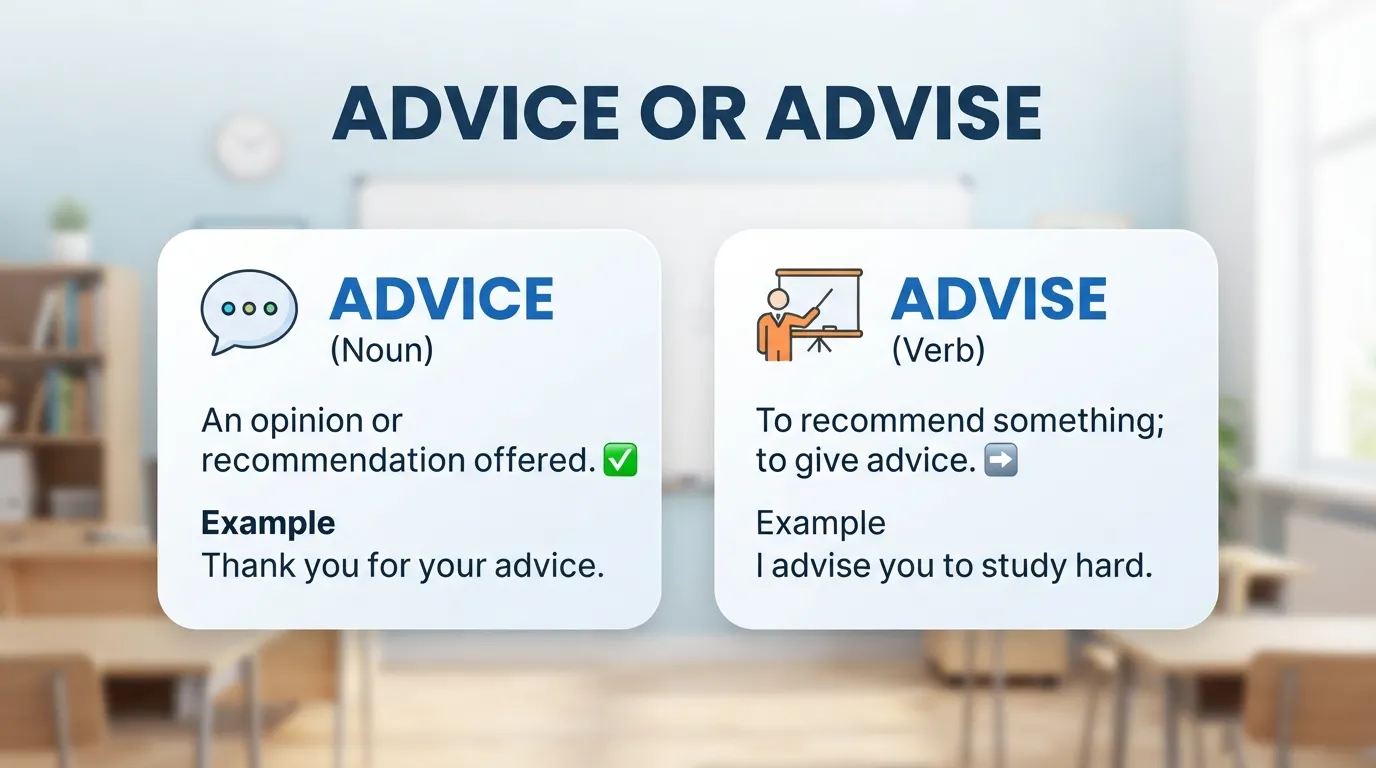
Advice or advise means you are choosing between a noun and a verb. “Advice” is the thing you give or receive. “Advise” is the action of giving that advice.
Have you ever written “Please advice me” and felt something looked wrong?
I’ve checked many student essays, emails, and website drafts with this exact mistake. The writer usually knows the message. They want help, guidance, or a suggestion. But the problem is the word form.
That is why advice or advise confuses many English learners. The words look almost the same. They also share the same basic idea. But one small letter changes the grammar.
Advice is a noun. It means guidance or a suggestion. Advise is a verb. It means to give guidance or tell someone what they should do.
This guide will make the difference simple. You’ll learn the meaning, correct usage, common mistakes, real examples, and the best choice for emails, essays, reports, and everyday writing.
By the end, you will know when to write advice and when to write advise.
Advice or Advise: Quick Answer
Use “advice” when you are talking about a suggestion, opinion, or guidance. Use “advise” when someone gives that suggestion or guidance. Cambridge explains that “advice” is a noun, while “advise” is a verb meaning to give someone advice.
Simple examples:
- Correct: Thank you for your advice.
- Correct: Please advise me on this issue.
- Wrong: Thank you for your advise.
- Wrong: Please advice me.
Easy rule:
- Advice = thing
- Advise = action
If you can say guidance, use advice.
If you can say give guidance, use advise.
The Origin / Background of Advice or Advise
The confusion happens because “advice” and “advise” look close and share the same idea. But English often uses different forms for nouns and verbs. In this pair, the “c” form is the noun, and the “s” form is the verb.
Merriam-Webster explains that advice and advise are different parts of speech. Advise is a verb meaning to give an opinion, suggestion, recommendation, or information. Advice is the noun for the suggestion or information given.
The pronunciation also changes.
- Advice ends with an s sound.
- Advise ends with a z sound.
That sound difference is easier to hear in speech than to notice in writing.
This pattern also appears in other English word pairs:
- device / devise
- practice / practise in British English
- licence / license in British English
For advice or advise, the rule is simple in both American and British English:
- Advice is a noun.
- Advise is a verb.
Advice or Advise Explained: Key Differences or Variations
The main difference is grammar. “Advice” names the guidance. “Advise” shows the action of giving guidance. You ask for advice, give advice, follow advice, or receive advice. You advise someone, advise against something, or advise someone to do something.
| Term | Meaning | When to Use | Region/Context |
| Advice | A suggestion or guidance | When naming the help or opinion | Standard English |
| Advise | To give advice | When showing the action | Standard English |
| A piece of advice | One suggestion | When counting advice | Formal and casual English |
| Advise someone to | Tell someone what they should do | Giving a recommendation | Professional and academic English |
| Advise against | Suggest not doing something | Warning or cautioning | Formal and general English |
Oxford Learner’s Dictionaries notes that advice is uncountable. That means you say some advice or a piece of advice, not an advice or advices.
Examples:
- Correct: I need some advice.
- Correct: She gave me a piece of advice.
- Wrong: She gave me an advice.
- Wrong: He gave me many advices.
For the verb, use advise:
- I advise you to wait.
- The lawyer advised us to read the contract.
- Experts advise against skipping sleep.
Which Version Should You Use?
Use “advice” when you need a noun after words like “some,” “good,” “bad,” “legal,” or “helpful.” Use “advise” when the sentence needs an action word. If someone is doing something, they advise. If something is being given, it is advice.
Here is the best practical advice:
- For students → use advice as a noun in essays.
- For business emails → use advise when asking someone to guide you.
- For formal writing → use advice for guidance and advise for the action.
- For legal or medical contexts → use advice for guidance, but avoid giving expert advice unless qualified.
- For global readers → keep the sentence simple and clear.
Examples:
- I need your advice.
- Please advise me on the next step.
- My teacher gave helpful advice.
- The doctor advised rest.
- We were advised to arrive early.
A quick test helps:
Can you add some before the word?
- some advice = correct
- some advise = wrong
Can you add to after it?
- advise someone to wait = correct
- advice someone to wait = wrong
Common Mistakes With Advice or Advise
Most mistakes happen when writers use “advice” as a verb or “advise” as a noun. Another common mistake is treating “advice” as countable. Since advice is uncountable, you should say “some advice” or “a piece of advice.”
| Mistake | Correction | Why It Happens |
| Please advice me. | Please advise me. | Writer uses noun as a verb |
| Thank you for your advise. | Thank you for your advice. | Writer uses verb as a noun |
| I need an advice. | I need some advice. | Advice is uncountable |
| She gave me many advices. | She gave me many pieces of advice. | Advice has no regular plural |
| He adviced me. | He advised me. | Wrong past tense spelling |
Mistake 1: “Please advice me”
Wrong:
Please advice me about this issue.
Correct:
Please advise me about this issue.
The word after please often needs to be a verb. So advise is correct.
Mistake 2: “Thank you for your advise”
Wrong:
Thank you for your advise.
Correct:
Thank you for your advice.
After your, you usually need a noun. So advice is correct.
Mistake 3: “An advice”
Wrong:
Can you give me an advice?
Correct:
Can you give me some advice?
Also correct:
Can you give me a piece of advice?
Cambridge also explains that advice is uncountable, so an advice and advices are not standard forms.
Advice or Advise in Real-World Examples
You will see “advice” and “advise” in emails, school writing, business documents, news articles, and social posts. “Advice” is common when people ask for help. “Advise” is common when someone recommends, warns, or gives official information.
Professional email example
Hi Sarah,
Thank you for your advice on the project. Please advise me if we need to update the final report.
This uses both words correctly.
News headline example
Experts Advise Parents to Check Online Safety Settings
Here, advise is a verb because experts are giving guidance.
Social media post example
Best advice I ever got: start before you feel ready.
Here, advice is the guidance itself.
Formal document example
Employees are advised to review the policy before signing the form.
This is formal and correct.
School sentence example
My teacher gave me useful advice and advised me to practice every day.
This sentence shows the noun and verb together.
Advice or Advise: Data, Trends & Usage
The search intent behind “advice or advise” is informational. Most readers want a fast grammar answer. They want to know which word is correct, how to use each one, and why sentences like “please advice me” sound wrong.
People often search this phrase because the mistake appears in daily writing.
It matters most in:
- school essays
- job applications
- business emails
- legal messages
- customer support replies
- website content
- professional reports
The difference also matters because the mistake is easy to notice. A sentence like “please advice me” may still be understood, but it can look unpolished.
Cambridge defines advice as an opinion someone offers about what you should do or how you should act. It defines advise as giving someone advice or official information.
That is the full difference in one idea:
Advice is what you receive. Advise is what someone does.
Advice or Advise Comparison Table
A comparison table makes the choice easier. Use “advice” when the word is a thing. Use “advise” when the word is an action. In most grammar mistakes, the sentence becomes clear once you check whether you need a noun or a verb.
| Term/Variant | Meaning | Region/Context | Best Used When |
| Advice | Guidance or suggestion | Standard English | You mean the idea, help, or recommendation |
| Advise | To give guidance | Standard English | Someone is giving the suggestion |
| Some advice | An amount of guidance | General English | Asking for help |
| A piece of advice | One suggestion | Formal and casual English | Counting one item of guidance |
| Advised | Past tense of advise | Formal and general English | Someone gave guidance in the past |
| Advisory | Official warning or notice | Government, travel, weather, safety | Referring to official information |
FAQs About Advice or Advise
Q: What does advice or advise mean?
A: Advice or advise is a grammar choice. Advice is a noun meaning guidance. Advise is a verb meaning to give guidance.
Q: Is “please advice me” correct?
A: No. The correct sentence is “Please advise me.” You need a verb after please, so advise is correct.
Q: Is “thank you for your advise” correct?
A: No. The correct sentence is “Thank you for your advice.” Here, you need a noun after your, so advice is correct.
Q: Advice vs advise: what’s the difference?
A: Advice is the suggestion itself. Advise is the action of giving that suggestion. For example, “She gave advice” and “She advised me.”
Q: Is advice countable?
A: No. Advice is uncountable in standard English. Say some advice or a piece of advice, not an advice or advices.
Q: Which version is correct: advice or advise?
A: Both are correct, but they have different jobs. Use advice as a noun and advise as a verb.
Q: Can advice or advise be used in formal writing?
A: Yes. Both words are fine in formal writing when used correctly. Use advice for guidance and advise for the act of giving guidance.
Conclusion
Now you know the difference between advice or advise.
The rule is simple. Advice is a noun. It means guidance, help, or a suggestion. Advise is a verb. It means to give that guidance or suggestion.
Remember these examples:
- I need your advice.
- Please advise me.
- She gave good advice.
- He advised me to wait.
Also remember that advice is uncountable. Say some advice or a piece of advice. Do not say an advice or advices.
If your sentence needs a thing, use advice. If your sentence needs an action, use advise.
Now you know exactly how to use advice or advise. Check your next email, essay, or message before you send it.
Read More: Repass or Repast: Easy Correct Usage Guide

Muhammad Afzal is a language content writer specializing in English grammar, word usage, and vocabulary distinctions. With a strong command of linguistic nuance, Muhammad Afzal focuses on simplifying commonly confused word pairs to help readers communicate with clarity and confidence.