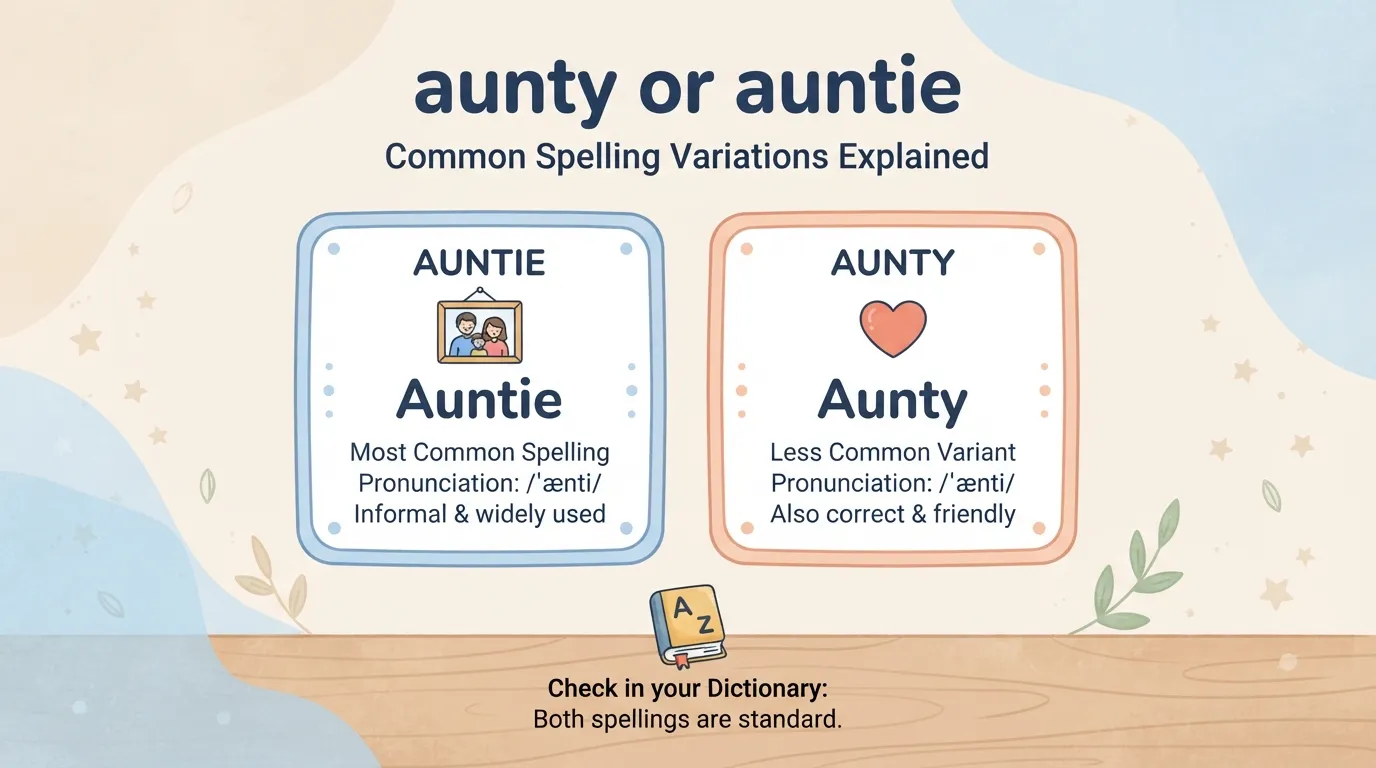
Aunty or auntie means you are choosing between two informal spellings of “aunt.” Both are correct, but “auntie” is more widely recognized in dictionaries, while “aunty” is also accepted and common in many English-speaking families and regions.
Have you ever typed “aunty” and then wondered if it should be “auntie”?
I’ve seen this question many times in student writing, birthday messages, family captions, and English-learning lessons. The confusion is understandable. Both words sound the same. Both are used for an aunt. Both feel warm and familiar.
But they do not always feel the same on the page.
In some families, aunty looks natural. In others, auntie feels softer and more common. If you are writing a greeting card, school essay, wedding speech, or social media post, you may pause and ask, “Which spelling is correct?”
The good news is simple. You can use both, but the better choice depends on tone, audience, and region.
This guide explains aunty or auntie in clear English. You’ll learn the meaning, differences, best usage, common mistakes, and real examples.
Aunty or Auntie: Quick Answer
Both “aunty” and “auntie” are correct informal forms of “aunt.” Use “auntie” when you want the more common dictionary spelling. Use “aunty” if that is the spelling used in your family, culture, or region. In formal writing, use “aunt.”
Cambridge lists auntie and aunty as informal forms of aunt, which means the sister of someone’s mother or father, or the wife of someone’s uncle or aunt.
Simple examples:
- Formal: My aunt lives in Canada.
- Informal: My auntie made dinner.
- Also informal: My aunty called me yesterday.
For school essays, reports, and formal writing, choose aunt. For family messages and casual writing, auntie or aunty can both work.
The Origin / Background of Aunty or Auntie
The words “aunty” and “auntie” come from “aunt.” They are friendly, informal forms often used by children or close family members. The ending “-ie” or “-y” makes the word sound warmer, softer, and more personal.
The base word is aunt. Oxford defines aunt as the sister of your father or mother, or the wife of your uncle or aunt.
The forms auntie and aunty add a familiar tone. That is why people often use them in family settings.
For example:
- Aunt sounds standard.
- Auntie sounds warm and familiar.
- Aunty also sounds warm, but may feel more regional or family-based.
Merriam-Webster defines auntie simply as aunt, which shows that it is accepted as a familiar form.
In some cultures, auntie is also used for older women who are not blood relatives. Oxford notes this use in Indian English and South-East Asian English, where auntie can be a polite way to address or refer to an older woman.
That is why the word can carry respect, warmth, and closeness.
Aunty or Auntie Explained: Key Differences or Variations
The main difference is style and preference. “Auntie” is often the safer choice for general readers because it is widely listed in dictionaries. “Aunty” is also correct and natural in many families. “Aunt” is the best choice for formal writing.
| Term | Meaning | When to Use | Region/Context |
| Aunt | Your parent’s sister or your uncle’s wife | Formal writing, essays, reports | Standard English |
| Auntie | Informal form of aunt | Family talk, greetings, casual writing | Common and widely recognized |
| Aunty | Informal form of aunt | Family use, casual messages, regional preference | Common in many English-speaking communities |
| Auntieji | Respectful form of auntie | Very polite address | Indian English context |
Cambridge shows auntie and aunty as informal forms under aunt, so both spellings are accepted in informal English.
Examples:
- My aunt is visiting next week.
- Happy birthday, Auntie Sara!
- Thank you, Aunty Maria, for the gift.
If you are writing for a broad audience, auntie is usually the smoother choice. If your family uses aunty, that spelling is fine in personal writing.
Which Version Should You Use?
Use “aunt” in formal writing, “auntie” in general casual writing, and “aunty” when that spelling fits your family, culture, or audience. If you are unsure, “auntie” is a safe informal choice, while “aunt” is the safest formal choice.
Here is the best practical advice:
- For students → use aunt in essays unless the sentence is dialogue.
- For birthday messages → use auntie or aunty based on family preference.
- For formal documents → use aunt.
- For social media captions → use auntie or aunty.
- For global readers → use auntie if you want an informal but widely understood word.
- For Indian or South-East Asian context → auntie may also be used as a polite address for an older woman.
Examples:
- Formal: My aunt helped raise me.
- Friendly: My auntie makes the best tea.
- Personal: Love you, Aunty Noor.
- Cultural: Good morning, Lotika auntie.
The last example follows Oxford’s note that in Indian English, the name may come before auntie in this kind of polite address.
Common Mistakes With Aunty or Auntie
Most mistakes happen when writers use “aunty” or “auntie” in writing that needs a formal tone. Another common mistake is thinking one spelling is always wrong. In truth, both informal spellings can be correct, but “aunt” is better for formal use.
| Mistake | Correction | Why It Happens |
| My auntie is my legal guardian. | My aunt is my legal guardian. | Formal context needs “aunt” |
| Aunty is always wrong. | Aunty is informal but accepted. | People know “auntie” better |
| Auntie is only for relatives. | Auntie can also be respectful in some cultures. | Cultural usage is overlooked |
| dear auntie sara | Dear Auntie Sara | Names and titles need capital letters |
| My anty is coming. | My aunty/auntie is coming. | Misspelling from sound |
Mistake 1: Using informal spelling in formal writing
Wrong for formal writing:
My auntie is listed as my emergency contact.
Better:
My aunt is listed as my emergency contact.
Mistake 2: Thinking “aunty” is incorrect
Wrong belief:
Aunty is not a real spelling.
Better understanding:
Aunty is an informal spelling of aunt and is accepted in informal use. Cambridge lists aunty alongside auntie as an informal form of aunt.
Mistake 3: Forgetting capitalization
If Auntie or Aunty is used like a title before a name, capitalize it.
Correct:
- Auntie Fatima
- Aunty Rose
- Aunt Linda
Lowercase it when it is only a general noun:
- My auntie came over.
- Her aunty made lunch.
Aunty or Auntie in Real-World Examples
You can use “aunt,” “auntie,” and “aunty” in real writing, but each one fits a different tone. “Aunt” is neutral and formal. “Auntie” is warm and widely recognized. “Aunty” is friendly and often shaped by family or regional habit.
Professional email example
Hi Ms. Carter,
I will be away on Friday because my aunt has a medical appointment.
Thank you for understanding.
This uses aunt because the email is professional.
Birthday message example
Happy birthday, Auntie Maria! Thank you for always making everyone feel loved.
This sounds warm and natural.
Social media post example
Weekend lunch with my favorite aunty. Nothing beats family time.
This works well for personal and casual writing.
Formal document example
The child’s aunt is authorized to collect the documents.
This is the best choice for official writing.
Cultural address example
I’ll ask Saira auntie if she needs help with the event.
This kind of use can appear in Indian English and South-East Asian English, where auntie may be used politely for an older woman.
Aunty or Auntie: Data, Trends & Usage
The search intent behind “aunty or auntie” is informational. Most readers want to know which spelling is correct, which one is more formal, and whether the choice changes by country, culture, or family habit.
People search this phrase because both spellings appear in real life.
You may see auntie in:
- dictionaries
- greeting cards
- children’s books
- family messages
- cultural address
- casual writing
You may see aunty in:
- family texts
- birthday wishes
- social captions
- regional English use
- personal notes
- informal messages
The topic matters because the word is often emotional. People use it for someone they love, respect, or see as family.
In formal English, aunt is the cleanest choice. In warm personal writing, auntie and aunty both feel more affectionate.
Collins also lists auntie or aunty as a familiar word for aunt, which supports the idea that both are informal family-style forms.
Aunty or Auntie Comparison Table
A quick comparison makes the choice easier. Use “aunt” when the writing needs to be formal. Use “auntie” when you want a friendly and widely recognized spelling. Use “aunty” when it matches your family’s usual spelling or regional style.
| Term/Variant | Meaning | Region/Context | Best Used When |
| Aunt | Parent’s sister or uncle’s wife | Standard English | Formal writing, essays, legal forms, reports |
| Auntie | Informal form of aunt | General casual English | Greeting cards, family messages, dialogue |
| Aunty | Informal form of aunt | Family or regional preference | Personal notes, captions, warm messages |
| Auntieji | Respectful form of auntie | Indian English | Very polite address |
| Anty | Misspelling | Not standard | Avoid in English writing |
FAQs About Aunty or Auntie
Q: What does aunty or auntie mean?
A: Aunty and auntie both mean aunt in an informal, friendly way. They can refer to your parent’s sister, your uncle’s wife, or sometimes a respected older woman.
Q: Is aunty correct?
A: Yes, aunty is correct in informal writing. Cambridge lists aunty as an informal form of aunt.
Q: Is auntie correct?
A: Yes, auntie is correct. Merriam-Webster defines auntie as aunt, and it is widely recognized in English dictionaries.
Q: Aunty vs auntie: what’s the difference?
A: The meaning is the same. Auntie is often the safer general spelling, while aunty is also accepted and common in many families and regions.
Q: Is aunty or auntie acceptable in formal writing?
A: For formal writing, use aunt. Aunty and auntie are informal and better for family messages, dialogue, captions, or friendly writing.
Q: Which version is correct: aunty or auntie?
A: Both are correct informal spellings. Use auntie for a widely recognized style, or aunty if that is the spelling your family or audience uses.
Q: Can auntie be used for someone who is not related to you?
A: Yes, in some cultures. Oxford notes that in Indian English and South-East Asian English, auntie can be used as a polite way to address or refer to an older woman.
Conclusion
Now you know the difference between aunty or auntie.
The short answer is simple. Both aunty and auntie are correct informal spellings. They both mean aunt, and both can sound warm, close, and loving.
Use aunt when your writing is formal. Use auntie when you want the most widely recognized informal spelling. Use aunty when that spelling feels natural in your family, culture, or region.
For birthday wishes, captions, and family notes, either spelling can work. For school essays, forms, reports, and professional writing, aunt is the better choice.
Remember this easy rule:
- Aunt = formal and standard
- Auntie = warm and widely recognized
- Aunty = warm and family-style
Now you know exactly how to use aunty or auntie. Pick the spelling that fits your reader, your tone, and your family style.
Read More: Til or Till: Easy Correct Spelling Guide

Muhammad Afzal is a language content writer specializing in English grammar, word usage, and vocabulary distinctions. With a strong command of linguistic nuance, Muhammad Afzal focuses on simplifying commonly confused word pairs to help readers communicate with clarity and confidence.