Til or till means you are choosing between informal “til” and standard “till.” The best choice is usually “till” or “until.” Use “till” in normal casual writing, “until” in formal writing, and “’til” only when you want a very informal clipped style.
Have you ever written “til” in a message and wondered if it looked unfinished?
I’ve seen this question come up often in student writing, social captions, emails, and even wedding phrases like “till death do us part.” Many people think till is a mistake because it looks like someone added an extra l to until. But that is not true.
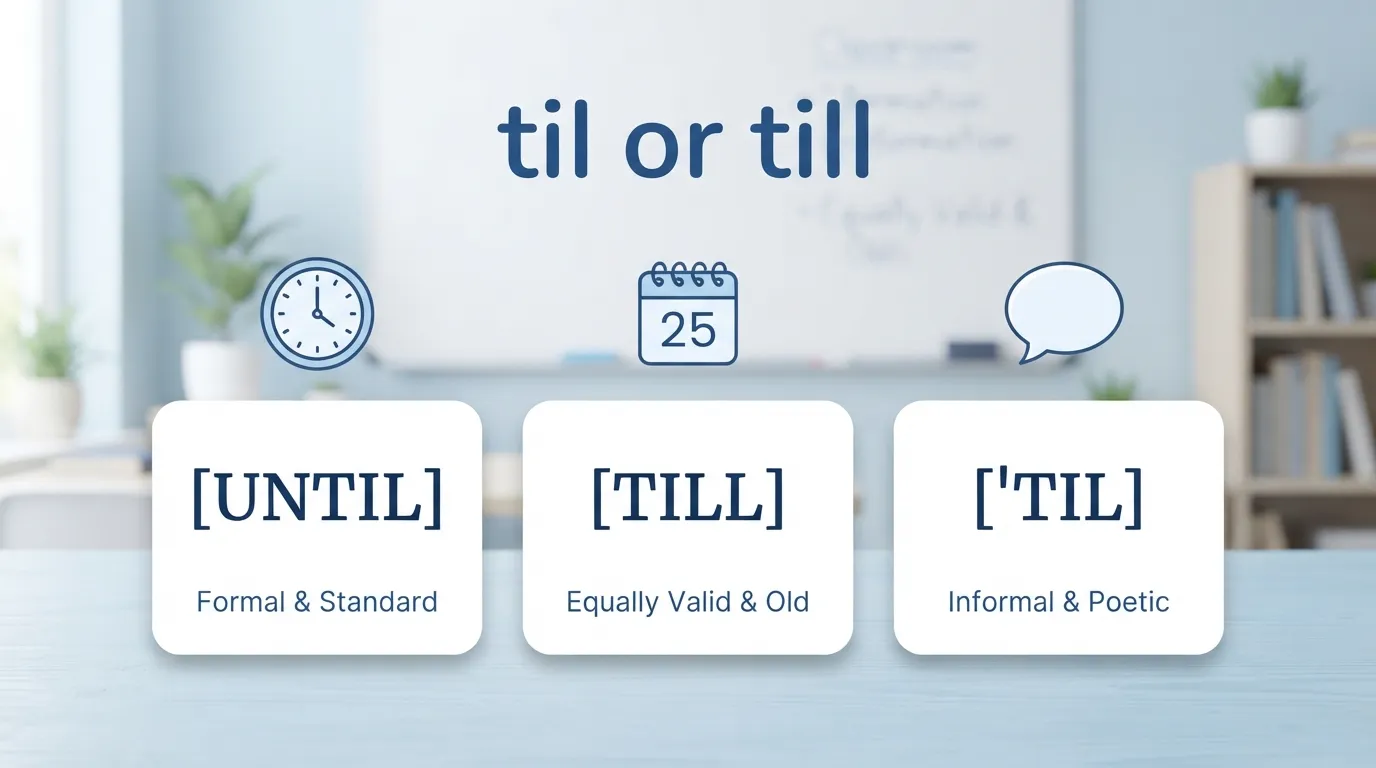
The real confusion comes from three similar words: until, till, and ’til. They all point to time, but they do not have the same tone. Until feels more formal. Till is shorter and fully accepted. ’Til feels casual because it is a shortened form.
So, which one should you use?
This guide explains til or till in simple English. You’ll learn the correct spelling, the difference between each form, common mistakes, real examples, and the best choice for school, work, blogs, and everyday messages.
Til or Till: Quick Answer
Use “till” when you want a correct short form of “until.” Use “until” when your writing needs to sound formal or polished. Avoid “til” in careful writing unless your style guide accepts it. “’Til” is informal and works best in casual writing, lyrics, slogans, and friendly messages.
Merriam-Webster says till means until and explains that until and till can be used interchangeably. It also notes that ’til is more informal and not ideal for formal writing.
Simple examples:
- Formal: Please wait until Friday.
- Casual but correct: Please wait till Friday.
- Very informal: Wait ’til Friday.
For most writing, the safest choices are until and till.
The Origin / Background of Til or Till
The word “till” is not a modern spelling mistake. It is an old English word that means “until.” Many people assume “till” came from “until,” but dictionaries treat “till” as a real word, not just a lazy short form.
This is why till is correct in phrases like:
- Wait till morning.
- We stayed till midnight.
- Till death do us part.
Cambridge defines till as meaning up to the time that or until. It gives examples like “We waited till six thirty for you.”
The confusion happens because until looks more complete. Many readers assume the longer word must be more correct. But English does not always work that way.
Till is shorter, but it is still standard. ’Til is different because it is a clipped form of until. It drops the first part of the word and uses an apostrophe to show missing letters.
The plain spelling til without an apostrophe is sometimes seen. Oxford Learner’s Dictionaries lists til and ’til as informal forms with till under until. Still, in polished writing, till or until is usually better.
Til or Till Explained: Key Differences or Variations
The main difference is tone. “Until” is the most formal. “Till” is correct and slightly more casual. “’Til” is informal and clipped. “Til” without the apostrophe is common online, but it is not the best choice for careful writing.
| Term | Meaning | When to Use | Region/Context |
| Until | Up to a time or event | Formal writing, essays, reports, business emails | Standard English |
| Till | Until | Casual and general writing | Standard English |
| ’Til | Shortened form of until | Songs, slogans, texts, casual posts | Informal English |
| Til | Informal spelling of ’til | Casual online writing | Very informal |
| ’Till | Nonstandard spelling | Best avoided | Often seen as an error |
Cambridge explains that until is a preposition and a conjunction. It also says until is often shortened to till or ’til, and that till and ’til are more informal and not usually used in formal writing.
Examples:
- I will wait until the meeting ends.
- I will wait till the meeting ends.
- I’ll wait ’til the meeting ends.
All three can be understood. But they do not feel the same.
Which Version Should You Use?
Use “until” when your writing needs a formal tone. Use “till” when you want a shorter but still correct word. Use “’til” only when the writing is casual. Avoid “til” and “’till” in school, business, and professional content.
Here is the best practical advice:
- For students → use until in essays and assignments.
- For business emails → use until for a polished tone.
- For blog writers → use until or till, depending on the style.
- For social media captions → till or ’til can work.
- For song lyrics or slogans → ’til may fit the rhythm.
- For formal documents → use until.
- For global readers → use until for maximum clarity.
Examples:
- Formal: Applications are open until June 30.
- Friendly: We’re open till 8 p.m.
- Casual: Can’t wait ’til summer.
- Weak for formal writing: Wait til tomorrow.
If you are unsure, choose until. It is always safe in professional writing.
Common Mistakes With Til or Till
Most mistakes happen because writers think “till” is wrong or that “til” is the standard short form. Another common mistake is writing “’till” with an apostrophe before two l’s. For clean writing, use “until,” “till,” or informal “’til.”
| Mistake | Correction | Why It Happens |
| Wait til tomorrow. | Wait till tomorrow. | “Til” looks like a simple short form |
| Wait ’till tomorrow. | Wait ’til tomorrow. | Writer adds an extra l |
| Open till Monday in a legal notice | Open until Monday | Formal tone needs “until” |
| I’ll stay until 9 in a casual slogan | I’ll stay till 9 | “Till” may sound more natural |
| I can’t wait til Friday in polished copy | I can’t wait ’til Friday | Apostrophe shows missing letters |
Mistake 1: Thinking “till” is incorrect
Wrong belief:
Till is always a mistake.
Better understanding:
Till is a real word that means until.
Merriam-Webster confirms that till and until can be used freely and interchangeably.
Mistake 2: Using “til” in formal writing
Weak:
The office will remain closed til Monday.
Better:
The office will remain closed until Monday.
Mistake 3: Writing “’till”
Avoid:
I’ll wait ’till noon.
Better:
I’ll wait ’til noon.
The apostrophe in ’til shows that part of until has been dropped. There is no need to add another l.
Til or Till in Real-World Examples
You can use “until,” “till,” and “’til” in real writing, but the context matters. A formal email usually needs “until.” A shop sign can use “till.” A casual caption or slogan may use “’til.”
Professional email example
Hi Anna,
I will be away from my desk until 3 p.m. today.
Please send any urgent updates before noon.
This sounds clear and professional.
News headline example
City Offices Closed Until Monday After Storm Damage
News writing often uses until because it sounds formal and clear.
Social media post example
Counting the days ’til vacation starts.
This sounds relaxed and natural.
Shop sign example
Open till 9 p.m.
This is short, clear, and acceptable for signage.
Formal document example
The agreement will remain active until the final payment is received.
This is the best choice for legal, business, or official writing.
Til or Till: Data, Trends & Usage
The search intent behind “til or till” is informational. Most readers want to know which spelling is correct, whether “till” is a mistake, and whether “til” needs an apostrophe. The answer depends on formality and context.
People often search this topic because they see many versions online:
- till
- til
- ’til
- until
- ’till
This matters because small spelling choices can change how your writing feels.
For example, until sounds polished. Till sounds natural and direct. ’Til sounds casual. Til may look unfinished to careful readers.
Oxford Learner’s Dictionaries describes till as generally more informal than until and less common in writing. It gives examples like “We’re open till 6 o’clock.”
The main search intent is spelling clarification. Readers want a direct answer they can use in emails, captions, essays, and everyday writing.
The simple rule is this:
Use until for formal writing, till for normal short writing, and ’til for casual style.
Til or Till Comparison Table
A simple table makes the choice easier. “Until” is the safest formal option. “Till” is correct and useful in everyday writing. “’Til” is informal. “Til” is common in casual typing, but it is not the best choice when your writing needs polish.
| Term/Variant | Meaning | Region/Context | Best Used When |
| Until | Up to a time or event | Formal and standard English | Writing essays, reports, policies, and business emails |
| Till | Until | Standard but more casual | Writing signs, friendly copy, and everyday sentences |
| ’Til | Short for until | Informal English | Writing captions, songs, slogans, and casual messages |
| Til | Informal spelling of ’til | Casual online use | Only when your style is very relaxed |
| ’Till | Nonstandard form | Usually avoided | Best not used in careful writing |
FAQs About Til or Till
Q: What does til or till mean?
A: Til or till is a spelling choice related to until. Till means until, while til is an informal spelling often used online.
Q: Is till a real word?
A: Yes. Till is a real word that means until. It is not a mistake or a lazy spelling.
Q: Is til correct?
A: Til is informal. It may appear in casual writing, but till, until, or ’til are better choices depending on the tone.
Q: Til vs till: what’s the difference?
A: Till is a standard word meaning until. Til is an informal spelling, often used as a shortened form of until.
Q: Is till acceptable in formal writing?
A: Till is correct, but until is usually better in formal writing. Use until in essays, reports, contracts, and business emails.
Q: Which version is correct: til or till?
A: Till is the better correct spelling. For formal writing, use until. For casual writing, ’til can also work.
Q: Should I write til or ’til?
A: If you want the clipped form of until, ’til is clearer because the apostrophe shows missing letters. But in most writing, till or until is better.
Conclusion
Now you know the difference between til or till.
The safest answer is simple. Use until when you need formal, polished writing. Use till when you want a shorter word that is still correct. Use ’til when your tone is casual, friendly, or creative.
Avoid ’till because it looks awkward and is widely treated as an error. Be careful with til too. It is common online, but it can look too informal in school, business, and professional writing.
Remember this quick rule:
- Until = formal and safest
- Till = correct and natural
- ’Til = informal and casual
- Til = very informal
- ’Till = avoid
Now you know exactly how to use til or till. Check your next message, caption, or email and choose the version that fits your tone.
Read More: Words With Or: Easy Word List and Usage Guide

Muhammad Afzal is a language content writer specializing in English grammar, word usage, and vocabulary distinctions. With a strong command of linguistic nuance, Muhammad Afzal focuses on simplifying commonly confused word pairs to help readers communicate with clarity and confidence.