Plus or minus means “more or less,” “approximately,” or “with a possible amount added or subtracted.” In math, science, and measurement, it is often shown with the symbol ± to show a range of possible values.
Have you ever seen a number like 50 ± 2 and wondered what it really means?
I’ve seen this question come up in math homework, product specs, weather reports, science notes, and even business estimates. The phrase plus or minus looks simple, but it can mean slightly different things based on the situation.
Sometimes, it means about. For example, “The meeting will take 30 minutes, plus or minus.” Other times, it means a number can be higher or lower by a set amount. For example, 100 plus or minus 5 means the value could be as low as 95 or as high as 105.
That is why this phrase is useful. It helps people speak honestly when a value is not exact.
This guide explains plus or minus in simple English. You’ll learn the meaning, symbol, examples, common mistakes, and the best way to use it in writing, math, reports, and daily speech.
Plus or Minus: Quick Answer
Plus or minus means a number may go up or down by a certain amount. It can also mean “approximately” in casual speech. Merriam-Webster defines “plus or minus” as a way to show a range of values, and also as “more or less” or “approximately.”
Simple examples:
- 20 plus or minus 2 means from 18 to 22.
- $100 plus or minus $10 means from $90 to $110.
- 30 minutes, plus or minus means about 30 minutes.
The symbol for plus or minus is ±.
Example:
50 ± 3 = from 47 to 53
So, plus or minus is used when the answer is close, but not exact.
The Origin / Background of Plus or Minus
The phrase comes from two basic math ideas: plus means added to, and minus means taken away. Over time, “plus or minus” became a useful phrase for estimates, measurements, margins, and casual guesses where the exact value may be slightly higher or lower.
Cambridge defines plus as “added to,” and minus as “reduced by a stated number.” These two meanings explain the phrase clearly. Plus moves a number up. Minus moves a number down.
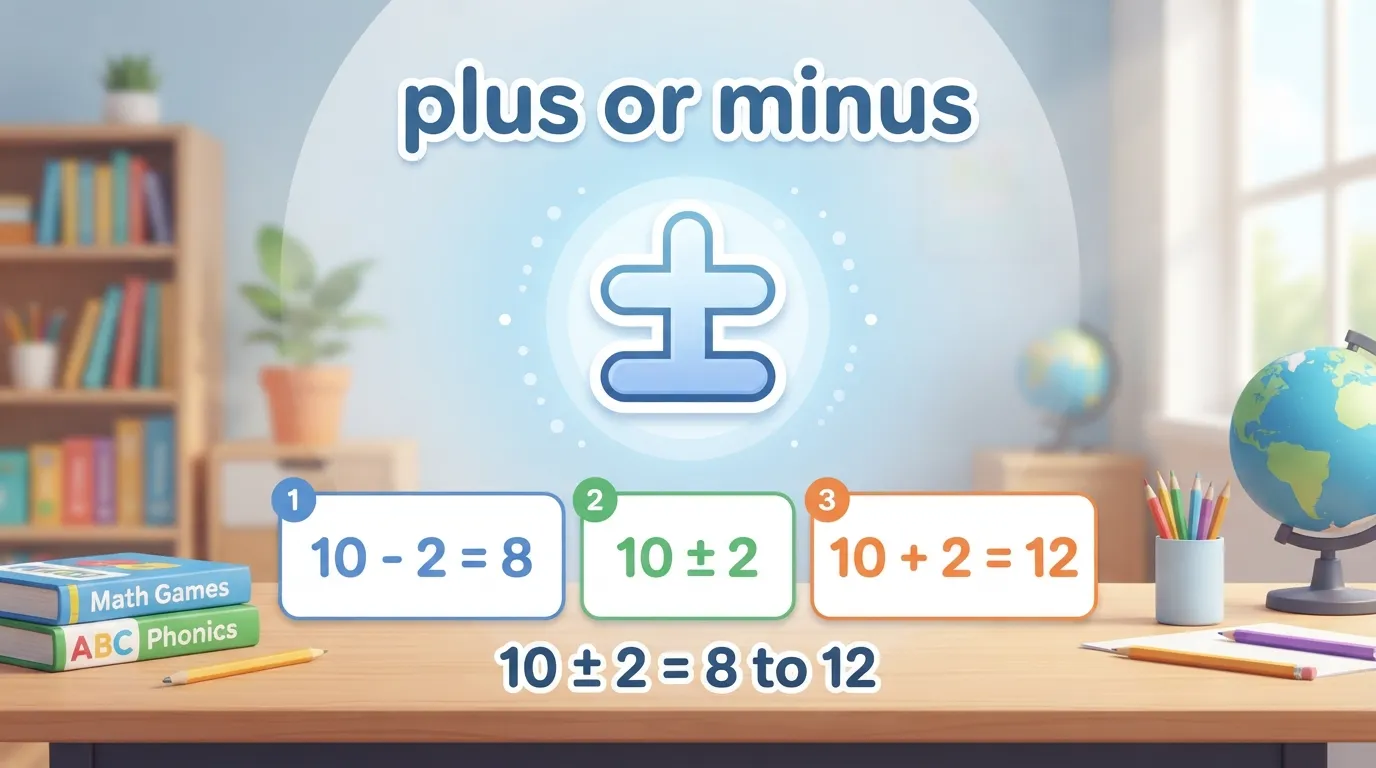
For example:
- 10 plus 2 = 12
- 10 minus 2 = 8
- 10 plus or minus 2 = 8 to 12
The plus-minus symbol ± is common in math and measurement. It shows that the value may be above or below a central number.
You may see it in:
- math problems
- science results
- engineering measurements
- medical readings
- product size tolerance
- survey margins of error
- weather estimates
The phrase is also used in daily speech when people do not want to sound too exact.
Example:
I’ll be there in 20 minutes, plus or minus.
That means the person may arrive a little earlier or later.
Plus or Minus Explained: Key Differences or Variations
The meaning changes by context. In math, plus or minus gives a clear range. In casual speech, it often means “about.” In science or measurement, it shows possible error or tolerance. In writing, it can make estimates sound more honest.
| Term | Meaning | When to Use | Region/Context |
|---|---|---|---|
| Plus | Add something | When increasing a number or amount | Math and general English |
| Minus | Subtract something | When reducing a number or amount | Math and general English |
| Plus or minus | Add or subtract a possible amount | When giving a range or estimate | Math, science, daily speech |
| ± symbol | Symbol for plus or minus | When writing a compact range | Math and measurement |
| Approximately | About, not exact | When exact value is unknown | Formal and general writing |
Oxford Learner’s Dictionaries defines minus as a word used when you subtract one number or thing from another. It also lists plus sign as the symbol +, used in mathematics.
Examples:
- Plus: 8 + 2 = 10
- Minus: 8 − 2 = 6
- Plus or minus: 8 ± 2 = 6 to 10
In plain words:
Plus or minus gives both possible directions.
Which Version Should You Use?
Use “plus or minus” when you want to show a value can be slightly higher or lower. Use the symbol ± in math, science, and technical writing. Use “about” or “approximately” when writing for readers who may not understand the symbol.
Here is the best practical advice:
- For students → use plus or minus to explain ranges in words.
- For math work → use the ± symbol when your teacher allows it.
- For science reports → use ± with measurement uncertainty.
- For business writing → use approximately if you want a formal tone.
- For casual speech → use plus or minus to mean “about.”
- For global readers → explain the range clearly in words.
Examples:
- Math: The answer is 12 ± 1.
- Simple writing: The answer is between 11 and 13.
- Business: The cost is approximately $500.
- Casual: It’ll take one hour, plus or minus.
If clarity matters, write the full range.
Instead of:
The box weighs 10 kg ± 1 kg.
You can write:
The box weighs between 9 kg and 11 kg.
That is easier for beginners.
Common Mistakes With Plus or Minus
Most mistakes happen when writers use plus or minus without explaining the range. Another common error is using it too casually in formal writing. The phrase is useful, but readers should still understand what amount may be added or subtracted.
| Mistake | Correction | Why It Happens |
|---|---|---|
| The result is 50 plus or minus. | The result is 50 plus or minus 2. | Missing range amount |
| 100 ± 5 means 100 to 105. | 100 ± 5 means 95 to 105. | Writer only adds, not subtracts |
| The price is plus or minus cheap. | The price is about $50. | Phrase used with the wrong structure |
| ±5 from 20 equals 25 only. | ±5 from 20 equals 15 to 25. | Minus side is ignored |
| Using ± in beginner content with no explanation | Write the range in words too | Symbol may confuse readers |
Mistake 1: Forgetting the minus side
Wrong:
40 ± 5 means 45.
Correct:
40 ± 5 means 35 to 45.
The value can move down or up.
Mistake 2: Not giving the amount
Unclear:
The delivery will take 3 days, plus or minus.
Clearer:
The delivery will take 3 days, plus or minus 1 day.
Mistake 3: Using the symbol without context
Weak:
The size is 12 ± 2.
Better:
The size is 12 ± 2 inches, which means it may be between 10 and 14 inches.
A symbol is helpful only when the reader knows what it means.
Plus or Minus in Real-World Examples
You can use plus or minus in math, emails, reports, product details, and casual messages. It works best when you give a clear base number and a clear range. The reader should know what may be added and what may be subtracted.
Professional email example
Hi Alex,
The project should take 10 days, plus or minus 2 days, depending on client feedback.
This means the project may take 8 to 12 days.
Math example
25 ± 4 means the value can be 21, 22, 23, 24, 25, 26, 27, 28, or 29, depending on the context.
In a range, it means 21 to 29.
Science example
The sample weighed 15.0 g ± 0.2 g.
This means the weight may be between 14.8 g and 15.2 g.
Social media post example
I’ll be live around 8 p.m., plus or minus a few minutes.
This means the time is close, but not exact.
Formal document example
The part must be cut to 100 mm ± 1 mm.
This means the accepted size is 99 mm to 101 mm.
Plus or Minus: Data, Trends & Usage
The search intent behind “plus or minus” is informational. Most readers want to know what the phrase means, how the ± symbol works, and how to use it in math, measurement, daily speech, or formal writing.
People often search this phrase while working on:
- math homework
- science reports
- engineering notes
- survey results
- product specifications
- business estimates
- grammar lessons
- English vocabulary
The phrase matters because it helps people avoid false precision.
For example, saying “exactly 100 people” means the number is fixed. Saying “100 people, plus or minus 5” means the number is likely between 95 and 105.
Cambridge gives an example of plus or minus in a margin of error: “The survey’s margin of error is plus or minus three percentage points.” This shows how the phrase is used when a number has a possible range.
That is why plus or minus is useful in both math and real life. It gives a number, but it also shows room for small change.
Plus or Minus Comparison Table
A quick comparison makes the phrase easier to understand. Plus adds. Minus subtracts. Plus or minus does both. The symbol ± is a short way to show that a value may be higher or lower by the same amount.
| Term/Variant | Meaning | Region/Context | Best Used When |
|---|---|---|---|
| Plus | Add | Math and general writing | Increasing a value |
| Minus | Subtract | Math and general writing | Decreasing a value |
| Plus or minus | Add or subtract | Estimates and ranges | Showing possible variation |
| ± | Plus-minus symbol | Math, science, technical writing | Writing compact ranges |
| Approximately | About | Formal and general writing | Exact number is not needed |
| More or less | About or nearly | Casual speech | Speaking informally |
FAQs About Plus or Minus
Q: What does plus or minus mean?
A: Plus or minus means a number may be higher or lower by a certain amount. It can also mean about or approximately in casual speech.
Q: What does ± mean?
A: The symbol ± means plus or minus. For example, 10 ± 2 means the value may be from 8 to 12.
Q: How do you use plus or minus correctly?
A: Start with a base number, then give the amount that may be added or subtracted. Example: 50 plus or minus 5 means 45 to 55.
Q: Plus vs minus: what’s the difference?
A: Plus means add. Minus means subtract. Plus or minus means the number may move in either direction.
Q: Is plus or minus formal?
A: It can be formal in math, science, and technical writing. In business or general writing, approximately may sound more polished.
Q: Is plus or minus the same as approximately?
A: Not always. Approximately means close to a value. Plus or minus is more specific when it gives a clear range, such as 100 ± 5.
Q: Can plus or minus be used in daily speech?
A: Yes. You can say, “I’ll arrive in 30 minutes, plus or minus.” This means the time is close, but not exact.
Conclusion
Now you know what plus or minus means.
The simple meaning is a little more or a little less. In math and measurement, it shows a range. In daily speech, it often means about or approximately.
Remember these examples:
- 10 ± 2 means 8 to 12.
- $50 plus or minus $5 means $45 to $55.
- 30 minutes, plus or minus means about 30 minutes.
Use plus or minus when a value is not exact but still close. Use the ± symbol in math, science, or technical writing. Use words like about or approximately when writing for beginners or general readers.
The key is clarity. Always make sure your reader knows the full range.
Now you know exactly how to use plus or minus. Try it the next time you write an estimate, measurement, report, or math answer.

Hassan Afzal has a background in English language instruction and writes to help non-native speakers and students master tricky grammar rules and word choices. Hassan Afzal’s writing style blends practical examples with clear explanations for everyday English learners.