Will or trust means you are choosing how your assets should pass to others after death. A will is simpler and often enough for basic plans, while a trust can offer more control, privacy, and probate avoidance when set up correctly.
Have you ever heard someone say, “You need a trust,” and then someone else says, “No, just make a will”?
I’ve seen this confuse many families. The words sound legal and serious. Most people only start thinking about them when they buy a home, have children, care for aging parents, or want to protect loved ones.
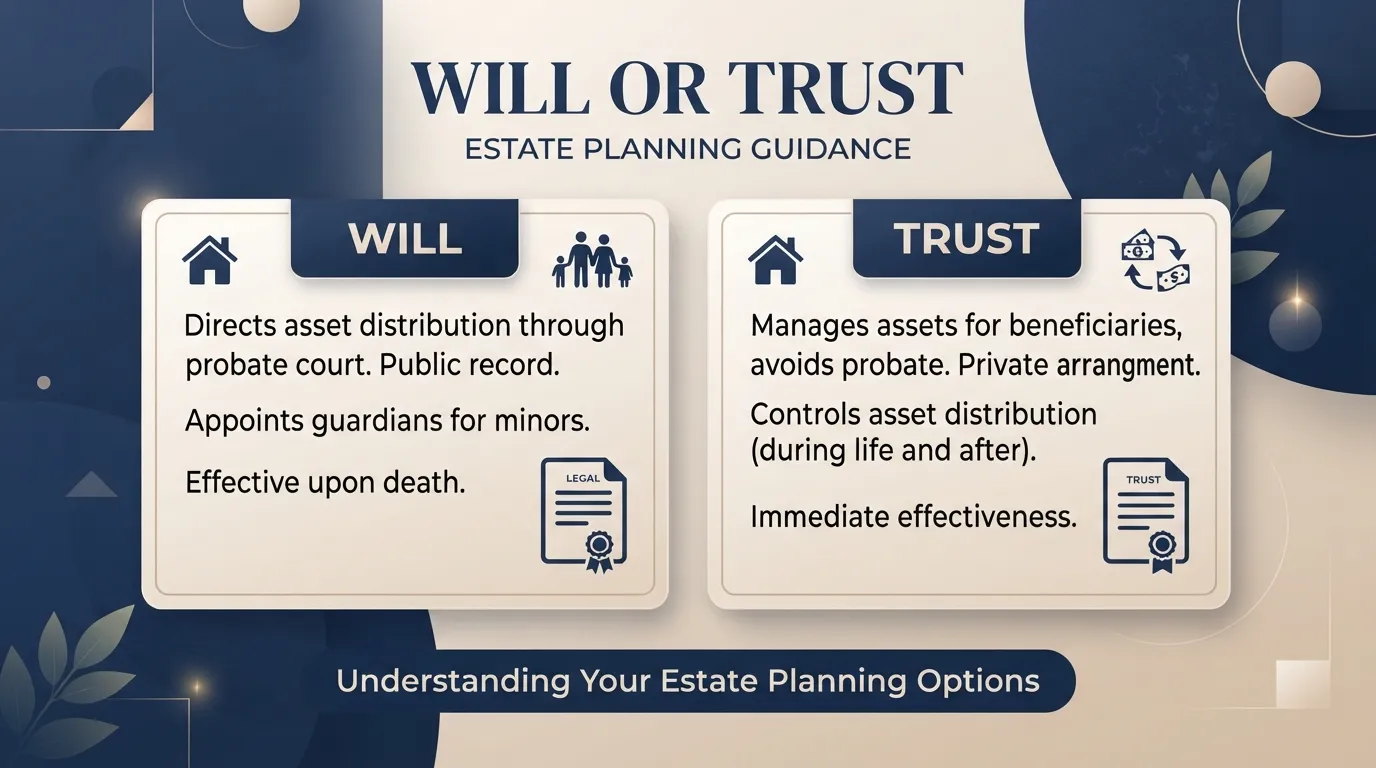
The truth is simple. A will and a trust can both help with estate planning, but they do different jobs. A will explains who should receive your property after death. A trust can hold and manage property during life and after death.
This topic also depends on your state law, your assets, your family, and your goals. So this guide gives general education, not legal advice.
You will learn the real difference between will or trust, when each one makes sense, common mistakes, real examples, and the best way to decide what fits your situation.
Will or Trust: Quick Answer
Choose a will if your estate is simple, your main goal is to name beneficiaries, and you need to name guardians for minor children. Choose a trust if you want more control, privacy, smoother asset transfer, or help managing property if you become unable to manage it yourself.
A will generally controls certain property you own at death and explains how it should be distributed. The American Bar Association notes that a will provides for distribution of certain property owned at death, though state laws may limit some choices. (American Bar Association)
A living trust can help avoid probate for property placed into the trust. A federal financial education resource explains that a living trust usually does not go through probate and that a revocable living trust can be changed or canceled during life.
Simple rule:
- Will = basic instructions after death
- Trust = asset management and transfer plan
- Many people = may need both
The Origin / Background of Will or Trust
A will and a trust both come from the same need: people want control over what happens to their property. A will speaks mainly after death. A trust can work during life, after death, or both, depending on how it is created and funded.
A will is one of the oldest and most common estate planning documents. It lets a person name beneficiaries, choose an executor, and give instructions for property after death. It can also name a guardian for minor children, which is one reason many parents start with a will.
A trust is a legal arrangement where property is held and managed for the benefit of someone else. The person who creates it is often called the grantor or settlor. The person who manages it is the trustee. The people who benefit from it are beneficiaries.
The California Attorney General explains that people can control asset distribution after death through a will or a trust, including a living trust.
The big reason people compare them is probate. Probate is the court process used to handle some assets after death. AARP notes that a will and updated beneficiary information may be enough for many estate plans, but people with substantial assets or complex needs may consider a trust for more control and probate avoidance.
Will or Trust Explained: Key Differences or Variations
The main difference is how each tool works. A will gives instructions after death and often goes through probate. A trust can hold assets during life and may transfer them outside probate if it is properly funded. Both can be useful in one estate plan.
| Term | Meaning | When to Use | Context |
|---|---|---|---|
| Will | Legal document giving instructions after death | Basic estate planning, naming heirs, naming guardians | Common starting point |
| Trust | Legal arrangement that holds and manages assets | Privacy, probate avoidance, control, incapacity planning | More detailed planning |
| Living trust | Trust created during your lifetime | Managing assets during life and after death | Often revocable |
| Revocable trust | Trust you can change or cancel | Flexible planning during life | Common estate planning tool |
| Irrevocable trust | Trust usually hard to change | Advanced asset, tax, or protection planning | Needs legal guidance |
Nolo explains one key difference clearly: property left through a living trust does not pass through probate, while property left through a will does go through probate.
That does not mean every person needs a trust. A trust can cost more to create and maintain. It also must be funded, which means assets need to be moved into it or connected to it correctly.
A will is usually simpler. But it may not avoid probate.
Which Version Should You Use?
Use a will for a simple plan, especially if cost and ease matter. Use a trust when you want stronger control, privacy, probate avoidance, or smoother management of assets. For many families, the best answer is not will or trust. It is a will and a trust together.
Here is the practical advice:
- For young parents → a will is important because it can name a guardian for minor children.
- For simple estates → a will plus updated beneficiary forms may be enough.
- For homeowners → a trust may help if probate avoidance is a goal.
- For blended families → a trust may give more control over timing and distribution.
- For privacy concerns → a trust may be better because probate can be public.
- For assets in multiple states → a trust may help reduce extra probate issues.
- For complex assets or taxes → speak with an estate planning attorney.
AARP states that a will and up-to-date beneficiary information can suffice for many estate plans, but people with substantial assets or complex circumstances may want to consider a trust and consult an estate planning attorney.
A good estate plan may also include documents beyond a will or trust. A recent AP estate-planning guide lists key documents like a last will, living will, healthcare power of attorney, and financial power of attorney. It also recommends updating documents after major life changes. (AP News)
Common Mistakes With Will or Trust
The biggest mistake is thinking a document alone solves everything. A will must be signed correctly under state law. A trust must be funded. Beneficiary forms must match your plan. Old documents should be reviewed after marriage, divorce, births, deaths, and major asset changes.
| Mistake | Correction | Why It Happens |
|---|---|---|
| Creating a trust but not funding it | Move or title assets properly | People think signing is enough |
| Thinking a will avoids probate | A will usually goes through probate | Probate rules are confusing |
| Forgetting beneficiary forms | Review accounts and insurance | Beneficiary forms can override plans |
| Using one template for every state | Check state law | Estate laws vary |
| Never updating documents | Review after major life changes | Life changes faster than paperwork |
Mistake 1: Trust not funded
A trust only works well for assets connected to it. If your home, accounts, or other assets are never placed into the trust or linked properly, the trust may not control them.
Mistake 2: Relying only on a will for privacy
A will may become part of probate court records. A trust can provide more privacy when it avoids probate, but the details depend on the assets and local law.
Mistake 3: Ignoring beneficiary designations
Retirement accounts, life insurance, and some bank accounts often pass by beneficiary forms. These forms should match your estate plan.
Mistake 4: Choosing based only on cost
A will may cost less upfront. A trust may save time or court steps later. The better choice depends on the full picture, not only the first price.
Will or Trust in Real-World Examples
A will or trust can be used in everyday family planning, home ownership, business planning, and care planning. The right choice depends on the goal. Some people need simple instructions. Others need asset management, privacy, or support for complex family needs.
Professional email example
Hi Jordan,
We are reviewing whether a will or trust makes more sense for our family. Our main goals are naming a guardian, keeping the home transfer simple, and avoiding confusion for our children.
Simple family example
A married couple with young children may start with a will because they need to name guardians and choose who receives their property.
Homeowner example
A homeowner may consider a living trust if they want the home to transfer more smoothly and avoid probate, when allowed by state law and properly set up.
Blended family example
A person with children from a first marriage may use a trust to support a spouse while also protecting future inheritance for children.
Business owner example
A small business owner may need more than a basic will. A trust, business succession plan, and powers of attorney may all matter.
Will or Trust: Data, Trends & Usage
The search intent behind “will or trust” is informational and practical. Most readers want to know which estate planning tool is better, how probate works, whether a trust is worth the cost, and if a will is enough for a simple family plan.
People often search this topic when they are:
- buying a home
- getting married
- having children
- caring for parents
- starting a business
- planning retirement
- preparing for illness
- trying to avoid family conflict
The topic matters because estate planning is not only for wealthy people. Basic planning can help families avoid confusion, delays, and arguments.
AARP says a will and updated beneficiary information may be enough for many plans, while a trust may help with greater control, probate avoidance, and more complex circumstances.
The key insight is this:
A will is often the starting point. A trust is often added when the plan needs more control.
You should also review your plan over time. Major life events can make old documents outdated.
Will or Trust Comparison Table
A side-by-side table makes the choice easier. A will is simpler and useful for basic instructions. A trust is more flexible and can avoid probate for properly funded assets. Many complete estate plans use both tools together.
| Term/Variant | Meaning | Context | Best Used When |
|---|---|---|---|
| Will | Instructions for property after death | Basic estate planning | You need a simple plan and guardian naming |
| Trust | Holds and manages assets | More detailed planning | You want control, privacy, or probate avoidance |
| Living trust | Trust created while alive | Flexible asset planning | You want planning during life and after death |
| Revocable trust | Changeable trust | Common estate planning | You want flexibility |
| Irrevocable trust | Harder to change | Advanced planning | You need tax or asset strategy advice |
| Beneficiary forms | Account transfer instructions | Insurance, retirement, bank accounts | You want certain accounts to pass directly |
FAQs About Will or Trust
Q: What does will or trust mean?
A: Will or trust means choosing between two estate planning tools. A will gives instructions after death. A trust can hold and manage assets during life and after death.
Q: Is a will better than a trust?
A: A will may be better for a simple estate. A trust may be better if you want privacy, probate avoidance, or more control. The best choice depends on your situation.
Q: Does a trust avoid probate?
A: A living trust can avoid probate for assets properly placed in the trust. Nolo explains that property left through a living trust does not pass through probate, while property left through a will does. (Nolo)
Q: Do I still need a will if I have a trust?
A: Often, yes. Many people with trusts also have a pour-over will to catch assets not placed in the trust and to handle matters a trust may not cover.
Q: Is a trust only for rich people?
A: No. A trust can help people with homes, blended families, privacy concerns, out-of-state property, or special distribution wishes. But not everyone needs one.
Q: Which is cheaper, a will or trust?
A: A will is often cheaper upfront. A trust may cost more to create, but it may reduce probate steps later. Costs vary by state, attorney, and complexity.
Q: Can I make a will or trust online?
A: Online tools exist, but estate laws vary by state. If you have children, real estate, blended family issues, business assets, or tax concerns, legal advice is safer.
Conclusion
Now you know the difference between will or trust.
A will is often the simpler starting point. It lets you name beneficiaries, choose an executor, and name guardians for minor children. It is useful for many basic estate plans.
A trust is more detailed. It can hold assets, help avoid probate for properly funded property, offer more privacy, and give more control over how and when beneficiaries receive assets.
The best answer is not always one or the other. Many people use both. A will handles basic instructions and guardianship. A trust handles asset management and transfer goals.
Remember this simple rule:
- Will = simple instructions after death
- Trust = more control and asset management
- Both = often the strongest plan
Before you decide, list your assets, family needs, debts, beneficiaries, and goals. Then speak with a qualified estate planning attorney in your state.
Bookmark this guide so you can compare will or trust before making your estate planning decision.

Muhammad Afzal is a language content writer specializing in English grammar, word usage, and vocabulary distinctions. With a strong command of linguistic nuance, Muhammad Afzal focuses on simplifying commonly confused word pairs to help readers communicate with clarity and confidence.