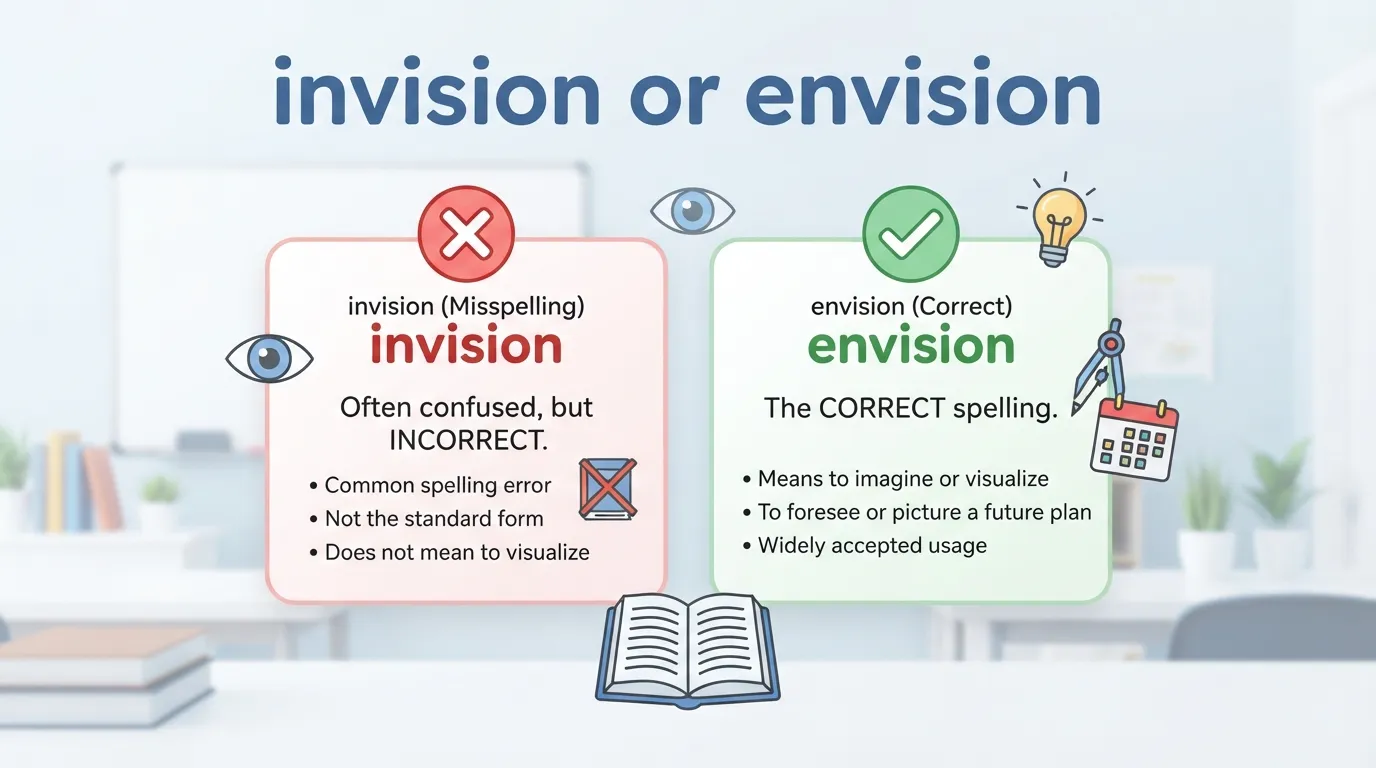
Invision or envision means you are choosing between a common misspelling and the correct verb. The correct word is “envision” when you mean to imagine, picture, or plan something in your mind.
Have you ever typed “I invision my future” and felt the word looked a little strange?
I’ve seen this mistake many times in student essays, business plans, vision statements, resumes, and social media captions. The writer usually wants to say something thoughtful. They want to describe a dream, goal, plan, or future idea. But one small spelling error can make the sentence look weak.
The correct word is envision.
The confusion makes sense. The word sounds like it could start with in, because it means seeing something “in” your mind. You may also see InVision as a brand or company name, which adds more confusion. But in normal English, when you mean imagine clearly, the correct spelling is envision.
This guide explains invision or envision in simple English. You’ll learn the meaning, difference, common mistakes, real examples, and the best way to use the correct word in formal and everyday writing.
Invision or Envision: Quick Answer
Use “envision” when you mean to imagine, picture, or expect something in the future. “Invision” is usually a misspelling of “envision.” Only use “InVision” if it is part of a proper brand name or title.
Merriam-Webster defines envision as meaning to picture to oneself, and Cambridge defines it as to imagine or expect something to happen, appear, etc. in a particular way.
Simple examples:
- Correct: I envision a better future.
- Correct: She envisioned a modern office design.
- Wrong: I invision a better future.
Easy rule:
- Envision = imagine clearly
- Invision = common misspelling
- InVision = possible brand or proper name
If your sentence is about imagining, planning, or picturing something, choose envision.
The Origin / Background of Invision or Envision
The confusion comes from sound and meaning. “Envision” sounds like it could be linked to seeing something “in” your mind, so many writers spell it as “invision.” But standard dictionaries list “envision” as the correct verb.
The word envision is connected to the idea of seeing or imagining something mentally. It often means you can picture an idea, result, future, or plan before it becomes real.
For example:
- A founder may envision a new business.
- A teacher may envision a better classroom.
- A designer may envision a cleaner website.
- A student may envision a successful career.
Dictionary.com lists invision as a frequent misspelling of envision.
That means invision may appear online, but it is not the spelling you should use in normal writing.
There is one important exception. InVision with capital letters has been used as a proper name, including for a design collaboration company. Proper names follow their own spelling. But that does not make lowercase invision correct as a normal verb.
So the spelling depends on meaning:
- If you mean imagine, write envision.
- If you mean a specific brand or name, copy the official spelling.
Invision or Envision Explained: Key Differences or Variations
The main difference is correctness and context. “Envision” is the standard verb. “Invision” is usually a spelling mistake. “InVision” may be a proper name, but it should not replace “envision” in normal sentences about imagining or planning.
| Term | Meaning | When to Use | Region/Context |
|---|---|---|---|
| Envision | To imagine, picture, or expect something | Normal writing | Standard English |
| Envisioned | Imagined or pictured in the past | Past tense use | Standard English |
| Envisioning | Imagining or planning mentally | Ongoing action | Standard English |
| Invision | Common misspelling of envision | Best avoided | Nonstandard spelling |
| InVision | Proper name or brand spelling | Only for official names | Brand or product context |
Merriam-Webster lists related meanings for envision, including forming a clear idea or image in the mind. It also gives synonyms like imagine, conceive, and envisage.
Examples:
- I envision a peaceful home.
- The team envisioned a faster checkout process.
- She is envisioning a new career path.
- They want to envision a cleaner city.
In each sentence, envision is correct because the meaning is about mental picture, planning, or future expectation.
Which Version Should You Use?
Use “envision” in almost every normal writing situation. Use “invision” only if it appears inside a proper name that officially uses that spelling. For essays, emails, business writing, captions, website copy, and formal documents, “envision” is the correct choice.
Here is the best practical advice:
- For students → use envision in essays and assignments.
- For business writers → use envision in vision statements and plans.
- For resume writing → use envisioned only when describing a real past idea or plan.
- For social media captions → use envision when talking about dreams or goals.
- For brand names → keep InVision only if that is the official name.
- For formal writing → avoid lowercase invision.
Examples:
- I envision myself becoming a better writer.
- Our company envisions a simpler customer experience.
- The architect envisioned a brighter living space.
- We are envisioning a new way to serve local customers.
Do not write:
- I invision my goals.
- She invisioned a new plan.
- We are invisioning the future.
Those forms are spelling mistakes in standard English.
Common Mistakes With Invision or Envision
Most mistakes happen because writers spell the word by sound. Another common mistake is confusing the normal verb “envision” with the proper name “InVision.” The fix is simple: use “envision” unless you are naming a specific brand or product.
| Mistake | Correction | Why It Happens |
|---|---|---|
| I invision my future. | I envision my future. | Writer spells by sound |
| She invisioned a new design. | She envisioned a new design. | Wrong past tense form |
| We are invisioning a new plan. | We are envisioning a new plan. | Wrong ongoing form |
| The company wants to invision change. | The company wants to envision change. | “In” feels logical but is wrong |
| I used envision for a brand name. | I used InVision. | Proper names need exact spelling |
Mistake 1: Writing “invision” as a verb
Wrong:
I invision a world where everyone has clean water.
Correct:
I envision a world where everyone has clean water.
Mistake 2: Writing “invisioned”
Wrong:
The designer invisioned a simple mobile layout.
Correct:
The designer envisioned a simple mobile layout.
Mistake 3: Mixing brand spelling with normal spelling
Wrong:
Our team will InVision a better workflow.
Correct:
Our team will envision a better workflow.
Use InVision only when it is a name. Use envision when it is a verb.
Invision or Envision in Real-World Examples
You will see “envision” in business plans, personal goals, school writing, design briefs, speeches, and formal documents. It is useful when someone imagines a result clearly before it happens. “Invision” should usually be corrected.
Professional email example
Hi team,
I envision a cleaner homepage that helps visitors find our services faster and contact us with less effort.
This sounds professional and clear.
Business plan example
The company envisions a future where small businesses can manage bookings, payments, and support from one simple dashboard.
This works well in a vision statement.
Social media post example
I envision a better version of myself, and I’m taking small steps every day to get there.
This sounds natural for personal growth content.
Formal document example
The project team envisioned a safer and more accessible public space for families, students, and older residents.
This is suitable for a report or proposal.
Brand-name example
The designer previously used InVision for prototype reviews.
Here, InVision is treated as a proper name, so the spelling is different.
Invision or Envision: Data, Trends & Usage
The search intent behind “invision or envision” is informational. Most readers want to know which spelling is correct, whether “invision” is a real word, and how to use “envision” in a sentence.
People often search this phrase while writing:
- essays
- resumes
- business plans
- vision statements
- proposals
- design briefs
- captions
- website copy
This topic matters because envision often appears in serious writing. It is used when talking about goals, plans, design, leadership, and the future. A spelling error can make a strong idea look less polished.
The most useful answer is direct:
Use envision, not invision, when you mean imagine or picture something.
Cambridge gives envision as the U.S. form related to envisage, meaning to imagine or expect something in the future.
This makes envision especially useful in American English. In British English, envisage may also appear in formal contexts, but envision is still widely understood.
Invision or Envision Comparison Table
A quick comparison makes the choice easy. “Envision” is the correct verb for imagining. “Invision” is usually a misspelling. “InVision” may be correct only as a proper name, brand name, or title.
| Term/Variant | Meaning | Region/Context | Best Used When |
|---|---|---|---|
| Envision | To imagine or picture clearly | Standard English | Talking about plans, dreams, goals, or future results |
| Envisioned | Imagined in the past | Standard English | Describing a past idea or plan |
| Envisioning | Imagining now | Standard English | Describing an ongoing planning process |
| Invision | Frequent misspelling of envision | Nonstandard English | Avoid in normal writing |
| InVision | Proper name or brand spelling | Brand/name context | Referring to a specific official name |
| Envisage | To imagine or expect | More formal, often British English | Formal writing or planning contexts |
FAQs About Invision or Envision
Q: What does invision or envision mean?
A: Invision or envision is a spelling choice. Envision is the correct verb when you mean to imagine, picture, or expect something.
Q: Is invision correct?
A: Lowercase invision is usually a misspelling of envision. Dictionary.com lists invision as a frequent misspelling of envision.
Q: Is envision correct?
A: Yes. Envision is correct. It means to picture something in your mind or imagine something happening in a certain way.
Q: Invision vs envision: what’s the difference?
A: Envision is the standard verb. Invision is usually a spelling mistake. InVision may be correct only if it is a proper name.
Q: Is envision formal?
A: Yes, envision can be used in formal and professional writing. It works well in business plans, proposals, reports, essays, and vision statements.
Q: Which is correct: I envision or I invision?
A: The correct phrase is I envision. Example: “I envision a future where my business helps more local customers.”
Q: Can I use InVision in a sentence?
A: Yes, but only as a proper name if you are referring to a brand, product, or official title. Do not use InVision as a replacement for the verb envision.
Conclusion
Now you know the difference between invision or envision.
The correct word is envision when you mean to imagine, picture, plan, or expect something in your mind. Use it for goals, dreams, business plans, design ideas, and future results.
Invision is usually a misspelling. It may look logical because the idea happens “in” your mind, but standard English uses envision.
Remember this simple rule:
- Envision = correct verb
- Invision = misspelling
- InVision = proper name only
So write I envision a better future, not I invision a better future.
If you want your writing to sound clean, confident, and professional, choose envision every time.
Now you know exactly how to use invision or envision. Check your next essay, email, vision statement, or business plan before you publish it.
Meta Description
Feature Image Prompt

Luqman Aleem holds a strong academic foundation in English language and linguistics. Luqman Aleem researches and writes in-depth comparisons of frequently misused words, drawing on formal grammar rules and real-world usage patterns to guide readers toward correct English.