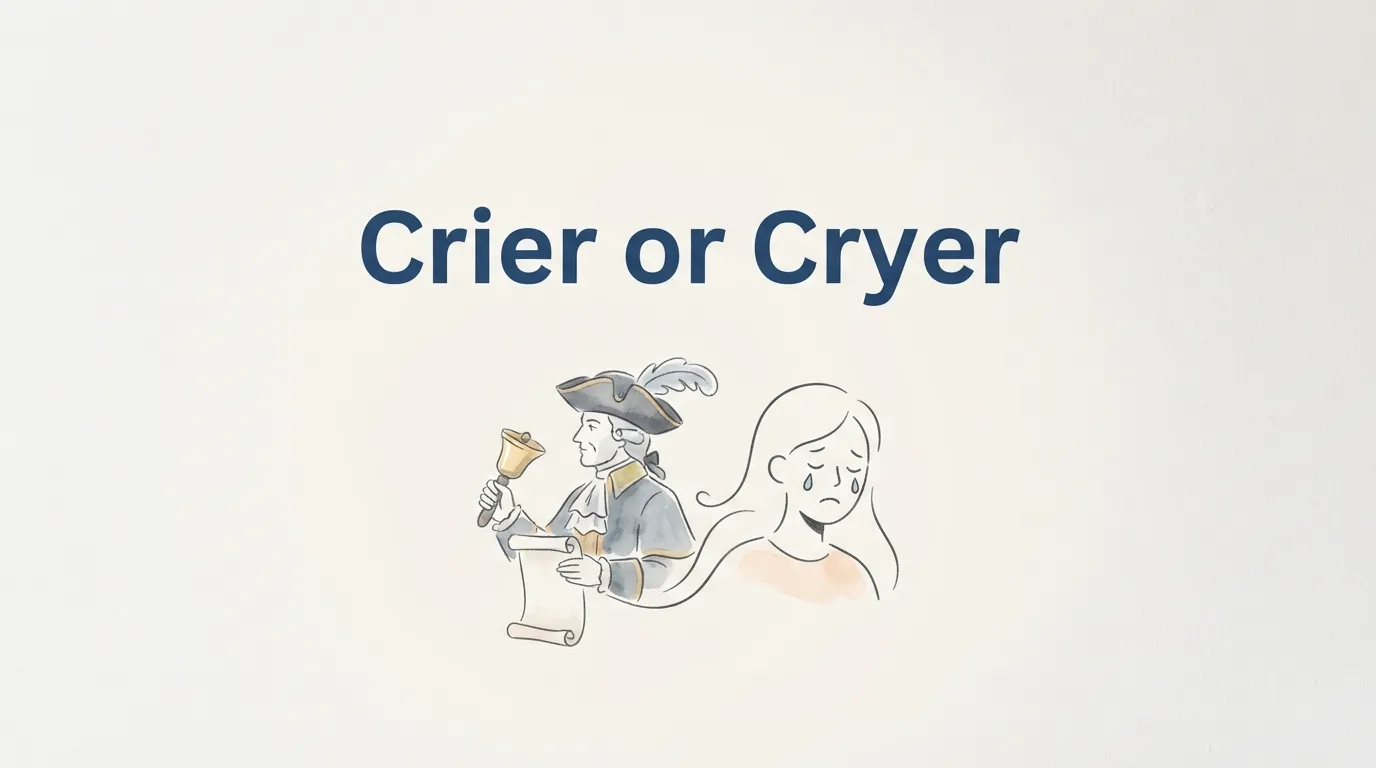
Crier is the standard and preferred spelling for a person who cries or someone who makes public announcements. Cryer is an accepted variant spelling, but it is much less commonly used.
Have you ever tried to write “She’s a crier” and wondered whether it should be crier or cryer? The confusion makes sense. The word comes from the verb cry, so keeping the “y” may seem natural.
However, standard English usually spells the noun crier. This spelling can describe someone who sheds tears, as well as a person who calls out announcements, such as a town crier. Cryer does exist, but it is a less common alternative.
Here is how to choose the right spelling.
What Is the Difference Between Crier and Cryer?
The main difference between crier and cryer is spelling, not meaning.
A crier is a person who cries. Depending on the context, “cry” can mean shedding tears or calling out loudly. The word can therefore have several related meanings.
For example:
- Someone who cries easily can be called a crier.
- A town crier traditionally makes public announcements.
- A court crier may call out information or instructions.
Major dictionaries use crier as the main spelling. Merriam-Webster defines it as someone who cries and also uses it for officials who make announcements. Cambridge likewise lists crier for someone who cries, while Collins includes both the emotional and announcement-related meanings.
Cryer has essentially the same meaning, but it is treated as a variant spelling rather than the main form. Merriam-Webster specifically lists cryer as a variant of crier.
| Spelling | Meaning | Status | Best Use |
|---|---|---|---|
| Crier | A person who cries or calls out | Standard spelling | General writing |
| Cryer | Same basic meaning as crier | Variant spelling | Rare or intentional use |
| Town crier | An official who makes public announcements | Standard expression | Historical and modern references |
Why Is Crier Spelled With an “I”?
The spelling becomes easier to understand when you look at the word cry.
English words ending in a consonant followed by y often change the y to i before certain endings are added.
For example:
- cry → cried
- cry → cries
- cry → crier
- dry → drier
- try → tried
So although cryer may look logical because it keeps the original word “cry” intact, crier follows a familiar English spelling pattern.
There are exceptions to English spelling rules, so you should not assume that every word ending in “y” behaves exactly the same way. For this particular word, though, crier is the established standard spelling.
What Does Crier Mean?
Crier is a noun. Its exact meaning depends on the situation.
1. Someone Who Cries Tears
A person who cries, especially someone who tends to cry easily, can be called a crier.
For example:
- I’m not usually a crier, but that film made me emotional.
- My brother was a big crier when he was little.
- She describes herself as a happy crier.
This use is common in informal conversation.
2. Someone Who Calls Out Loudly
The verb cry can also mean to shout or call out. Because of this older meaning, crier can refer to someone who announces something loudly.
Merriam-Webster includes officials who proclaim court orders and town criers within its definition of the word.
3. A Town Crier
A town crier is traditionally an official who makes public announcements.
Before newspapers, television, phones, and the internet, important information could be announced publicly by a person speaking loudly in a central place.
Town crier remains the standard spelling of this expression. Merriam-Webster defines a town crier as a town officer who makes public proclamations.
For example:
- The town crier announced the start of the festival.
- An actor dressed as a town crier welcomed the visitors.
- The ceremony began with an announcement from the town crier.
Is Cryer a Real Word?
Yes. Cryer is a real variant spelling, so calling it completely nonexistent or automatically wrong would be inaccurate.
However, it is not normally the best spelling to choose in standard modern writing. Merriam-Webster directs cryer to crier, showing that crier is the main dictionary form.
If you are writing an essay, article, email, story, report, or other general text, crier is the safer choice.
There is also an important exception: Cryer can be a surname. When it is someone’s family name, you should of course keep that spelling and capitalize it.
Crier or Cryer in British and American English
There is no major British-versus-American spelling split here.
Crier is used as the standard form in both British and American English. Collins, for example, gives crier in both its British and American English definitions.
This is different from pairs such as:
- colour / color
- travelling / traveling
- centre / center
You therefore do not need to change crier according to whether you are writing for UK or US readers.
For a global audience, crier is the clearest choice.
Practical Examples of Crier and Cryer
Here are some natural examples showing how the standard spelling works.
Someone Who Cries
- He says he isn’t a crier, but sad films always get to him.
- I was never much of a crier as a child.
- She is a happy crier and often tears up at weddings.
- Don’t be surprised if I cry. I’m a terrible crier during emotional scenes.
- The ending was so moving that even the least likely crier in the group had tears in his eyes.
Someone Making Announcements
- The crier called everyone’s attention to the announcement.
- A town crier opened the historical festival.
- The court crier asked everyone to remain quiet.
Using Cryer
Because cryer is a recognized variant, you may occasionally encounter sentences such as:
- He has always been an emotional cryer.
The meaning is understandable, but crier is preferable in ordinary edited English:
- He has always been an emotional crier.
Common Mistakes With Crier and Cryer
| Incorrect or Less Suitable | Preferred | Why |
|---|---|---|
| She is a big cryer. | She is a big crier. | Crier is the standard spelling. |
| The town cryer made an announcement. | The town crier made an announcement. | “Town crier” is the established expression. |
| He is a cryer because he cries easily. | He is a crier because he cries easily. | Use the standard form in general writing. |
| Cryer is always a spelling mistake. | Cryer is a variant spelling. | It exists, although crier is preferred. |
| British English uses “cryer.” | British English uses crier. | This is not a standard UK-US spelling difference. |
One common mistake is assuming that cryer must be correct because the base word is cry. English spelling does not always preserve the exact form of a base word when a suffix is added.
Another mistake is going too far in the opposite direction and saying that cryer is not a word at all. It is recognized as a variant. The better distinction is standard versus less common, rather than real versus fake.
Which Should You Use: Crier or Cryer?
Use crier in normal English writing.
It is the standard spelling found as the main form in major dictionaries and works in both British and American English.
A simple rule to remember is:
cry + person = crier
Use crier when you mean:
- someone who sheds tears
- someone who cries easily
- a person who calls things out
- a court crier
- a town crier
Use Cryer when it is a person’s surname or when you have another specific reason to preserve that spelling.
For schoolwork, professional writing, websites, articles, and general communication, choose crier.
Frequently Asked Questions
Is It Crier or Cryer for Someone Who Cries?
Crier is the standard spelling for someone who cries. Cryer exists as a variant, but crier is the safer and more widely accepted choice for normal writing.
Is Cryer Incorrect?
Not completely. Cryer is recognized as a variant spelling of crier by Merriam-Webster. However, crier is the main form and should usually be preferred.
Is It Town Crier or Town Cryer?
The standard expression is town crier. A town crier is a person who traditionally makes public announcements.
Why Does Cry Become Crier?
When certain suffixes are added to words ending in a consonant plus y, the y often changes to i. That pattern gives us forms such as cried, cries, and crier.
Is Crier British or American English?
Crier is used in both British and American English. It is not one of the spelling differences that normally separate the two varieties. Collins lists the spelling in both British and American definitions.
Can Crier Mean Someone Who Shouts?
Yes. Cry can mean to call or shout loudly as well as to shed tears. This is why crier can refer to someone making announcements, not only someone who is weeping.
Can Cryer Be a Name?
Yes. Cryer can occur as a surname. When referring to a person whose name is spelled Cryer, keep the original spelling and capitalize it.
Conclusion
When choosing between crier or cryer, use crier in most situations. It is the standard spelling for a person who cries and for someone who calls out announcements. It is also the correct form in the familiar expression town crier.
Cryer is an accepted variant, so it is not always wrong, but it is less suitable as the default spelling. There is no important British-versus-American difference: crier works for both.
An easy way to remember the spelling is to connect it with cried and cries. If you are unsure in future writing, choose crier.

Hassan Afzal has a background in English language instruction and writes to help non-native speakers and students master tricky grammar rules and word choices. Hassan Afzal’s writing style blends practical examples with clear explanations for everyday English learners.