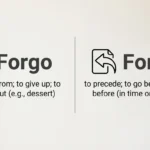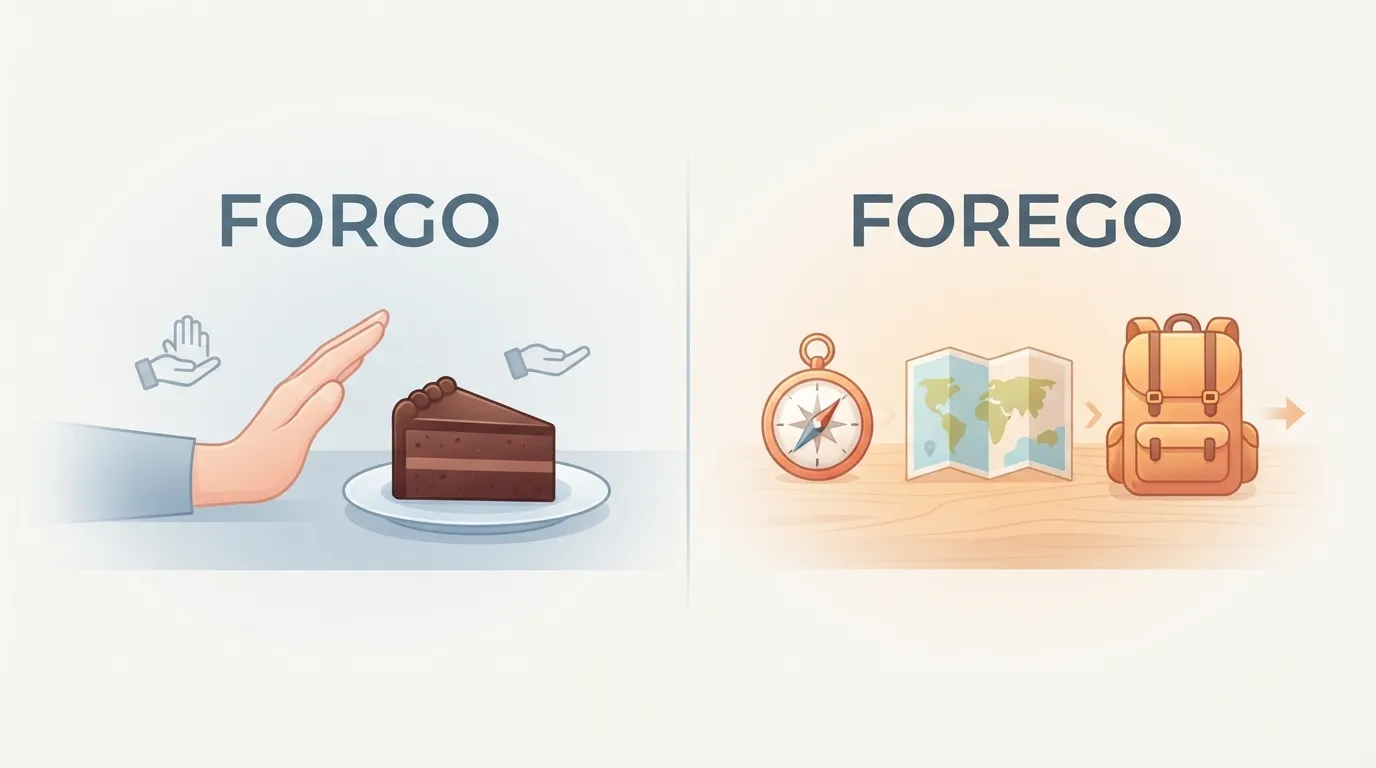
Use forgo when you mean “give up,” “go without,” or “choose not to have something.” Traditionally, forego means “go before” or “precede,” although modern dictionaries also recognize forego as a variant spelling of forgo.
Should you forego dessert or forgo dessert? Both spellings appear in English, which makes the choice surprisingly confusing.
The clearest rule is to use forgo when you mean willingly doing without something. Use forego when you mean that something comes before something else. Merriam-Webster maintains this traditional distinction, although Cambridge and Collins also record forego as an alternative spelling of forgo.
For clear modern writing, forgo is usually the better choice when the meaning is “give up.”
Forego or Forgo: What Is the Difference?
The traditional distinction is based on meaning.
| Word | Main Meaning | Example |
|---|---|---|
| Forgo | Give up or do without | I decided to forgo dessert. |
| Forego | Go before or precede | A short introduction will forego the presentation. |
| Forego as a variant | Give up or do without | Some dictionaries also accept this spelling. |
Merriam-Webster defines forgo as giving up an enjoyment or advantage or doing without something. Its separate entry for forego gives the meaning “to go before” or “precede.”
However, usage is not completely divided. Cambridge lists forego as another spelling of forgo, and Collins also recognizes the spelling for the “do without” meaning.
What Does Forgo Mean?
Forgo is a verb meaning to give something up, do without it, or intentionally choose not to have or do it.
For example:
- She decided to forgo dessert.
- We may have to forgo our vacation this year.
- He chose to forgo his usual morning coffee.
- The company will forgo the additional fee.
- They decided to forgo a large wedding.
Merriam-Webster gives “do without” as a central meaning of forgo, while Cambridge similarly defines it as giving up or doing without something.
A simple synonym test can help:
If you can replace the word with give up, skip, or do without, choose forgo.
For example:
- I’ll forgo dessert.
- I’ll skip dessert.
The meaning remains similar.
What Does Forego Mean?
Traditionally, forego means to go before, come before, or precede.
The prefix fore- often relates to something being before or in front, as in words such as foreword and foresee. That helps explain the traditional meaning of forego.
Merriam-Webster’s main entry for forego defines it as “to go before” or “precede.”
For example:
- A brief explanation will forego the demonstration.
- Several announcements forego the main ceremony.
This meaning is much less common in everyday conversation than the “give up” meaning of forgo.
You are more likely to meet the related word foregoing in formal writing.
What Does Foregoing Mean?
Foregoing commonly means previously mentioned, stated, or described.
For example:
- The foregoing examples show the main difference.
- Please consider the foregoing information before making a decision.
- The foregoing rules apply to all applicants.
Cambridge defines this adjective as referring to something that has just been mentioned or described.
This is a useful clue for remembering forego:
fore- = before
So something foregoing is something that comes before the current point in the text.
Is Forego Wrong When You Mean Give Up?
No. It is not necessarily wrong.
This is where the issue becomes more nuanced.
Cambridge lists forego as another spelling of forgo for the meaning “give up or do without.” Collins also recognizes forego with this meaning. Merriam-Webster lists forego as a less common variant under its entry for forgo.
Therefore, this sentence can be found in accepted usage:
- She decided to forego dessert.
However, writing:
- She decided to forgo dessert.
avoids the possible confusion between the two historically different words.
For careful edited writing, forgo is the clearest recommendation when you mean “do without.”
Forgo vs. Forego With Dessert
Dessert provides an easy way to see the distinction.
Forgo Dessert
If you forgo dessert, you do not eat dessert.
- I’m trying to eat less sugar, so I’ll forgo dessert tonight.
Dessert Foregoes Dinner
Using forego in its traditional sense means something comes before something else.
- Dessert will forego dinner at this unusual party.
Here, dessert is served before dinner.
Merriam-Webster uses essentially this distinction to explain why the extra e matters: forego can suggest something precedes another thing, whereas forgo specifically means doing without.
A useful memory pair is:
Forgo dessert = skip dessert.
Dessert foregoes dinner = dessert comes first.
Forgo, Forgoes, Forgoing, Forwent, and Forgone
Forgo is an irregular verb.
Its main forms are:
| Verb Form | Correct Form |
|---|---|
| Base form | forgo |
| Third-person singular | forgoes |
| Present participle | forgoing |
| Past tense | forwent |
| Past participle | forgone |
Merriam-Webster and Cambridge both record forwent as the past tense and forgone as the past participle.
Examples:
- She forgoes dessert during the week.
- We’re forgoing the usual celebration.
- He forwent his bonus last year.
- They have forgone several luxuries.
Because forgo is irregular, the past tense is not forgoed.
Forgone or Foregone?
The spelling distinction can also appear in the past participle.
When referring to something that has been given up, forgone follows naturally from forgo.
- They have forgone their usual vacation.
The spelling foregone also exists and is especially familiar in the expression a foregone conclusion.
That phrase means an outcome that appears to have been decided or made certain in advance.
This reinforces the association of fore- with something that comes or is known before.
For straightforward writing about sacrificing or doing without something, using the forgo → forgone spelling family keeps the distinction clear. Merriam-Webster gives forgone as the past participle of forgo.
Is It Forgoing or Foregoing?
These two forms are particularly useful to distinguish.
Forgoing
Forgoing means giving something up.
- She is forgoing dessert.
- We are forgoing the extra expense.
- He is forgoing his vacation this year.
Foregoing
As an adjective, foregoing commonly means previously stated or mentioned.
- The foregoing paragraph explains the rule.
- Based on the foregoing evidence, the proposal was accepted.
Cambridge specifically records this meaning of foregoing.
So:
forgoing = giving up
foregoing = previously mentioned
This distinction is especially valuable in professional, academic, and legal-style writing.
Forego or Forgo in British and American English
This is not simply a British-versus-American spelling difference.
Both forgo and forego occur in English dictionaries on both sides of the Atlantic, and dictionaries recognize overlap in the “give up” meaning. Cambridge gives forego as another spelling of forgo, while Collins also accepts forego for doing without something.
Therefore, you should not apply a rule such as:
- British English = forego
- American English = forgo
That would be misleading.
A better rule for global English is based on meaning:
- forgo = give up
- forego = precede
This distinction produces clearer writing regardless of region.
Practical Examples of Forgo
Here are natural examples where forgo is the clearest choice.
Everyday Life
- I’ll forgo coffee this evening.
- She decided to forgo dessert.
- We might forgo the trip because of the cost.
- He chose to forgo buying a new phone.
Work and Business
- The director agreed to forgo part of the payment.
- The company may forgo expansion this year.
- Employees can forgo the benefit if they choose.
- We decided to forgo another meeting.
Formal Writing
- Applicants may forgo the optional interview.
- Participants can forgo additional testing.
- The organization chose to forgo further legal action.
In each example, give up, skip, or do without could replace forgo without greatly changing the meaning.
Practical Examples of Forego
The traditional sense of forego is much less common, but examples can show how it works.
- A short introduction will forego the main speech.
- Several preliminary events forego the final ceremony.
In modern writing, precede may often sound clearer than forego for this meaning:
- A short introduction will precede the main speech.
Using precede can be especially helpful when there is any risk that readers will interpret forego as “give up.”
Common Mistakes With Forego and Forgo
| Common Mistake | Better Form | Why |
|---|---|---|
| I’ll forego dessert. | I’ll forgo dessert. | “Forgo” clearly means do without. |
| She forgoed her bonus. | She forwent her bonus. | “Forgo” has an irregular past tense. |
| They have forgoed the payment. | They have forgone the payment. | The past participle is “forgone.” |
| We are foregoing dessert. | We are forgoing dessert. | “Forgoing” is clearest for giving something up. |
| “Forego” can never mean “give up.” | Dictionaries recognize that usage. | It is an accepted variant in modern English. |
The most important point is not to oversimplify the issue. Forego is genuinely used for the “give up” meaning, but forgo provides a clearer distinction and is usually the better editorial choice.
How to Remember Forego vs. Forgo
Use the e as your memory clue:
FORE = BEFORE
So:
forego → go before
Without the e:
forgo → go without
Another simple pair is:
Forgo food = go without food.
Forego an event = go before the event.
You do not need the historical distinction to understand every modern example, but remembering it will help you make a clear spelling choice.
Which Should You Use: Forego or Forgo?
For clear modern writing, follow this recommendation:
Use forgo when you mean “give up,” “skip,” or “do without.”
- We will forgo the extra expense.
- She decided to forgo dessert.
Use forego when you mean “go before” or “precede.”
- The introduction will forego the main presentation.
Because forego is also accepted by several dictionaries as a variant of forgo, it is not automatically an error when used to mean “give up.”
Still, preserving the distinction makes your writing clearer.
Frequently Asked Questions
Which Is Correct, Forego or Forgo?
Both are words, but they traditionally have different meanings. Use forgo for “give up or do without” and forego for “precede or go before.” Modern dictionaries also recognize forego as an alternative spelling of forgo.
Is It Forgo or Forego Dessert?
Forgo dessert is the clearest spelling if you mean that you will not eat dessert. Forego dessert is also recorded in modern usage, but forgo preserves the traditional distinction.
Does Forego Mean Give Up?
It can. Cambridge and Collins both recognize forego with the meaning “give up” or “do without.” However, its traditional separate meaning is “go before,” so many editors prefer forgo for “give up.”
What Is the Past Tense of Forgo?
The past tense is forwent, not forgoed. For example: “She forwent the opportunity.”
Is It Forgone or Forgoed?
Use forgone as the past participle: “They have forgone the usual celebration.” Forgoed is not the standard form.
Is It Forgoing or Foregoing?
Use forgoing when you mean giving something up: “We are forgoing dessert.” Foregoing commonly means previously mentioned: “The foregoing examples explain the rule.”
Is Forego British and Forgo American?
No. This is not simply a UK-US spelling distinction. Both forms occur in modern dictionaries, and the clearest distinction is based on meaning rather than region.
Conclusion
When deciding between forego or forgo, forgo is the clearest choice when you mean give up, skip, or do without something. Traditionally, forego means go before or precede.
Modern English is less strict: Cambridge, Collins, and Merriam-Webster all recognize some use of forego as a variant of forgo.
For precise writing, remember: forgo = go without; forego = go before. Also keep the related forms in mind: forgoing, forwent, and forgone.

Muhammad Afzal is a language content writer specializing in English grammar, word usage, and vocabulary distinctions. With a strong command of linguistic nuance, Muhammad Afzal focuses on simplifying commonly confused word pairs to help readers communicate with clarity and confidence.