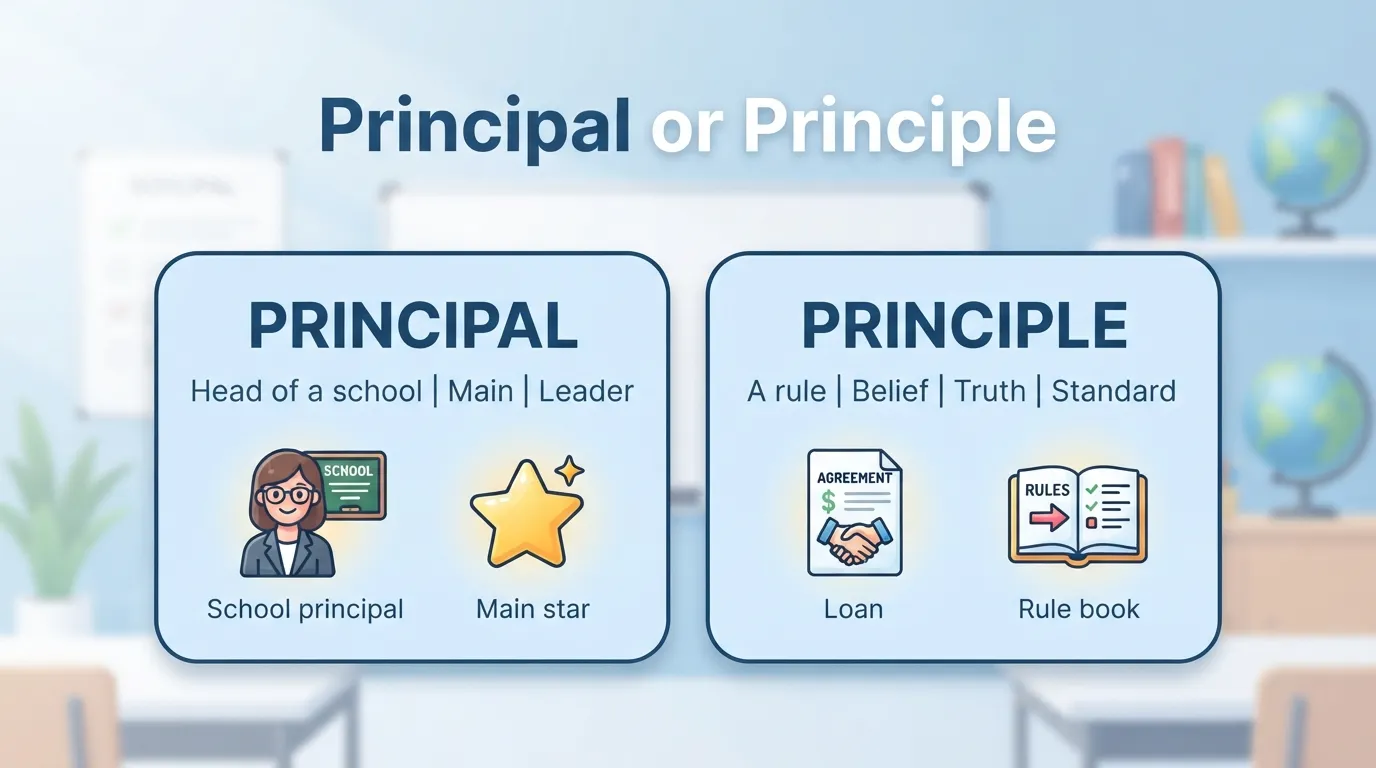
Principal or principle means you are choosing between two words that sound the same but mean different things. “Principal” means main, most important, a school leader, or loan amount. “Principle” means a rule, belief, law, or basic truth.
Have you ever typed “my principle reason” and then wondered if it should be “principal reason”?
I’ve seen this mistake many times in student essays, business emails, school notes, resumes, and finance content. It is easy to understand why. Principal and principle sound the same. They look almost the same too. Only the last three letters change.
But that small spelling change matters.
Principal is often about importance, leadership, or money. Principle is about rules, values, and ideas. If you mix them up, the sentence may still be readable, but it can look weak or confusing.
This guide will make principal or principle simple. You’ll learn the meaning, the difference, the correct usage, common mistakes, real examples, and an easy memory trick. By the end, you’ll know which spelling to use in school, work, finance, and everyday writing.
Principal or Principle: Quick Answer
Use “principal” when you mean main, most important, a school leader, or the original amount of money in a loan or investment. Use “principle” when you mean a rule, belief, law, value, or basic idea. Cambridge explains that principal means “most important,” while principle means a basic idea or rule.
Simple examples:
- Correct: The principal reason was poor planning.
- Correct: The school principal spoke to the students.
- Correct: Honesty is an important principle.
- Wrong: The school principle spoke to the students.
Easy rule:
- Principal = main person, main thing, or money
- Principle = rule, belief, or idea
The Origin / Background of Principal or Principle
The confusion happens because principal and principle are homophones. That means they sound the same but have different spellings and meanings. English has many word pairs like this, so writers often choose the spelling by sound instead of meaning.
Merriam-Webster explains that principal can work as an adjective meaning “most important.” It can also work as a noun for someone in a leading position, such as a school principal. Principle, on the other hand, is only a noun and refers to a fundamental truth, code, law, or rule.
That is why the word job matters.
Ask yourself:
- Am I talking about the main reason?
- Am I talking about a school leader?
- Am I talking about loan money?
- Am I talking about a rule or belief?
The answer tells you the spelling.
There is also a common memory trick:
The principal is your pal.
This helps students remember that principal can mean the person in charge of a school. But do not stop there. Principal can also mean main or most important.
Principal or Principle Explained: Key Differences or Variations
The main difference is meaning and grammar. “Principal” can be an adjective or a noun. “Principle” is a noun only. Principal can describe the main reason, name a school leader, or refer to money. Principle names a rule, value, belief, or basic law.
| Term | Meaning | When to Use | Region/Context |
|---|---|---|---|
| Principal | Main or most important | Describing the top reason, issue, or goal | Standard English |
| Principal | Person in charge of a school | Talking about a school leader | Common in American English |
| Principal | Original loan or investment amount | Finance and banking | Money context |
| Principle | Rule, belief, or value | Talking about morals or conduct | General English |
| Principle | Basic law or idea | Science, law, education, theory | Academic and formal English |
Cambridge defines principal as “first in order of importance” and also as the person in charge of a school. It defines principle as a basic idea or rule that explains or controls how something happens or works.
Examples:
- The principal cause of the delay was traffic.
- The principal met with parents.
- The loan principal must be repaid.
- She acted on principle.
- The course explains the basic principles of design.
Which Version Should You Use?
Use “principal” when the sentence points to importance, leadership, or money. Use “principle” when the sentence points to rules, values, beliefs, or basic truths. If you can replace the word with “main,” use principal. If you can replace it with “rule,” use principle.
Here is the best practical advice:
- For students → use principal for a school leader and principle for rules or beliefs.
- For business writers → use principal for the main reason or main person.
- For finance content → use principal for the original loan or investment amount.
- For ethics or values → use principle.
- For science or theory → use principle.
- For formal writing → check whether the word means main or rule.
Examples:
- The principal goal is to improve reading.
- The principal approved the new schedule.
- The borrower paid part of the principal.
- Fairness is a core principle.
- The teacher explained the principle of gravity.
Quick test:
- “Main reason” = principal reason
- “Moral rule” = moral principle
- “School leader” = principal
- “Basic idea” = principle
Common Mistakes With Principal or Principle
Most mistakes happen because the words sound the same. Writers often use “principle” when they mean “main” or “school leader.” They also use “principal” when they mean a rule or belief. The best fix is to check the meaning, not the sound.
| Mistake | Correction | Why It Happens |
|---|---|---|
| The principle reason was cost. | The principal reason was cost. | The sentence means main reason. |
| The school principle called home. | The school principal called home. | The sentence means school leader. |
| She acted on principal. | She acted on principle. | The sentence means belief or value. |
| The principle amount was $5,000. | The principal amount was $5,000. | The sentence is about loan money. |
| Learn the basic principals of grammar. | Learn the basic principles of grammar. | The sentence means rules or ideas. |
Mistake 1: Writing “principle reason”
Wrong:
The principle reason for the change was safety.
Correct:
The principal reason for the change was safety.
Here, the word means main, so use principal.
Mistake 2: Writing “school principle”
Wrong:
The school principle welcomed the parents.
Correct:
The school principal welcomed the parents.
A school leader is a principal.
Mistake 3: Writing “on principal”
Wrong:
He refused the offer on principal.
Correct:
He refused the offer on principle.
The phrase on principle means because of a belief, rule, or moral value.
Mistake 4: Writing “principle balance”
Wrong:
The principle balance on the loan is lower now.
Correct:
The principal balance on the loan is lower now.
In finance, principal means the original amount of money borrowed or invested.
Principal or Principle in Real-World Examples
You will see principal and principle in school writing, business reports, finance documents, emails, news articles, and social media posts. The right word depends on the meaning. Principal points to importance, leadership, or money. Principle points to rules and beliefs.
Professional email example
Hi Karen,
The principal reason for the delay was the missing approval form. We have updated the process based on the same principle of clear communication.
This uses both words correctly.
School example
The principal reminded students to follow the school’s safety principles.
Here, principal means school leader. Principles means rules or values.
News headline example
School Principal Announces New Attendance Policy
This is correct because the headline is about a school leader.
Finance example
Each payment reduces the loan principal and interest over time.
This is correct because the sentence is about money.
Social media post example
Never compromise your principles just to impress people.
This means values or beliefs.
Formal document example
The principal objective of this policy is to protect user data while following the principles of transparency and consent.
This is formal and correct.
Principal or Principle: Data, Trends & Usage
The search intent behind “principal or principle” is informational. Most readers want a fast grammar answer. They want to know which spelling is correct, how the meanings differ, and why sentences like “principle reason” or “school principle” are wrong.
People often search this phrase while writing:
- school essays
- emails
- resumes
- finance content
- loan documents
- business reports
- grammar worksheets
- website articles
This topic matters because both words are common in serious writing. A spelling mistake can change the meaning.
For example:
- Principal reason means main reason.
- Principle reason does not work in standard English.
- School principal means school leader.
- School principle sounds like a school rule or belief.
- Loan principal means the money amount.
- Moral principle means a value or rule.
Merriam-Webster gives a clear summary: principal can mean most important or a leading person, while principle refers to a fundamental truth, code, law, or underlying quality.
Principal or Principle Comparison Table
A quick comparison makes the choice easier. Use “principal” for main things, school leaders, and money. Use “principle” for rules, beliefs, values, and basic ideas. If the word can mean “main,” choose principal. If it can mean “rule,” choose principle.
| Term/Variant | Meaning | Region/Context | Best Used When |
|---|---|---|---|
| Principal | Main or most important | General English | Saying the main reason, goal, cause, or issue |
| Principal | School leader | Education | Talking about the person in charge of a school |
| Principal | Original money amount | Banking and finance | Talking about loans, debt, or investment |
| Principle | Rule or belief | Ethics and behavior | Talking about values or morals |
| Principle | Basic law or idea | Science, law, theory, education | Explaining how something works |
| Principles | More than one rule or belief | General and academic writing | Talking about several values or rules |
FAQs About Principal or Principle
Q: What does principal or principle mean?
A: Principal or principle is a spelling and grammar choice. Principal means main, most important, a school leader, or a money amount. Principle means a rule, belief, value, or basic truth.
Q: What is the difference between principal and principle?
A: Principal can be an adjective or noun. It often means main, school leader, or loan amount. Principle is a noun that means a rule, belief, or basic idea.
Q: Is it principal reason or principle reason?
A: The correct phrase is principal reason. It means the main reason. Principle reason is not correct for that meaning.
Q: Is it school principal or school principle?
A: The correct phrase is school principal. A principal is the person in charge of a school. A principle is a rule or belief.
Q: Is it on principal or on principle?
A: The correct phrase is on principle. It means because of a belief, value, or moral rule.
Q: Which word is used for loans, principal or principle?
A: Use principal for loans. The principal is the original amount of money borrowed or still owed, separate from interest.
Q: Can principal and principle be used in formal writing?
A: Yes. Both words are acceptable in formal writing when used correctly. Use principal for main, leader, or money. Use principle for rules, beliefs, and basic ideas.
Conclusion
Now you know the difference between principal or principle.
The rule is simple. Use principal when you mean main, most important, a school leader, or a loan amount. Use principle when you mean a rule, belief, value, or basic idea.
Remember these examples:
- The principal reason was cost.
- The school principal spoke to parents.
- The loan principal was reduced.
- Honesty is a good principle.
- She refused on principle.
A quick memory trick can help: the principal can be your pal. But also remember that principal can mean main.
If your sentence means main, choose principal. If your sentence means rule, choose principle.
Now you know exactly how to use principal or principle. Check your next essay, email, report, or finance document before you send it.

Muhammad Afzal is a language content writer specializing in English grammar, word usage, and vocabulary distinctions. With a strong command of linguistic nuance, Muhammad Afzal focuses on simplifying commonly confused word pairs to help readers communicate with clarity and confidence.